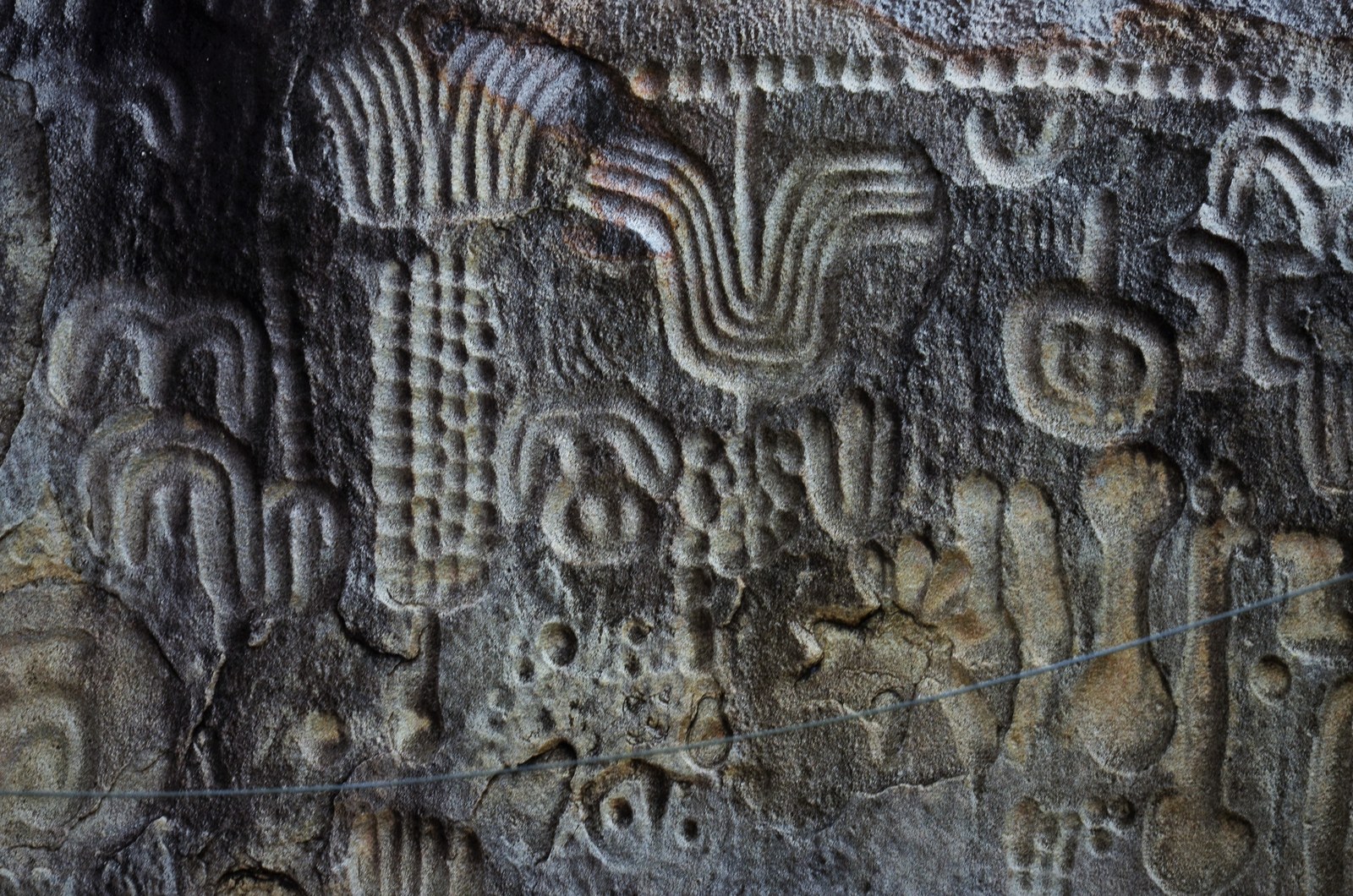
In a river valley in the north-eastern Brazilian state of Paraíba, near the small city of Ingá, about 96 kilometres from the state capital João Pessoa, there is a rock face covered in hundreds of carved symbols. Spirals, concentric circles, rows of dots, wavy lines, and figures that may be animals, fruits, or people are pecked into the dark stone. The carvings are called the Ingá Stone, or Itacoatiara do Ingá, and they have puzzled archaeologists, astronomers, and fringe theorists for more than a century. Nobody knows exactly who made them. Nobody knows precisely when. Nobody knows for certain what they mean.
A Wall of Writing in Stone
The Ingá Stone sits in the middle of the Ingá River, a tributary of the Paraíba River. It is a rock formation in gneiss — a dark, hard metamorphic rock — covering about 250 square metres. The main carved wall runs about 24 metres long and 3.5 metres high at its highest point, though some accounts give 46 metres for the full carved face, with adjacent panels bringing the total higher. The engravings were made by pecking and then polishing grooves into the rock, the grooves averaging about 3 centimetres wide and half a millimetre to 7 millimetres deep. Most are abstract — smooth, polished spirals and rectilinear patterns — but some are figurative, suggesting animals, fruits, and astronomical features.
The word itacoatiara comes from Tupi, combining itá, stone or rock, and kûatiara, scratched or painted. The term has become synonymous with this type of large, polished, curvilinear petroglyph, found at the Ingá site and at other sites along the river, including Sítio do Bravo, Pedra do Altar, and Casa de Pedra. The Ingá Rock is Brazil’s most famous petroglyph panel, and on 30 November 1944 it became the first archaeological monument to receive official protection in Brazil, listed by the National Heritage Service. It has been on UNESCO’s Tentative List for World Heritage since 2015, as “The Ingá River Itacoatiaras.”
How Old, and Who Made It?
Dating the Ingá Stone precisely has proven difficult, for a simple reason: the carvings themselves cannot be carbon-dated. Carbon dating requires organic material, and stone contains none. Estimates range widely, from about 1,000 to 6,000 years old, and the UNESCO tentative listing suggests a possible age of up to 6,000 years, which would make the carvings roughly contemporary with the earliest phases of ancient Egyptian civilisation. The most recent additions may have been made as recently as the 18th century, by Indigenous peoples still living in the area. The scholarly consensus is that the stone was created by Indigenous South American peoples. The specific cultural group or groups are not identified in any surviving historical record.
Until the 1940s, the great boulder was quarried and even blasted, partly by treasure hunters who believed the engravings marked a hidden trove, and partly by locals for cobblestone production. The site remains under threat from scavengers and vandals, and from its own setting: the rock sits in the open air on the riverbed, exposed to cycles of cold submersion and heat that stress the carvings through expansion and contraction.
The Sky on the Stone
The most striking claim about the Ingá Stone is astronomical. Some of its carved groupings — circles and dots arranged in patterns — are said to match the arrangement of the Orion constellation as seen from the Southern Hemisphere, and other figures have been read as the Milky Way. In 1986, the researcher F. Pavía Alemany proposed that the stone functioned as a solar calendar. These are hypotheses, not established readings, and no interpretation of the carvings has been generally accepted. The carvings may record a calendar, a map, a myth, or something else entirely. The honest answer, after a century of study, is that the stone has not been read.
Fringe readings have filled the gap. A Greek, Latin, and theology professor named Father Ignatius Rolim once claimed the markings were identical to ancient Phoenician carvings, a suggestion that would require Mediterranean visitors to have reached inland Brazil. Others, including the ufologist Claudio Quintans, have suggested that a spacecraft landed in the Ingá area in the remote past and that extraterrestrials traced the symbols. Neither claim has supporting evidence, and the scholarly consensus remains Indigenous South American origin. The stone does not need visitors from across the ocean, or from space, to be extraordinary. A people whose name is lost spent generations carving a message into a river rock, and the message has outlasted them.
What Is Documented, and What Is Not
Documented: The Ingá Stone is a gneiss outcrop of about 250 square metres on the Ingá River near Ingá, Paraíba, covered in pecked and polished petroglyphs; it became Brazil’s first officially protected archaeological monument on 30 November 1944; it has been on UNESCO’s Tentative List since 2015; the carvings cannot be carbon-dated and are estimated at 1,000 to 6,000 years old; the creators were Indigenous South American peoples.
Unverified or disputed: Which peoples made the carvings and when; what the symbols mean; the claim that some groupings depict the Orion constellation or function as a solar calendar; the Phoenician and extraterrestrial readings. None of these interpretations has been established.