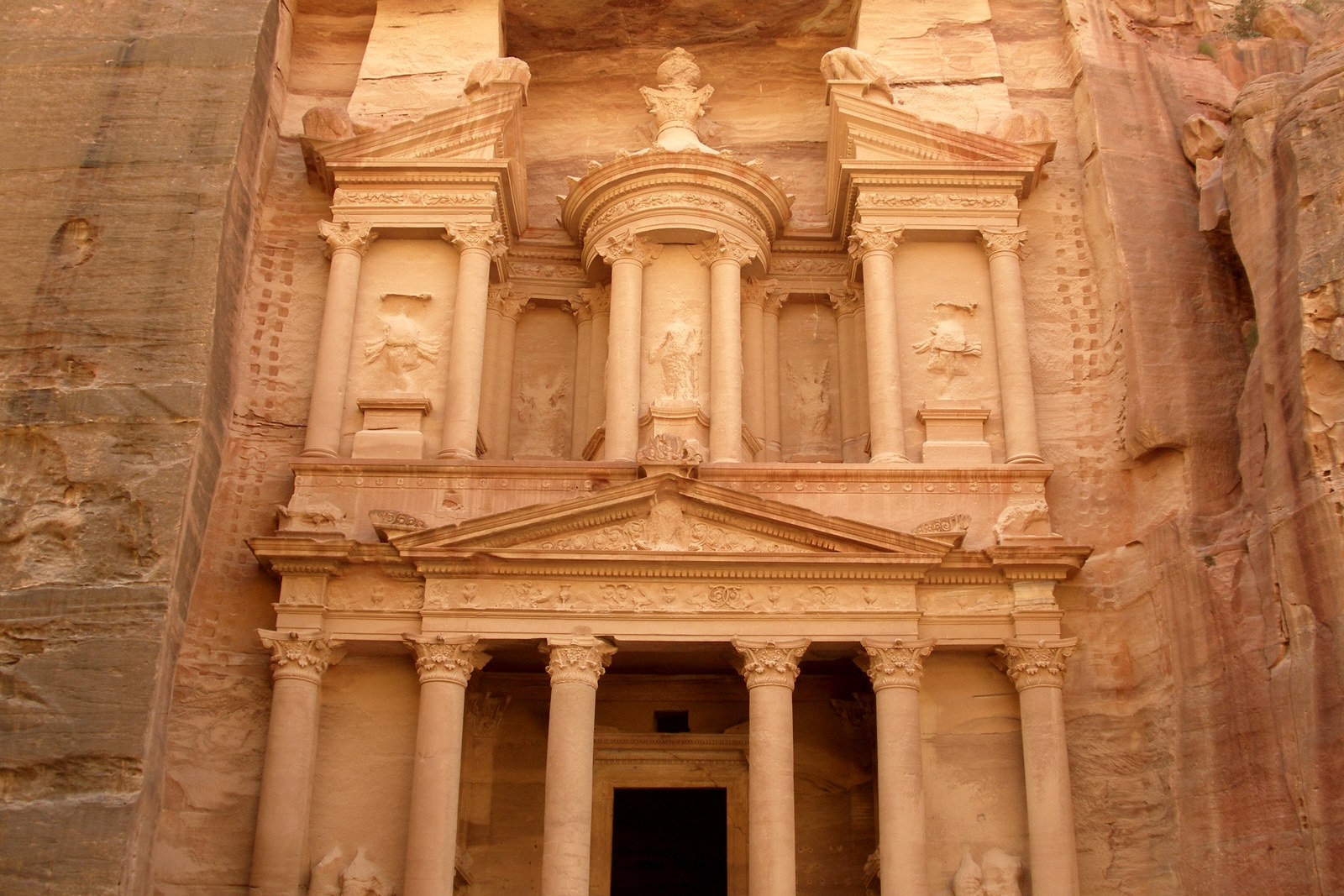
The walk in takes more than an hour, and it is designed to humble you. A narrow gorge called the Siq winds for over a kilometre between cliffs that rise a hundred metres on either side, so close in places that two people can barely pass. The rock changes colour as you go — rose, ochre, violet, rust — and the light comes down in thin ribbons. Then the gorge turns, and the cliff ahead opens into a facade forty metres high: columns, pediments, statues, all cut from the living rock. This is Al-Khazneh, the Treasury, the most famous face of Petra. Nothing in the approach prepares you for it, and that is exactly the point. The Nabataeans who built it understood theatre.
Petra was the capital of the Nabataean Arabs, a kingdom that grew rich on the most valuable cargo of the ancient world: scent. Frankincense and myrrh travelled by camel caravan from southern Arabia to the Mediterranean, and Petra sat at the crossroads of the routes. At its height, in the first century BC and the first century AD, the city may have held tens of thousands of people, all living in a desert canyon where it almost never rains. That alone is a mystery worth taking seriously. How do you build a city in a place with no river? The Nabataeans answered with engineering so good that modern archaeologists still study it. And then, within a few centuries, the city emptied, and the world forgot it existed.
The people who carved a city
The Nabataeans began as nomadic Arab tribes moving through the deserts of what is now Jordan and Saudi Arabia. By the fourth century BC they had settled at Petra, and by the first century BC they controlled a kingdom stretching from Damascus to the Red Sea. Their wealth came from trade, and their skill was water. In a landscape that receives only a few centimetres of rain a year, they built dams to catch flash floods, channels cut into the cliff faces to carry water for kilometres, and cisterns to store it. The Siq itself was partly a water system: channels ran along its walls, and a dam at its entrance protected the city from floods. Visitors see a beautiful gorge. Engineers see a dam, a pipeline, and a flood defence in one structure.
The city they built was not a collection of huts. Petra had a colonnaded main street, a great temple, a theatre carved from the rock that could seat several thousand people, and hundreds of tombs cut into the cliffs. The facades are the famous part — the Treasury, the Monastery, the Royal Tombs — but they are only the visible edge. Most of ancient Petra lies underground or unexcavated, and archaeologists estimate that only a fraction of the site has been properly dug. What stands above ground is the stone skeleton of a city that was once full of plastered, painted buildings, gardens, and running water.
The Treasury and the treasure that was never there
Al-Khazneh takes its name from a legend. Local Bedouin believed that the great stone urn on top of the facade — the tholos — held the treasure of a pharaoh, and treasure hunters fired bullets at it for generations. The pockmarks are still visible. The urn is solid stone. There was never any treasure in it.
What the Treasury actually was is still debated, but the leading view is that it was a royal tomb, built in the first century BC, probably during the reign of King Aretas IV, who ruled from 9 BC to AD 40. Excavations beneath the Treasury have found burial chambers, which supports the tomb theory, and the facade’s elaborate classical decoration — Corinthian columns, a broken pediment, statues of gods — fits a monument meant to honour a king and impress everyone who walked the Siq. Yet no inscription names the occupant, and no body has been identified with certainty. The most famous building in Jordan is, in a strict sense, anonymous.
The facade is also a puzzle of influence. The Nabataeans were Arabs, but the Treasury looks Greek and Roman: the columns, the pediment, the symmetry are all borrowed from the classical world. Petra sat between empires, and its art mixed Nabataean, Greek, Roman, and Egyptian elements without apology. The statues in the Treasury’s niches include the twin gods Castor and Pollux, the goddess Isis, and a figure of Victory. The building is a statement of cosmopolitan wealth — a desert kingdom announcing that it belonged to the wider world.
The Monastery and the city beyond the postcards
Most visitors stop at the Treasury. Those who climb the eight hundred steps beyond it reach Ad Deir, the Monastery, a facade even larger than the Treasury — forty-seven metres wide and nearly fifty high — cut into a cliff at the far end of the site. It was probably built as a Nabataean temple in the first century BC and later used by Byzantine Christians as a monastery, which is how it got its name. From its terrace, the desert stretches to the horizon, and the scale of Petra becomes clear: this was not a single monument but a city spread across several square kilometres of canyon.
The Royal Tombs, a row of grand facades on the cliff face opposite the theatre, add another layer. The Urn Tomb, the Silk Tomb with its swirling coloured rock, the Corinthian Tomb, and the Palace Tomb each imitate a different architectural style, as if the Nabataean elite were competing in stone. Inside some of them, Byzantine Christians later built churches, leaving mosaics and inscriptions on top of Nabataean carving. Petra was reused for centuries, and every layer of its history is written on the same walls.
The fall: earthquake, trade, and silence
Petra’s decline was not a single event but a slow unravelling. In AD 106 the Roman emperor Trajan annexed the Nabataean kingdom, and Petra became a Roman city. Trade routes shifted from the overland caravan trails to the sea, and the city’s income shrank. Then, in AD 363, a great earthquake struck the region, collapsing buildings across Petra and damaging the water system that made life there possible. The city was partly rebuilt, and a Byzantine community lived on for centuries — a church with fine mosaics stood in the city centre — but by the seventh and eighth centuries Petra was largely abandoned, and the desert took it back.
What happened next is one of the great myths of archaeology. In the West, Petra became a legend: a “rose-red city half as old as time”, in the words of the poet John William Burgon, who had never seen it. The city was never actually lost — local Bedouin tribes lived in and around it throughout the centuries — but it was unknown to European scholars until 1812, when the Swiss explorer Johann Ludwig Burckhardt reached it disguised as a pilgrim, guided by local people. His account set off two centuries of exploration, excavation, and tourism. Petra became a UNESCO World Heritage site in 1985 and was voted one of the New7Wonders of the World in 2007. The Treasury’s facade became one of the most photographed sights on earth, helped by its appearance as the Grail temple in the 1989 film Indiana Jones and the Last Crusade.
What is documented, and what is not
Documented facts: Petra was the capital of the Nabataean kingdom, which grew rich on the incense and spice trade. Al-Khazneh, the Treasury, is a rock-cut facade about forty metres high at the end of the Siq, built in the first century BC and most likely a royal tomb, probably connected with King Aretas IV. The Nabataeans built an extensive water system of dams, channels, and cisterns that sustained a large population in an arid canyon. Rome annexed the kingdom in AD 106. A major earthquake struck in AD 363. Johann Ludwig Burckhardt reached Petra in 1812, and the site was listed by UNESCO in 1985 and named one of the New7Wonders of the World in 2007. Excavations have found burial chambers beneath the Treasury. The Ad Deir, or Monastery, is larger than the Treasury and was later used by Byzantine Christians.
Unverified or disputed claims: The identity of the person buried in the Treasury is not established; the link to Aretas IV is a strong scholarly inference, not a proven fact. The exact population of Petra at its height is estimated in the tens of thousands, but no census survives. The legend of a pharaoh’s treasure hidden in the tholos has no basis and the urn is solid stone. Claims that Petra was entirely unknown or uninhabited between its abandonment and 1812 are wrong: local Bedouin knew the site and lived in the area throughout. The precise causes of Petra’s decline are still debated — the earthquake of AD 363, the shift of trade to sea routes, and political change all played a part, and their relative importance is not settled.