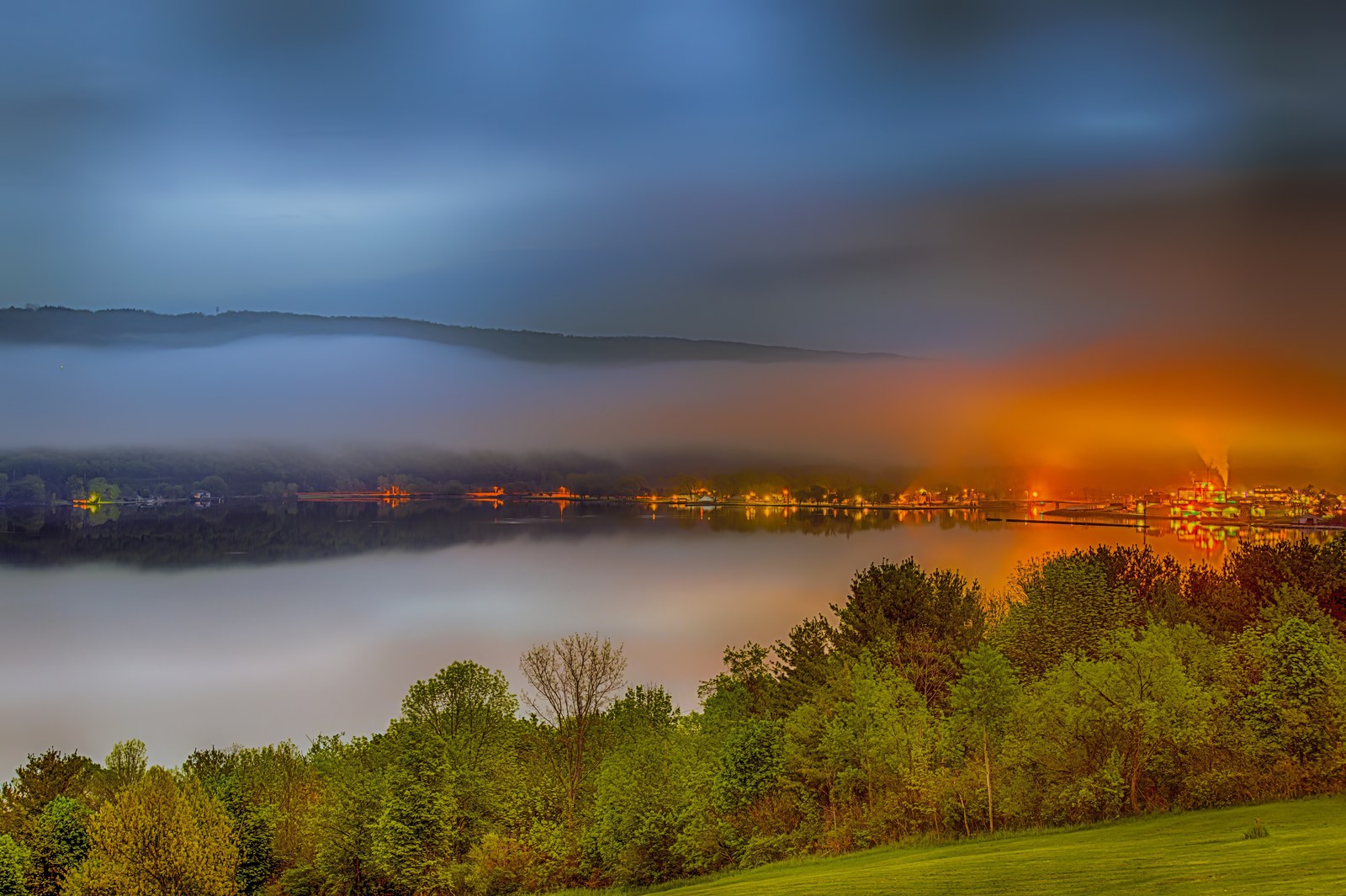
Imagine standing on the shore of a quiet lake on a windless evening and hearing a cannon fire. The boom rolls across the water, low and heavy, and fades into the hills. You look for smoke, for a boat, for anything that could have made the sound, and there is nothing. No flash, no vessel, no disturbance on the surface at all. Then it happens again. For the people who live around Seneca Lake in upstate New York, this is not a hypothetical. They have been hearing it for centuries. They call the sounds the Seneca guns, or the Seneca drums, and until very recently no one could prove what made them.
A sound older than the republic
Seneca Lake is the deepest of New York’s Finger Lakes, a long, narrow body of water carved by glaciers at the end of the last ice age. It holds roughly 4.2 trillion gallons of water, reaches depths of up to 618 feet, and its bed descends some 200 feet below sea level. It is a serious lake, cold and deep, and it has been producing its strange artillery for as long as anyone has lived beside it. Reports of the booms go back at least to the 1700s, and similar sounds have been reported as far away as New Jersey, Pennsylvania, North Carolina, and Florida — a whole family of unexplained booms along the American east coast and inland waterways.
The earliest accounts treated the sound as something spiritual. According to popular accounts, the Seneca people believed the booms were the voice of Manitou, the Great Spirit, shouting in anger. The sound entered American literature in 1850, when James Fenimore Cooper — the author of The Last of the Mohicans — made it the pivot of his short story The Lake Gun. In Cooper’s tale, the boom is presented as the voice of Manitou, and the story did more than any scientific paper to fix the name in the public mind. The lake guns became part of the folklore of the Finger Lakes, a sound everyone had heard and no one could explain.
The gas hypothesis
Science took its first serious run at the problem in 1934. Herman LeRoy Fairchild, the American geologist who founded the geology department at the University of Rochester, proposed that the cause was bubbles of natural gas rising from a deep layer of sandstone beneath the lake, passing up through the water, and bursting at the surface with a booming sound. In his words, the explanation was “bubbles of natural gas escaping from a layer of sandstone deep in the earth and coming up through the waters of the lake, where they burst with a booming sound.”
It was a good hypothesis, and it had the virtue of being testable in principle. But in 1934, nobody had the tools to test it. Nearly four decades later, in 1971, the geoscientist William F. Ahrnsbrak revisited the idea and described it as “conceivable” that methane bubbles were bursting through the mud of the lakebed. Conceivable was as far as anyone could go. The lake is deep, the bottom is dark, and a bubble that bursts once and is gone leaves nothing behind to examine.
Meanwhile, other explanations competed for the sound. Some blamed shallow earthquakes offshore. In 2005, Tyler Clark, chief geologist with the North Carolina Geological Survey, suggested that shallow offshore quakes were the most likely cause for the coastal version of the sounds heard in the Carolinas, though the US Geological Survey noted that many reports could not be connected to any quake detected by seismographs. Others suggested sonic booms from military jets, meteors burning up in the atmosphere, or landslides on the continental shelf. The USGS ruled out tidal waves, lightning, and tectonic plate shifts for the coastal sounds. The sound remained officially unexplained, and the lake kept firing.
Craters on the lakebed
The breakthrough came almost by accident. Between 2018 and 2024, a team of researchers led by Art Cohn of the Lake Champlain Maritime Museum was working on Seneca Lake hunting for 19th-century canal boat shipwrecks. They found plenty — 44 wrecks so far, some with coal still in their holds. But they also found something nobody expected: a field of enormous craters pockmarking the southern lakebed. By various counts there are between seventy and 144 of them, each roughly 400 feet wide and 30 feet deep. One researcher described the lake floor as looking like the surface of the Moon.
A multibeam sonar survey in 2019, led by Thomas Manley of Middlebury College, had already mapped the crater field. The craters were up to ten metres deep and on the order of a hundred metres across. Analysis showed that the methane beneath the lakebed was of mixed origin — partly biogenic, produced by decaying organic matter in the sediments, and partly from deep gas-bearing strata below.
The craters needed an explanation, and the old gas hypothesis supplied one. Tim Morin, a researcher at SUNY ESF — the State University of New York College of Environmental Science and Forestry in Syracuse — assembled a team with colleagues from Cornell University to investigate whether the craters and the drums were connected. In 2025, Cornell and SUNY ESF received a grant for the work. In September of that year, Morin and Dr. Jed Sparks, director of Cornell’s Isotope Laboratory, took a boat out and dropped sampling equipment 600 feet down into the craters, looking for methane. They found it.
How a lake fires a gun
The picture that emerged is dramatic, and it vindicates Fairchild’s 1934 guess almost exactly. Methane builds up beneath the lakebed over years, even decades, trapped under dense mud or an impermeable layer. Pressure grows until the overlying layer can no longer hold it. Then the gas breaks through in one large release, blasting a crater into the sediment and sending a huge bubble rising toward the surface.
The physics of the rising bubble is what makes the sound so loud. At 600 feet down, the bubble is under enormous pressure. As it rises and the pressure decreases, it expands — by the time it reaches the surface, it has grown to roughly forty times its original volume. When it breaks at the surface, it delivers a short, low-frequency pulse into the air. From the shore, that pulse is heard as a single booming thud resembling distant cannon fire or an explosion, with no flash, no smoke, and no visible source of any kind. The lake itself acts as a natural amplifier: its steep glacial valley walls catch the sound and project it across vast distances, which is why the booms seem to come from everywhere and nowhere.
The triggers for a release fit the pattern of the reports. A drop in atmospheric pressure ahead of bad weather, a fall in water level, heavy waves, or occasionally a weak earth tremor can all tip a pressurised pocket over the edge. The intensity of bubble release has been shown to track the pressure curve, and the breakthrough leaves its mark on the bottom — a pockmark, a crater with a rim, clearly visible to multibeam sonar.
Why the guns fell silent
There is a coda to the story that makes it even more convincing. The Seneca guns, once a regular feature of life on the lake, became genuinely rare in the twentieth century. Carol Sisler, author of Seneca Lake: Past, Present and Future, explains that after natural gas fields were developed in the region in the 1930s, the lake guns largely fell silent. The gas found other outlets. Salt mining operations beneath the lake, which have been running for over a century, may have helped as well, changing the pressures and pathways under the lakebed.
That timing is a strong piece of circumstantial evidence. A phenomenon that was common before the gas fields were tapped and rare afterwards fits the gas hypothesis neatly. And the same geological features that make the lake boom may explain another of its quirks: Seneca Lake has mysteriously high chloride levels, higher than the other Finger Lakes. The lake sits above ancient salt deposits, and researchers are now testing whether briny water is seeping up through the same pockmarks along with the methane. The drums, it turns out, are connected to the lake’s chemistry and to the drinking water supply of some 100,000 people.
What is still missing
It would be satisfying to declare the Seneca guns solved, and in a broad sense they are. But science is careful about the last step, and the last step has not yet been taken. A direct link between one particular gas release and one particular boom has still not been recorded. No boom has ever been captured by a microphone and seen by instruments as a rising bubble at the same time. The craters are real, the methane is real, and the mechanism is sound, but the smoking gun — the moment of the shot itself, observed from below and above at once — has not yet been caught.
That is why Morin’s team and their partners at Cornell and the state Department of Environmental Conservation are continuing the work, with plans to place seismic listening equipment at the south end of the lake. The goal is to catch a release in the act and close the case for good. Until then, the Seneca guns stand as one of the best examples of a mystery that was solved the slow way: not by a single eureka moment, but by ninety years of patient hypothesis, better instruments, and a team that went looking for shipwrecks and found the answer to a different question entirely.
What is documented, and what is not
Documented facts: Booms resembling distant cannon fire have been reported around Seneca Lake, New York, since at least the 1700s, and similar sounds have been reported along the US east coast. James Fenimore Cooper described the phenomenon in his 1850 story The Lake Gun. In 1934, geologist Herman LeRoy Fairchild proposed that the cause was bubbles of natural gas rising from deep sandstone and bursting at the surface; in 1971, William F. Ahrnsbrak called the methane-bubble explanation “conceivable”. A multibeam sonar survey in 2019 revealed a field of large craters on the southern lakebed, roughly 400 feet wide and 30 feet deep, numbering in the dozens to 144 by different counts. In 2025, a team from SUNY ESF and Cornell University sampled the craters and confirmed methane beneath the lakebed. Seneca Lake is the deepest of the Finger Lakes, holding about 4.2 trillion gallons of water and reaching 618 feet deep. The lake guns became rare after natural gas fields in the region were developed in the 1930s.
Unverified or disputed claims: No single boom has yet been directly observed as a gas release — recorded by microphone at the surface and by instruments below at the same moment — so the final link between a specific release and a specific sound remains unproven, though the mechanism is strongly supported. Coastal “Seneca guns” heard in the Carolinas and elsewhere may have different causes, including offshore earthquakes and atmospheric effects, and cannot all be attributed to lakebed methane. Claims that the sounds are supernatural, or the voice of a spirit, are matters of folklore, not of evidence.