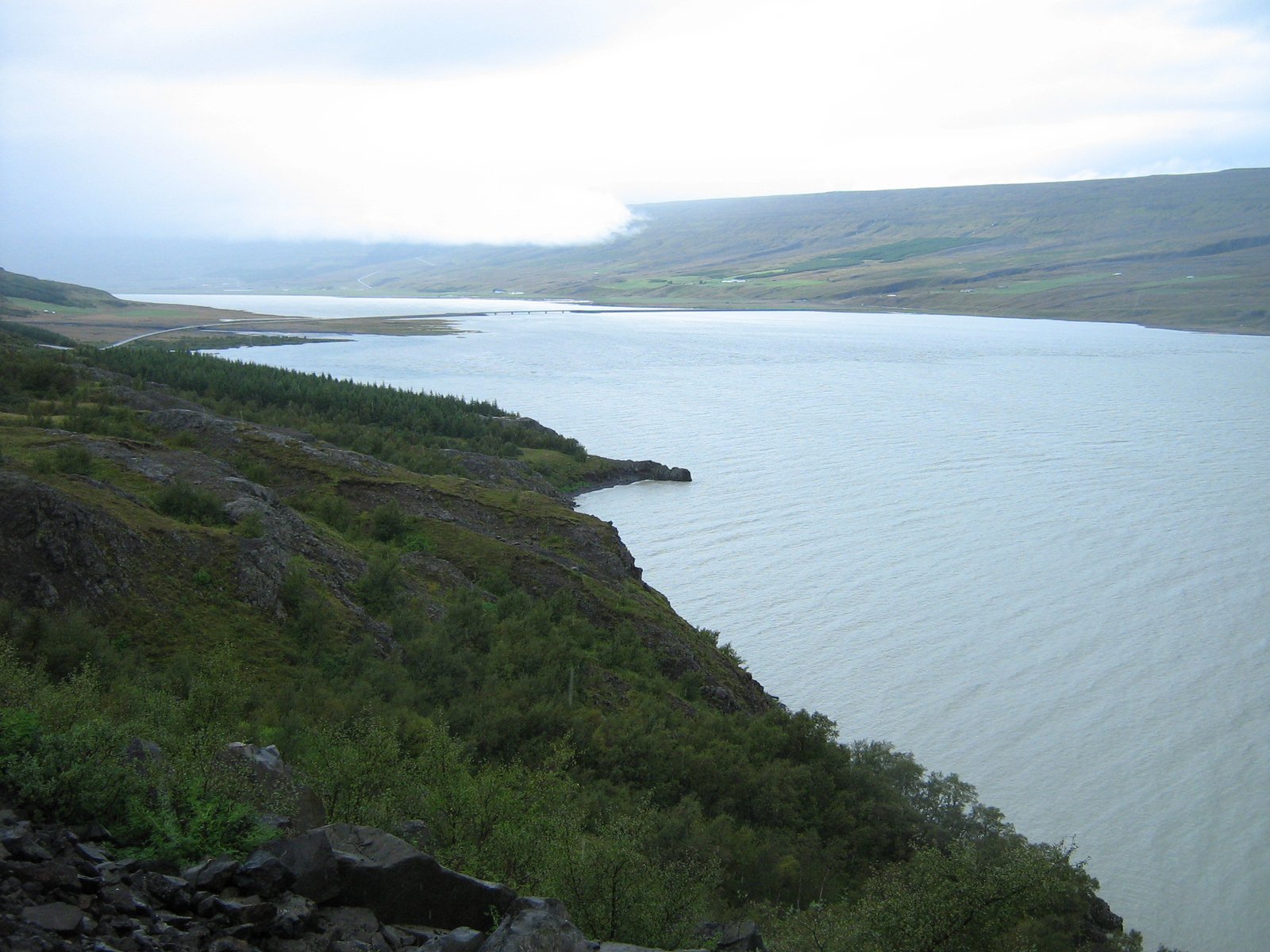
In the far east of Iceland, near the town of Egilsstaðir, a long, narrow glacial lake called Lagarfljót stretches for about twenty-five miles through a valley of dark hills. Its water is cold, milky with glacial sediment, and up to 367 feet deep. For nearly seven hundred years, people living beside it have said that something lives in it. The Lagarfljótsormurinn — the Lagarfljót Worm — is Iceland’s most famous lake monster, older in the record than the Loch Ness Monster by almost six centuries. In 2012, a farmer’s video brought it to the attention of the whole world, and the argument that followed has never really been settled.
A serpent in the annals
The earliest known reference to the Worm appears in the Skálholts Annáll, an Icelandic annal, under the year 1345. It is one of the oldest lake-monster reports in the world. The folklore that grew around it tells of a girl who put a gold ring beneath a small worm — a lyngormur, a heather worm — and placed it in a chest. The worm grew with the gold. It grew too large for the chest, and the girl threw it into the lake, where it kept growing, until it became a serpent that terrorised the people living around the water. The story is a fairy tale, but it is also a precise description of how the Worm has been imagined ever since: a serpent, long and dark, living in the deep, cold water.
Reports continued through the centuries. Witnesses described a long, humped shape moving through the lake, sometimes surfacing for a few seconds before sinking again. The lake’s glacial water is cloudy with fine sediment, which reduces visibility and makes it difficult to judge size and distance beneath the surface. That murk is part of the story. In a clear lake, a floating log is a floating log. In Lagarfljót, it can be anything.
The sightings of the twentieth century
The modern history of the Worm begins in the twentieth century, when named witnesses with positions to lose started reporting what they had seen. In 1963, the head of Iceland’s National Forest Service reported seeing a moving object in the lake that he could not account for. In the 1980s, a group of contractors working on the lake came home with a badly damaged cable and tales of a rather large beast. These were not tourists chasing a legend. They were people who knew the lake, and they were puzzled.
There were also the natural explanations, and they were never far away. The lake’s currents can move floating debris in ways that look like swimming. Methane gas rising from the lake bed can disturb the surface. Tangled tree trunks, caught in the ice in winter, can shift and roll. Clusters of leaves and organic matter can form long, dark shapes on the water. Each of these has been offered as an explanation for one sighting or another, and each probably explains some of them.
The video of 2012
On the morning of 2 February 2012, a farmer named Hjörtur E. Kjerúlf was drinking coffee in his kitchen at Hrafnkelsstaðir, in the Fljótsdalur valley. From his window he could see the Jökulsá í Fljótsdal, the glacial river that flows from Lagarfljót. Something was moving in the water. He picked up his camera and filmed it.
The video shows a long, sinuous, hump-like form in the icy river, appearing to swim against the current. It was posted online, and it went viral, gathering millions of views. News organisations around the world picked it up. For a few weeks in early 2012, the Lagarfljót Worm was one of the most talked-about creatures on the planet. An American television show, “Fact or Faked: Paranormal Files”, sent a team to east Iceland to search for it, led by a former FBI agent. About twenty people camped near Hrafnkelsstaðir, waiting for the creature to appear.
Kjerúlf himself was careful. He never claimed he had filmed the Worm. He said he had filmed something, and left the identification to others. He also admitted something important: the object moved, but it did not advance relative to points on the shore. It appeared to swim upstream, but it was not actually going anywhere.
The fishing net
That observation was the key. A Finnish researcher named Miisa McKeown, who had studied ice and how frozen objects behave in water, examined the video frame by frame. She concluded that the water was flowing quickly past the object, rather than the object moving through the water. The “worm” was, in her analysis, a flexible object trapped in the current — most likely a commercial fishing net, common in the area for salmon, encrusted with ice and frazil ice, caught on something beneath the surface. The current made it ripple and undulate, creating the illusion of swimming.
It was February in Iceland, in a glacial river full of ice. A net, stiff with ice, snagged on a rock or a branch, would look exactly like what the video shows: a long, dark, serpentine shape, apparently moving, in water that is itself moving fast. Other analysts reached the same conclusion. The object was real, and it was inanimate.
The commission
The story might have ended there, but the local council had made a promise. The municipality of Fljótsdalshérað had long offered a prize to anyone who caught the monster on camera. After the video went viral, the council appointed a thirteen-member commission, including a scientist, to decide whether Kjerúlf’s footage was genuine and whether he was entitled to the prize.
It took the commission two years. In 2014, it ruled that the video was authentic — meaning it was a genuine recording, not a hoax — and awarded Kjerúlf the prize money. The commission also recommended further investigation of the Worm. Headlines around the world announced that Iceland had officially declared its lake monster real. The reality was narrower: the commission had judged the video, not the creature. It had said the footage was not faked. It had not said what was in the footage.
Sceptics were quick to point out that the commission’s conclusion may have been influenced by the dramatic rise in cryptozoological tourism that followed the video. The Worm is good for business in east Iceland. The town has never discouraged the legend, and the video brought visitors, television crews and attention to a remote valley. That does not make the commission’s ruling wrong. It does mean the ruling should be read carefully.
The lake itself
Part of the Worm’s endurance is the lake. Lagarfljót is one of Iceland’s largest bodies of fresh water, and it is not a friendly place to search. Its glacial water is opaque, its currents are strong, and its bed is uneven. Sonar searches and diver searches have found nothing anomalous. No carcass has ever washed up. No clear photograph has ever been taken. No biological residue has ever been recovered.
And yet the reports continue. The Worm has been reported for nearly seven centuries, and the people who report it are, in many cases, people who know the lake well. The legend is woven into the identity of the region. The Worm appears on signs, in stories told to visitors, and in the name of the place itself. It is, as one writer put it, half monster and half pet.
What the evidence says
The Lagarfljót Worm sits in an interesting middle ground. Unlike many lake monsters, it has a documented history going back to the fourteenth century, a named and dated video that was examined by a formal commission, and a specific, testable natural explanation for that video. The sceptical explanation — an ice-encrusted fishing net — fits the footage well, and it was offered by a researcher who understood ice. The commission’s ruling that the video was authentic does not contradict that explanation, because the video was authentic: it showed a real object in a real river. The question was never whether the video was faked. The question was what the object was.
The Worm remains, in the end, a story about a lake. The lake is real, the history is real, the video is real, and the creature is unproven. That combination — a real place, a real record, and a mystery that will not quite close — is why the Lagarfljót Worm has outlasted almost every other lake monster in the world.
What is documented, and what is not
Documented facts: The earliest reference to the Worm appears in the Skálholts Annáll under the year 1345. Lagarfljót is a glacial lake in eastern Iceland, about 25 miles long and up to 367 feet deep. On 2 February 2012, Hjörtur E. Kjerúlf filmed a long, serpentine object in the Jökulsá í Fljótsdal river; the video went viral. In 2014, a thirteen-member municipal commission ruled the video authentic and awarded Kjerúlf a prize. Kjerúlf himself never claimed the object was the Worm. Sonar and diver searches have found nothing anomalous.
Unverified or disputed claims: The claim that a large unknown serpent lives in Lagarfljót rests on eyewitness reports and folklore, with no physical specimen, carcass or clear photograph. The claim that the 2012 video shows the Worm is disputed: frame-by-frame analysis indicates an inanimate, ice-encrusted object, most likely a fishing net, caught in the current. The claim that the 2014 commission “proved” the Worm exists misreads its ruling, which concerned the authenticity of the video, not the identity of the object in it.