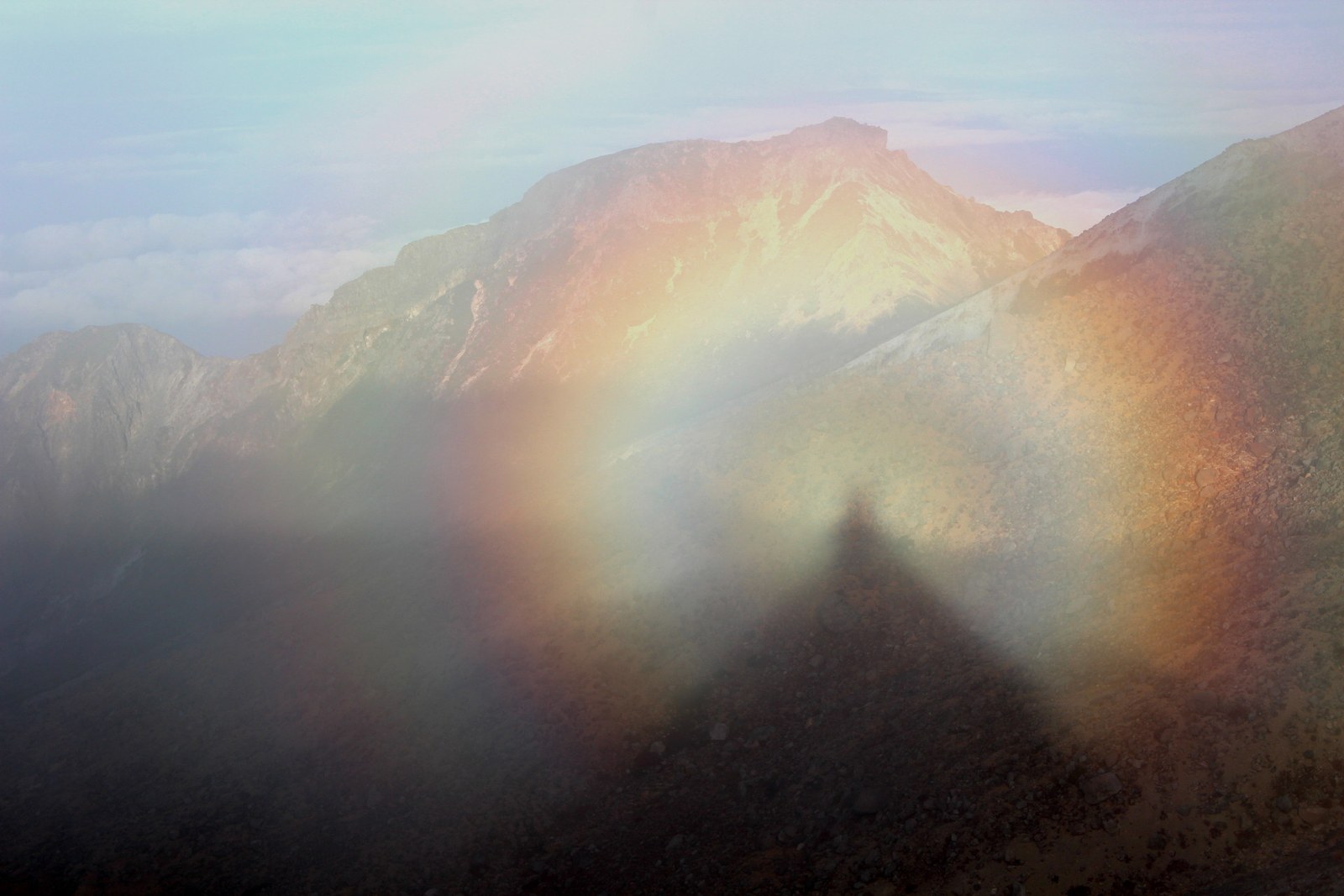
There is a mountain in northern Germany where the fog almost never lifts, and where, for centuries, climbers have reported seeing a ghost. The figure appears in the mist ahead of them: a giant human shape, many times life size, ringed by a halo of coloured light, moving as they move and standing still when they stand still. It has frightened people for so long that the mountain became the home of witches in German folklore. The figure is real. The halo is real. And the ghost is the climber himself.
The mountain of fog and witches
The Brocken is the highest peak in the Harz Mountains, rising 1,141 metres above sea level in what is now the German state of Saxony-Anhalt. It is not a particularly high mountain, but it protrudes above the treeline, and its northerly latitude gives it alpine conditions more often found on much higher peaks. Cloud or mist drapes its flanks for as many as 300 days a year, creating ideal conditions for the phenomenon that bears its name. For centuries it was called Blocksberg and was believed to be the place where evil spirits gather on Walpurgis Night, the eve of 1 May, when witches were said to ride to the summit.
The naturalist Johann Silberschlag is first credited with observing and describing a spectre he saw from the peak in 1780. But the phenomenon had been seen earlier: it was first reported by the Spanish naval officer Antonio de Ulloa and the French mathematician and astronomer Pierre Bouguer during the eighteenth-century French Geodesic Mission to the Equator, when they saw their shadows cast upon the clouds of the Andes. The name, however, belongs to the Brocken, because of the notoriety of the accounts from that mountain and the frequency with which the phenomenon can be observed there.
Legend records an incident that happened when a climber was scaling the Brocken. At a particularly precipitous point, he glanced up and saw, in the haze before him, a human figure with a halo surrounding its head. Understandably startled by this apparition, he lost his hold and fell to his death. If the story is true, the unfortunate climber had jumped to a conclusion. What he saw had little to do with the sanctity of the beholder, or that of whatever being he thought he saw. He was looking at himself.
How the ghost is made
A Brocken spectre occurs when a person stands on a mountain ridge with the sun low behind them and a bank of mist or cloud in front. The observer’s shadow is projected onto the cloud, often appearing enormous and distorted. Because the cloud surface is much farther away than the observer expects, the shadow can seem gigantic, often many times larger than the person. The light projects the shadow through the mist, often in a triangular shape due to perspective. The apparent magnification of the shadow is an optical illusion that occurs when the observer judges their shadow on relatively nearby clouds to be at the same distance as faraway land objects seen through gaps in the clouds, or when there are no reference points by which to judge its size.
The shadow also falls on water droplets at varying distances from the eye, confusing depth perception. The movement of the cloud layer and variations in fog density can make the shadow appear to move, adding an ethereal touch to the visual spectacle — and when the shadow falls over lower or higher clouds, it can appear to suddenly jump. The effect becomes even stranger because the cloud droplets are constantly moving, so the ghost shimmers and shifts even when the observer stands still.
The halo is a separate phenomenon, and it has its own name: the glory. Around the shadow’s head appear one or more concentric rings of coloured light, resembling a halo. The glory forms when sunlight is scattered backward by tiny water droplets in the cloud. When sunlight penetrates water droplets, some is transmitted, but some is reflected backward from the rear side of the droplet. In the reflected sunlight, similar wavelengths of light can enhance each other, creating rings of particular colours around the shadow, while at other angles the waves cancel each other out and create dark bands. The ratio between the diameters of the first and second dark rings is about three to one, regardless of distance — a fingerprint of the physics that makes the glory.
Unlike a rainbow, which appears opposite the sun and is produced by refraction and reflection within raindrops, a glory results from complex interactions between light waves and microscopic cloud droplets. It is sometimes called the Brocken bow. The phenomenon can happen over a wide range of distances, but the illusion is nearly always the same, regardless of scale.
Only you can see your own ghost
The most unsettling feature of the Brocken spectre is a personal one. The spectre can only be observed by the person whose shadow is projected. No matter how many people are around, each individual only sees their own coloured halo, while the shadows of others remain just that — shadows. The glory is centred on the antisolar point, the point directly opposite the sun from the observer’s eyes, so each observer’s glory is centred on their own shadow’s head, and no one else’s. Two climbers standing side by side on the same ridge will each see a ghost with a halo, and each ghost will be themselves.
This is also why the spectre appears to stand upright rather than lying flat. The shadow is projected onto a bank of fog that is, in effect, a vertical screen in front of the observer, so the figure appears as an upright silhouette, walking on the clouds. The combination — a giant, upright figure, haloed, moving when you move — is so convincing that even people who know the explanation can find it startling the first time they see it.
The phenomenon is not unique to the Brocken, and it can occur anywhere suitable conditions exist. Eric Shipton, the great British mountaineer, famously saw one during an ascent of Mount Kenya in 1929. Climbers have reported them in many mountain ranges around the world. Airline passengers see them too: the shadow of an aircraft cast onto the clouds below, ringed by a glory, is the same phenomenon at a different scale. The conditions are always the same — the sun low behind the observer, a cloud or light mist in a low area ahead — and the result is always the same: a ghost that is, in the end, only you.
What is documented, and what is not
Documented facts: A Brocken spectre is the magnified shadow of an observer cast onto a bank of mist or cloud when the sun is low behind them, accompanied by concentric rings of coloured light called a glory. The phenomenon is named after the Brocken, the highest peak in Germany’s Harz Mountains at 1,141 metres, where cloud or mist drapes the flanks for as many as 300 days a year. The naturalist Johann Silberschlag first described a spectre from the peak in 1780; the phenomenon was earlier reported by Antonio de Ulloa and Pierre Bouguer during the French Geodesic Mission to the Equator. The shadow appears magnified because the observer misjudges the distance to the cloud surface, and often triangular because of perspective. The glory is produced by sunlight scattered backward by tiny water droplets, with constructive and destructive interference creating alternating coloured and dark rings; the ratio between the diameters of the first and second dark rings is about three to one. Each observer sees only their own glory, centred on their own shadow’s head. The Brocken was long known as Blocksberg, associated in folklore with witches gathering on Walpurgis Night. The phenomenon also occurs on other mountains and from aircraft.
Unverified or disputed claims: The legend of a climber who fell to his death after mistaking his own spectre for an apparition is a traditional account, not a documented incident. Claims that the figure is a supernatural being, a spirit, or a divine sign have no supporting evidence; halos were often interpreted as divine signs in earlier times, but the effect is fully explained by optics. The spectre does not predict anything, and seeing one carries no significance beyond the weather conditions that produce it.
Sources
- https://www.gi.alaska.edu/alaska-science-forum/old-superstition-explained
- https://www.wildernessmag.co.nz/see-brocken-spectres/
- https://www.amusingplanet.com/2026/06/brocken-spectre-erie-optical-phenomenon.html
- https://www.iflscience.com/try-making-a-brocken-specter-on-your-next-walk-theyre-seriously-cool-61933