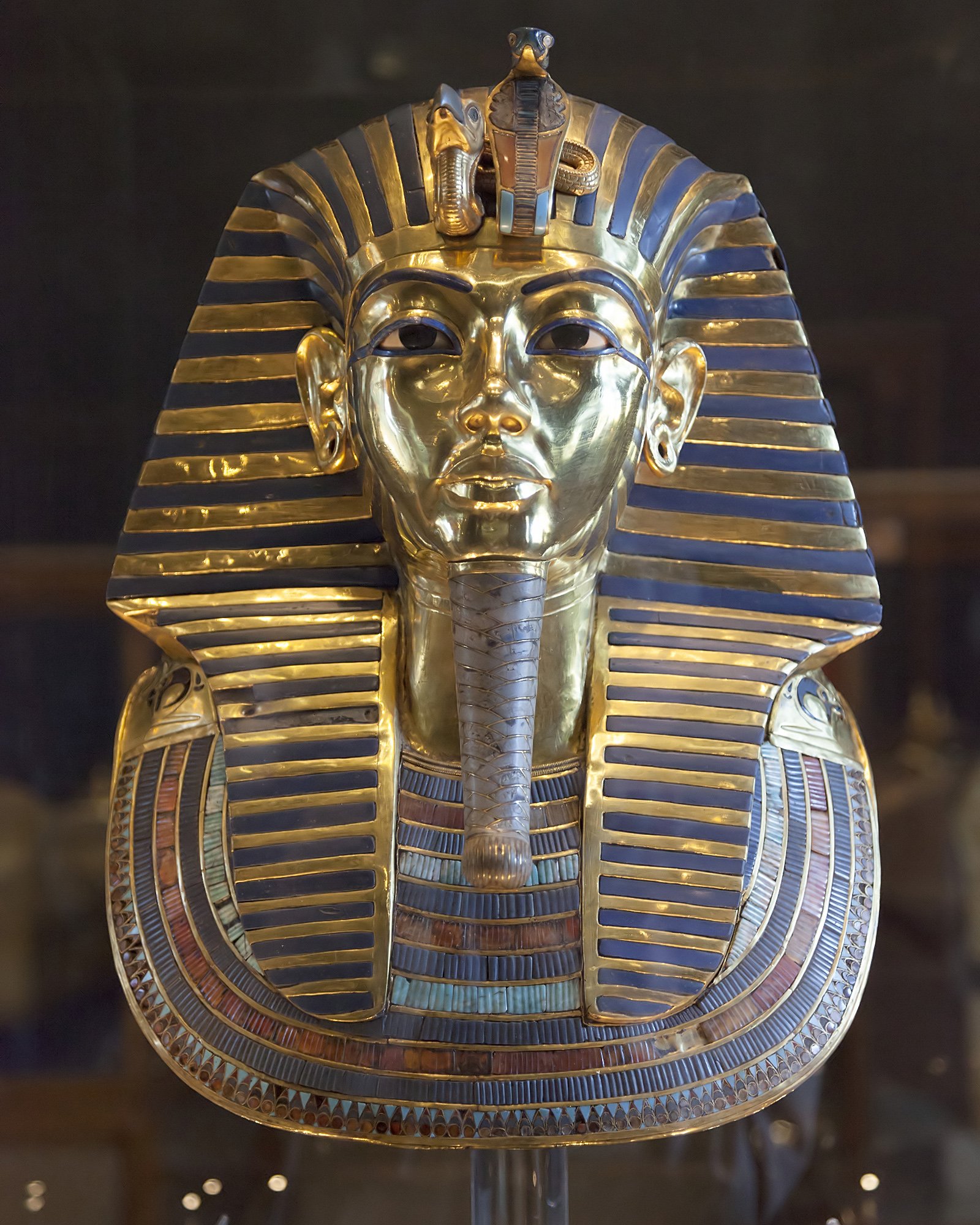
On 26 November 1922, in the Valley of the Kings in Egypt, the archaeologist Howard Carter made a small hole in a sealed doorway, held a candle to it, and looked inside. Behind him stood his patron, Lord Carnarvon. Carnarvon asked if he could see anything. Carter answered, “Yes, wonderful things.” He was looking into the tomb of Tutankhamun, a pharaoh who had reigned more than three thousand years earlier and died at about nineteen. The tomb was intact. It contained more than five thousand objects, including the gold funerary mask that has become one of the most famous artefacts in the world. Five months later, Lord Carnarvon was dead. The newspapers knew why. A curse, they said, had been placed on anyone who disturbed the pharaoh’s rest. The curse of the pharaohs was born, and it has never quite died.
The tomb
Tutankhamun — King Tut — reigned for about ten years, from around 1332 to 1323 BC, during the Eighteenth Dynasty of ancient Egypt. He came to the throne as a child, married his half-sister Ankhesenamun, and died young, probably from a combination of malaria and a broken leg, though the exact cause is still debated. He was buried in a small tomb in the Valley of the Kings, designated KV62. Because he died young and unexpectedly, the tomb was modest, and because it was modest, it was overlooked. Later tombs were built over it, and it was forgotten.
Howard Carter had been searching the Valley for years, funded by George Herbert, the 5th Earl of Carnarvon, a wealthy English aristocrat with a passion for Egyptology. In November 1922, Carter’s workmen found a step cut into the rock. Clearing it revealed a staircase descending to a sealed door. Carter sent for Carnarvon, who arrived from England. On 26 November, they opened the door and saw the antechamber, piled high with treasure: chariots, beds, chairs, boxes, statues, and gold everywhere.
The tomb took ten years to empty and catalogue. It was the greatest archaeological discovery of the century, and it made Carter and Carnarvon famous around the world. It also, within months, made Carnarvon dead.
The death of Lord Carnarvon
Carnarvon died in Cairo on 5 April 1923, five months after the tomb was opened. He was fifty-six. The cause, according to his doctors, was blood poisoning. He had cut a mosquito bite on his cheek while shaving, the cut became infected, and the infection spread into his bloodstream, causing erysipelas and then pneumonia. He had been in poor health for years, following a serious motoring accident in 1901 that had left him frail. Egypt’s heat and dust did not help.
It was, in medical terms, an unremarkable death for a frail man in a hot climate with an infected wound. But it happened at a remarkable moment, and the press did the rest. Within days of Carnarvon’s death, newspapers in Britain and America were reporting that he had been killed by the curse of the pharaoh. The story was irresistible: a tomb sealed for three thousand years, a lord who opened it, and a death five months later.
The press had been preparing the ground for months. The novelist Marie Corelli had written a warning, published in the press before the tomb was opened, that “dire punishment” would follow anyone who entered a sealed tomb. After Carnarvon’s death, her letter was quoted everywhere as a prophecy. A supposed curse inscription was also quoted in the papers: “Death shall come on swift wings to him who disturbs the peace of the King.” No such inscription was ever found in the tomb. It was invented, probably by a journalist, and it has been repeated ever since.
The list of the dead
Once the curse had a name, it needed victims, and the newspapers supplied them. Over the following years, a list of the curse’s dead was assembled, and it grew with each retelling.
George Jay Gould I, an American railway magnate who had visited the tomb, died of pneumonia in May 1923, a month after Carnarvon. Aubrey Herbert, Carnarvon’s half-brother, died in September 1923 of blood poisoning following dental work. Prince Ali Kamel Fahmy Bey, an Egyptian prince who had nothing to do with the tomb, was shot by his wife in 1923, and was added to the list anyway. Hugh Evelyn-White, an archaeologist who had worked in Egypt, hanged himself in 1924, leaving a note that mentioned the curse. Arthur Mace, a member of Carter’s team, died in 1928. Richard Bethell, Carter’s secretary, died in his sleep in 1929.
The list looks impressive until it is examined. Gould was an elderly man with a fever. Herbert died of a dental infection. Fahmy Bey was murdered by his wife for reasons that had nothing to do with Tutankhamun. Evelyn-White was suffering from depression. Mace died of pleurisy. Bethell died in his sleep at forty-six, of causes that were never established. Each death has its own explanation, and none of them requires a curse.
The most telling fact is the one the newspapers left out. Howard Carter, the man who actually opened the tomb, who spent ten years working inside it, breathing its air and handling its contents, lived until 1939. He died of Hodgkin’s disease at sixty-four, seventeen years after the discovery. If there was a curse, it missed the man who mattered most.
The science of the curse
In 2002, a study examined the question properly. Of the fifty-eight people who were present at the opening of the tomb, only eight had died within twelve years. There was no excess mortality. The people who entered the tomb lived, on average, as long as anyone else. The curse, statistically, did not exist.
That has not stopped scientists from proposing natural explanations for the deaths that did occur. Tombs that have been sealed for three thousand years can harbour moulds and bacteria, including Aspergillus, which can cause respiratory illness. Ancient tombs can also contain radon gas. These are real hazards, and they may explain some illnesses among tomb workers. But they do not explain Carnarvon’s death, which was caused by an infected mosquito bite, or the deaths on the list, which had ordinary medical causes.
The modern origins of the mummy’s curse, as historians have shown, lie not in ancient Egypt but in nineteenth-century Europe. Egyptian curses were primarily a cultural phenomenon, developed in European fiction and journalism, and used to condemn the disturbance of the dead — and, later, to entertain horror film audiences. The ancient Egyptians did sometimes place protective texts in tombs, but there is no evidence of a curse in Tutankhamun’s tomb, and no inscription of the kind the newspapers quoted.
Why the curse endures
The curse endures because it is a good story, and because it arrived at the perfect moment. The discovery of Tutankhamun’s tomb was the first great archaeological event of the age of mass media. The newspapers needed a story that would sell, and a curse was better than a catalogue. Carnarvon’s death gave them one. The list of the dead gave them a sequel. The films that followed — “The Mummy” in 1932, and a dozen remakes since — gave the curse a permanent home in popular culture.
It also endures because it touches something real. There is a genuine unease about opening the graves of the dead, and the curse gives that unease a shape. The tomb was sealed for a reason, the story says, and those who break the seal will pay. It is a moral tale, dressed as a supernatural one. And it is, in its way, a tribute to the power of the discovery. Tutankhamun’s tomb was so extraordinary that people needed an extraordinary explanation for what followed.
What is documented, and what is not
Documented facts: Howard Carter discovered the tomb of Tutankhamun (KV62) in November 1922, funded by Lord Carnarvon; the tomb was opened on 26 November 1922 and contained more than 5,000 objects. Carnarvon died in Cairo on 5 April 1923 from blood poisoning following an infected mosquito bite. No curse inscription has been found in the tomb; the widely quoted “Death shall come on swift wings” text was invented by the press. Howard Carter lived until 1939. A 2002 study found no excess mortality among the 58 people present at the opening of the tomb. Tutankhamun reigned around 1332–1323 BC and died at about nineteen.
Unverified or disputed claims: The claim that a curse killed Carnarvon and others is unsupported: each death on the commonly cited list has an ordinary medical or circumstantial explanation, and the statistical evidence shows no excess mortality. The claim that Marie Corelli’s warning was a prophecy is a retrospective reading of a letter published before the opening. The claim that tomb moulds or bacteria caused the deaths is a plausible hazard of sealed tombs in general, but has not been shown to have caused any specific death in this case. The claim that Prince Ali Kamel Fahmy Bey was a victim of the curse is baseless; he was murdered by his wife and had no connection to the tomb.