In the last winter of the Second World War, Allied aircrews on both sides of the planet began bringing back the same story. A small, coloured, glowing object had paced their aircraft, sometimes for minutes at a time, sometimes through evasive manoeuvres, and then either vanished or peeled away. The objects never attacked. They could not be outrun, shot down, or identified. The pilots called them foo fighters, after a comic strip. Wartime intelligence treated them as a possible secret weapon. The weapon never materialised. Eighty years later, what the aircrews actually saw is partly explained, partly disputed, and partly still an open file.
The first reports
Royal Air Force crews had reported unexplained lights following their aircraft as early as March 1942, with similar encounters over the Balkans from April 1944. American night-fighter crews in Belgium began reporting them in the first week of October 1944 — the 422nd Night Fighter Squadron’s crews at first believed they were seeing Messerschmitt Me 163 rocket interceptors, which did not operate at night. But the bulk of the sightings began in the last week of November 1944, when pilots flying over Western Europe by night reported fast-moving round glowing objects following their aircraft.
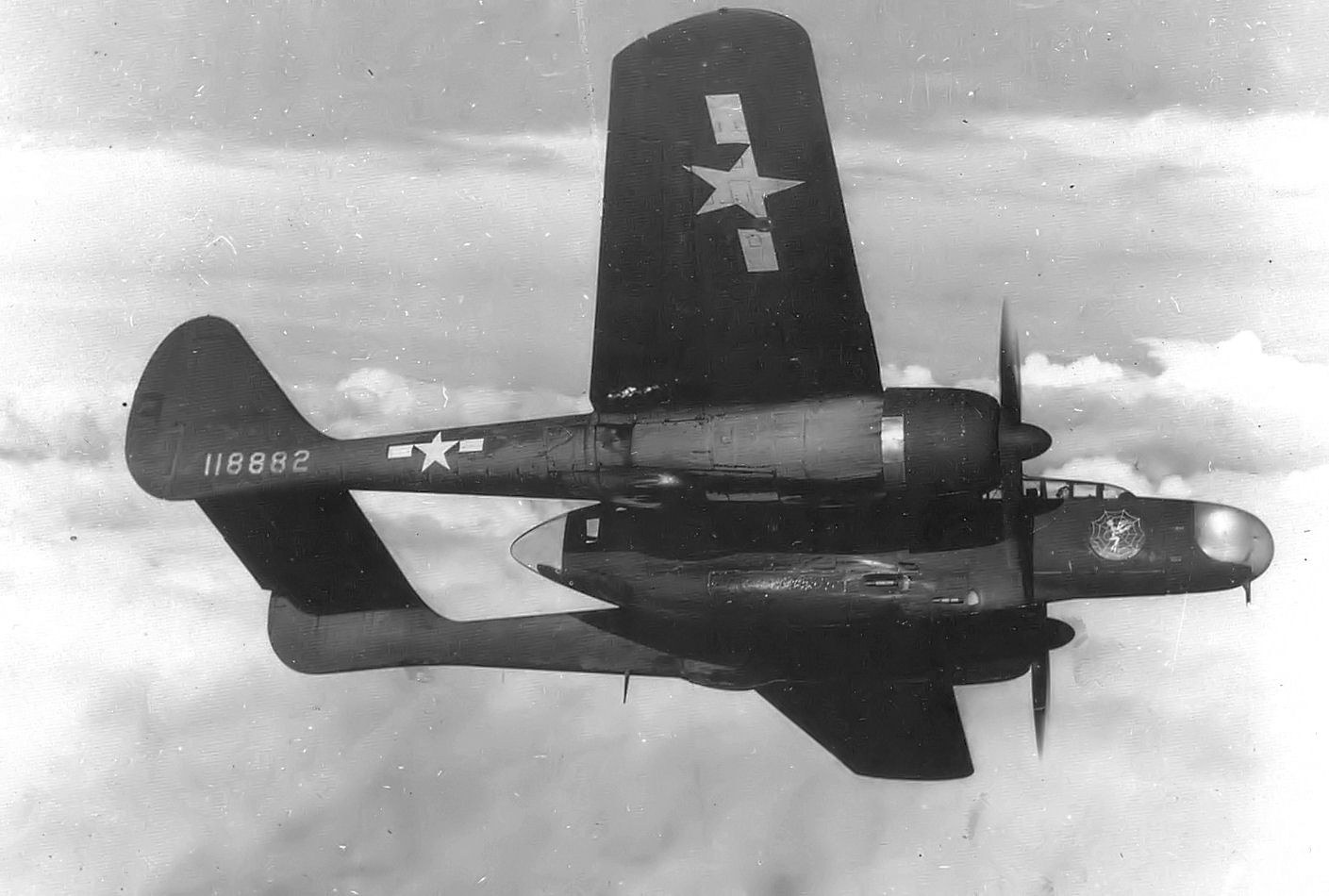
The unit most associated with the phenomenon was the 415th Night Fighter Squadron of the United States Army Air Forces’ Ninth Air Force, flying Bristol Beaufighters and later Northrop P-61 Black Widow night fighters from bases in southern France and northern Italy. The squadron’s first formal report came from a mission debriefing on the evening of 27 November 1944. Lieutenant Ed Schlueter was piloting the aircraft, Lieutenant Fred Ringwald — the unit’s intelligence officer — was riding as observer, and Lieutenant Donald J. Meiers was on radar. They were roaming the Rhine Valley just north of Strasbourg, on the French-German border, on a late November evening, partly cloudy with a quarter moon.
Ringwald was the first to see them. “I wonder what those lights are, over there in the hills,” he said, according to an account published in American Legion Magazine in 1945. There were eight to ten of them in a row, glowing fiery orange. Then Schlueter saw them off his right wing. The lights paced the aircraft through a series of high-speed manoeuvres, staying with it as if attached, and then vanished.
More reports followed quickly. On 17 December 1944, near Breisach, Germany, a pilot flying at about 800 feet saw five or six flashing red and green lights in a T shape. On 22 December, two more flight crews sighted lights: one crew, near Hagenau, reported two lights in a large orange glow, seeming to rise from the earth to 10,000 feet and tailing the fighter for approximately two minutes. Lieutenant Samuel A. Krasney reported a wingless, cigar-shaped object, glowing red, just a few yards off his plane’s wingtip.
The name
The term “foo fighter” has a surprisingly human origin. It comes from “Smokey Stover”, a comic strip by Bill Holman, in which the fireman Smokey would declare, “Where there’s foo, there’s fire.” Donald J. Meiers, the 415th’s radar operator, was an avid reader of the strip. According to most members of the squadron, Meiers gave the lights their name: after the debriefing on 27 November, he reportedly slammed a comic strip on the desk and exclaimed that it had been another one of those foo fighters.
The name stuck, and it was cleaned up for public consumption. An Associated Press reporter, Bob Wilson, was sent to the 415th’s base outside Dijon, France, in December 1944 to investigate, and his dispatch of 1 January 1945 broke the story to the public. On 13 December 1944, Supreme Headquarters Allied Expeditionary Force in Paris had already issued a press release describing the sightings as a possible “new German weapon”. In January 1945, Time magazine published an article titled “Foo-Fighter”, noting that Allied pilots had been encountering the glowing objects for over a month and remained unable to explain them.
A secret weapon?
The military took the sightings seriously, because the obvious explanation was the frightening one: that the Germans had a new weapon. In the winter of 1944–45, Germany was fielding genuinely novel technology — the V-2 rocket, the Me 262 jet fighter, the Me 163 rocket interceptor — and Allied intelligence could not rule out another. The lights were reported to have paced aircraft at speeds above 300 miles per hour, to have matched evasive manoeuvres, and to have appeared and vanished without warning. If they were a weapon, they were a weapon that never fired.
The German side, so far as the postwar record shows, had no such weapon. German pilots reported their own unexplained lights, and German intelligence was as puzzled as the Allies’. The most careful modern research on the subject, Keith Chester’s “Strange Company: Military Encounters with UFOs in World War II” (2007), based on declassified records, found that the foo fighters were reported by aircrews on both sides, and that neither side could identify them.
The objects were typically described as roughly spherical, about one to two metres in apparent diameter, glowing red, orange, white, or occasionally green. They were seen in the European theatre — Alsace, the Rhineland, northern Italy — and in the Pacific, where B-29 crews over Japan reported similar objects. They never displayed hostile behaviour. They never collided with an aircraft. They never left wreckage.
The explanations
The postwar Robertson Panel, convened in 1953 to review the UFO evidence, considered the foo fighters and suggested several possibilities: electrostatic phenomena similar to St. Elmo’s fire, electromagnetic phenomena, or simple reflections of light from ice crystals. None of these was presented as a firm conclusion, and none has since been shown to account for the full pattern of reports.
St. Elmo’s fire is the most commonly cited explanation. It is a luminous electrical discharge that can appear on the tips of objects — including aircraft wingtips and propellers — in stormy weather, and it can look like a glowing ball. But the pilots of the 415th had seen St. Elmo’s fire before, and they said the foo fighters were different: the lights appeared at a distance, moved independently of the aircraft, and paced it through manoeuvres. Flares and weather balloons, the other standard explanations, cannot track an aircraft through evasive turns.
Ball lightning has also been proposed. It is a rare, poorly understood atmospheric phenomenon in which a glowing sphere appears during thunderstorms and moves erratically before vanishing. Ball lightning could account for some reports, but it is associated with storms, and many foo fighter sightings occurred in clear weather. And ball lightning does not pace an aircraft at 300 miles per hour for minutes at a time.
More recent research has suggested that some reports may have been misidentified German ordnance — flak rockets, or the exhaust glow of jet aircraft seen at a distance. Others may have been Venus, or bright stars seen through thin cloud, or the lights of distant towns reflected in haze. Each of these explains some reports. None explains all of them, and the reports that resist explanation are the ones that made the phenomenon famous: the lights that stayed with an aircraft through turns, climbed from the ground to 10,000 feet, and then vanished.
Why the foo fighters matter
The foo fighters matter because they are the first modern UFO phenomenon: the first time that trained observers, flying military aircraft, reported unknown objects in a systematic way, and the first time that a military bureaucracy treated the reports as a serious intelligence problem. They predate the flying saucer era by three years — Kenneth Arnold’s sighting was in June 1947 — and they show that the phenomenon did not begin with the saucers. It was already there, in the night sky over the Rhine, while the war was still being fought.
They also matter because they show how a mystery survives explanation. The foo fighters have been explained many times, by many people, in many ways. Each explanation covers part of the evidence and leaves the rest untouched. The lights that paced the 415th through the winter of 1944–45 remain, in the words of the most thorough modern study, “partly explained, partly disputed, and partly an open file”. That is not a failure of investigation. It is an honest description of what the record supports — and it is the reason the foo fighters are still discussed, eighty years after the pilots of the 415th first saw eight orange lights in a row over the Rhine Valley and wondered what they were.
What is documented, and what is not
Documented facts: Allied aircrews reported small glowing objects pacing their aircraft from late 1944 through May 1945, in the European and Pacific theatres. The 415th Night Fighter Squadron’s first formal report came from a debriefing on 27 November 1944, involving Lieutenant Ed Schlueter, Lieutenant Fred Ringwald, and Lieutenant Donald J. Meiers, who coined the term “foo fighter” from the “Smokey Stover” comic strip. Further sightings were reported on 17 and 22 December 1944. An Associated Press report by Bob Wilson broke the story on 1 January 1945, and Time magazine published an article titled “Foo-Fighter” the same month. The Robertson Panel in 1953 suggested St. Elmo’s fire, electromagnetic phenomena, or ice-crystal reflections as possible explanations. RAF crews had reported similar lights as early as March 1942.
Unverified or disputed claims: The claim that the foo fighters were a secret German weapon was considered by wartime intelligence and by SHAEF, but no such weapon was ever found, and German aircrews reported similar lights. The claim that the lights were St. Elmo’s fire, ball lightning, flares, or misidentified aircraft explains some reports but not the full pattern, particularly the lights that paced aircraft through manoeuvres at high speed. The claim that the lights were extraterrestrial craft is a later interpretation with no supporting physical evidence. No foo fighter was ever shot down, captured, or photographed clearly.
Sources
- https://www.history.com/articles/wwii-ufos-allied-airmen-orange-lights-foo-fighters
- https://en.wikipedia.org/wiki/Foo_fighter
- https://anomalydesk.com/foo-fighters-wwii.html
- https://www.ufohistory.online/foo-fighters