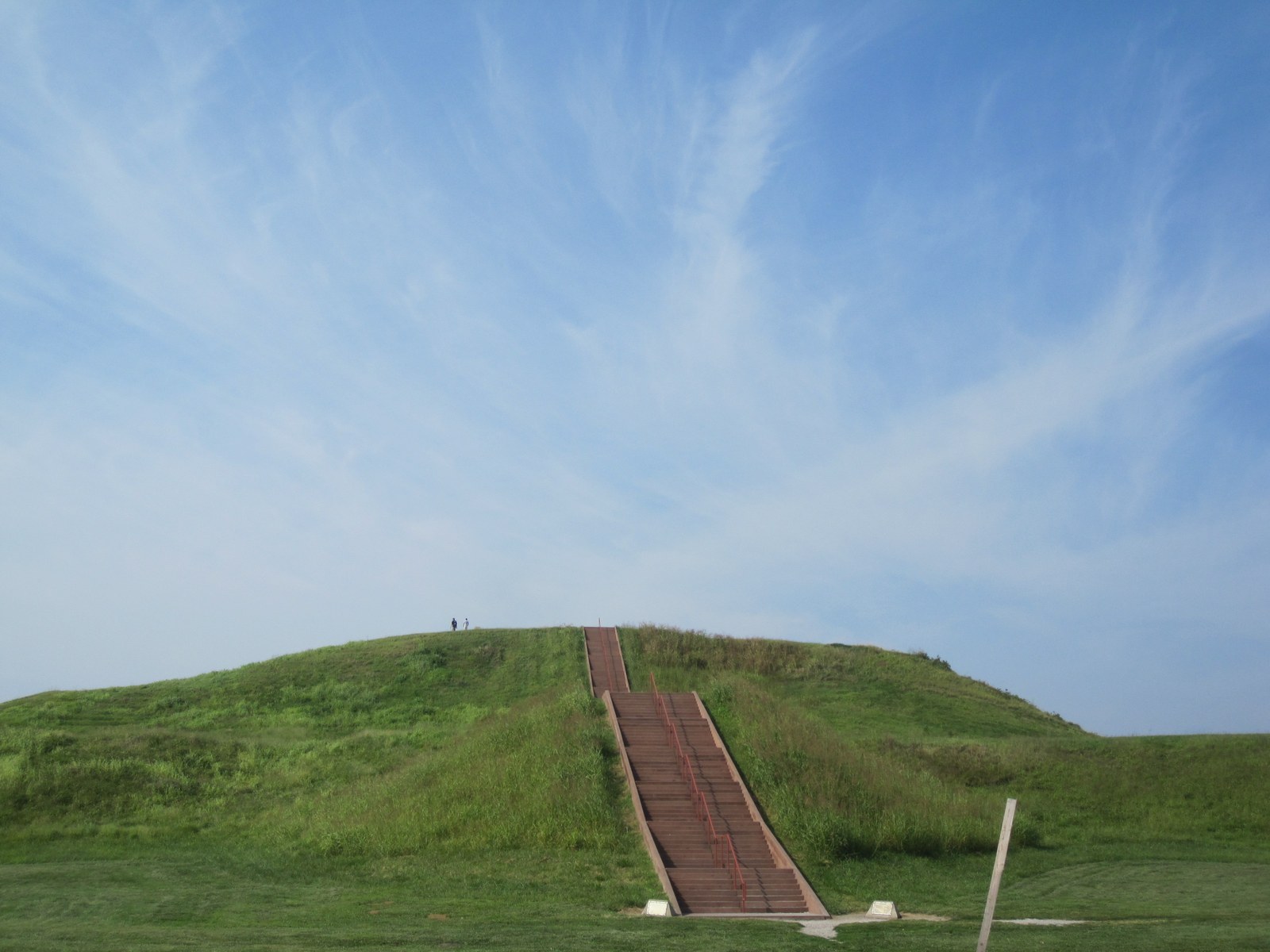
A few miles east of modern St. Louis, across the Mississippi in Illinois, a grass-covered hill rises from flat farmland. It looks like a natural ridge, with a staircase cut into its side — until you learn its measurements: about 30 metres (100 feet) high, more than 14 acres at its base, and built entirely by human hands, basketful by basketful, nearly a thousand years ago.
This is Monks Mound, the centrepiece of Cahokia, the largest pre-Columbian settlement north of Mexico. At its height, around 1100 CE, Cahokia held perhaps 10,000 to 20,000 people — by most estimates, larger than London at the time. It had plazas, temples, a defensive palisade, and trade links from the Great Lakes to the Gulf of Mexico. Within two centuries it was largely empty, and its builders left no written history, so everything we know comes from the earth they moved and the objects they buried.
A city on the floodplain
Cahokia stood on the American Bottom, a broad, fertile floodplain on the Mississippi’s eastern bank, near present-day Collinsville, Illinois. The floodplain offered rich soil for farming, and the river offered transport, fish, and a meeting point for peoples from across the continent.
The site was first settled around 600 CE, but mound building began around the 9th century, as the Mississippian culture emerged. That culture was not a single empire, but a shared way of life — maize farming, mound building, and a distinctive art and religious symbolism — that spread across the river valleys of the central and south-eastern United States between roughly 800 and 1600 CE. Cahokia was its largest city.
At its greatest extent, around 1100 CE, the city covered about 6 square miles (16 square kilometres) and contained about 120 earthen mounds: flat-topped platforms for temples and elite homes, conical burial mounds, and ridge-top mounds marking ceremonial boundaries. Today about 80 mounds survive, some 70 of them protected within the Cahokia Mounds State Historic Site (about 2,200 acres). The site is a National Historic Landmark, and UNESCO added it to the World Heritage List in 1982.
The “Big Bang” of 1050
For centuries, Cahokia was a modest settlement of perhaps a thousand people. Then, around 1050 CE, came what archaeologists call the “Big Bang”: a sudden transformation in which the scattered settlement was rebuilt as a planned city. Within a few decades the population grew enormously, the great plaza was laid out, and Monks Mound rose in stages — though whether the change was truly sudden is still debated.
Peak population estimates vary. Most put the city at 10,000 to 20,000 people around 1050–1150, with more in surrounding towns and farmsteads; some scholars suggest higher figures, others lower. London in 1100 is itself estimated at roughly 10,000 to 20,000, so Cahokia was at least comparable, and very possibly larger. The point is not the exact ranking: a city of this size existed in North America centuries before European contact, and most people today have never heard of it.
Maize was the engine of this growth: rich soil fed far more people than earlier farming, and surplus food supported priests, rulers, and craft specialists — and the immense hand labour of mound building.
Monks Mound: a mountain made of baskets
Monks Mound is the largest prehistoric earthen construction in the Americas north of Mexico: a platform mound with four terraces, rising about 30 metres — roughly a ten-storey building — and covering more than 14 acres at its base, a footprint roughly comparable to the Great Pyramid of Giza, though built of earth rather than stone.
Construction began around 900–950 CE and continued in stages until about 1200 CE. The mound contains roughly 22 million cubic feet of earth, all dug by hand and carried in baskets and bags from borrow pits nearby. There were no wheels, no draft animals, and no metal tools. On the summit stood a building more than 30 metres (100 feet) long, the largest in the city, believed to have been the residence of the paramount ruler, a temple, or both. It is long gone; only post holes and the mound remain.
The name “Monks Mound” has nothing to do with the original builders: it comes from Trappist monks who lived there briefly in the 19th century, some 700 years after it was built.
A planned city: plazas, palisade, and mounds
Cahokia was a deliberately planned city, laid out along a north–south axis linking Monks Mound with the Rattlesnake Mound (Mound 66) to the south by an elevated causeway some 800 metres long. South of Monks Mound lay the Grand Plaza, nearly 40 acres (16 hectares) of levelled open ground — one of the largest public spaces in the pre-Columbian Americas — used for ceremonies, gatherings, markets, and games. Around it stood platform mounds carrying temples and elite residences.
Around the central precinct stood a defensive palisade, a wall of upright wooden posts about two miles long, with regularly spaced bastions. It was rebuilt several times, suggesting defence was a continuing concern. Whether the threat came from rival groups, from within Cahokian society, or from both is not known — but a city that builds a two-mile wall is a city that expects trouble.
Woodhenge: a calendar made of cedar
West of Monks Mound, archaeologists led by Warren Wittry found arcs of large post holes in the 1960s. Reconstructed, they formed great circles of red cedar posts: at least five were built over time, the largest about 130 metres (427 feet) across, with 48 posts. Because they seemed to work like England’s Stonehenge, they were nicknamed “Woodhenge.”
The posts marked the solstices and equinoxes: from a central post, the sun rose over one post on the summer solstice, another on the winter solstice, and others at the equinoxes. For a farming society this was practical knowledge — it told people when to plant and harvest — and sacred knowledge too, since whoever controlled the calendar controlled the ritual year. A reconstructed Woodhenge stands on the site today.
Mound 72 and the Birdman
The most famous burial at Cahokia was found in Mound 72, a ridge-top burial mound south of Monks Mound. Excavations in the 1960s found a man in his 40s, probably an important ruler, buried on a bed of more than 20,000 marine-shell disc beads arranged as a falcon, its head beneath his head and its wings and tail beneath his arms and legs. The burial is often called the “Birdman,” after the falcon imagery in Mississippian art.
More than 250 other skeletons were recovered from Mound 72, including a mass burial of 40 men and women who appear to have been violently killed. Their relationship to the central burial is unclear: some may have been retainers or sacrifices buried with the ruler, others deposited at different times. The evidence points to a society where power was concentrated in a small elite and ritual killing took place, but details are still debated.
What Mound 72 does show is the reach of Cahokia’s world. The marine shells came from the Gulf of Mexico, hundreds of miles away, and copper came from the Great Lakes. Cahokia was a hub in a trading network spanning much of North America, and its rulers displayed power through far-travelled objects.
The decline: a city empties
Cahokia’s peak was brief. Growth stalled after about 1150–1200, the population fell — by the mid-1200s it may have halved — and by around 1350 the city was essentially empty, a century and a half before Europeans arrived.
Why? There is no single proven answer; the causes were probably multiple. Severe flooding may have damaged fields and settlements. Drought and a shifting climate between about 1150 and 1350 may have made maize farming less reliable. Forests cut for building and fuel may have caused erosion and timber shortages. Social unrest and warfare, suggested by the rebuilt palisade, may have driven people away.
A 2020 study from the University of California, Berkeley, corrected the popular “vanishing” story: chemical evidence in lake sediments showed the region was repopulated by Native peoples within a few generations and remained inhabited into the 1700s. Cahokia the city ended, but the people did not simply disappear. They dispersed and regrouped elsewhere, leaving no written account of what happened.
A name that is not theirs
The name we use comes from the Cahokia tribe, a historic Illiniwek people living in the area when the first French explorers arrived in the 17th century — centuries after the city was abandoned. That tribe was not necessarily descended from the original inhabitants, and scholars do not know which, if any, living Native American groups descend from Cahokia’s builders. Several have been suggested, including Dhegiha Siouan-speaking peoples such as the Osage and Omaha, but the connection remains debated. So the greatest city of the Mississippian world is known by a name its builders never used.
What is documented, and what is not
Documented facts: Cahokia was the largest pre-Columbian settlement north of Mexico, on the Mississippi floodplain near present-day Collinsville, Illinois, across the river from St. Louis. It flourished from about 1050 to 1350 CE, covered about 6 square miles, and originally contained about 120 earthen mounds, of which about 80 survive. Monks Mound is the largest prehistoric earthen construction in the Americas north of Mexico, about 30 metres high and more than 14 acres at its base, built in stages between about 900 and 1200 CE. The site includes the Grand Plaza, a defensive palisade, and at least five Woodhenge circles, the largest about 130 metres across. Mound 72 held a man in his 40s laid on more than 20,000 marine-shell disc beads arranged as a falcon, with more than 250 other skeletons. Cahokia was designated a UNESCO World Heritage Site in 1982. The name “Cahokia” comes from a later Illiniwek people, not the original builders.
Unverified or disputed claims: The exact peak population is an estimate, not a settled fact — most estimates fall between 10,000 and 20,000, and the London comparison depends on uncertain estimates for both cities. The identity and role of the “Birdman” in Mound 72 are inferred from burial goods, not proven by any written record. The precise functions of some mounds and of the Woodhenge circles beyond their solar alignments are not fully established. The reasons for Cahokia’s decline are debated — flooding, drought, deforestation, social unrest, and warfare have all been proposed, and no single cause has been proven. Claims that the city “vanished” are misleading, since sediment evidence shows the region was repopulated within a few generations. Which modern Native American groups descend from Cahokia’s builders remains unproven.
Sources
- Wikipedia, “Cahokia Mounds” — https://en.wikipedia.org/wiki/Cahokia_Mounds
- UNESCO World Heritage Centre, “Cahokia Mounds State Historic Site” — https://whc.unesco.org/pg.cfm?cid=31&l=en&id_site=198&
- University of Southern California, Scalar, “Cahokia” (Archaeology of Complex Societies) — https://scalar.usc.edu/works/archaeology-of-complex-societies/cahokia-1