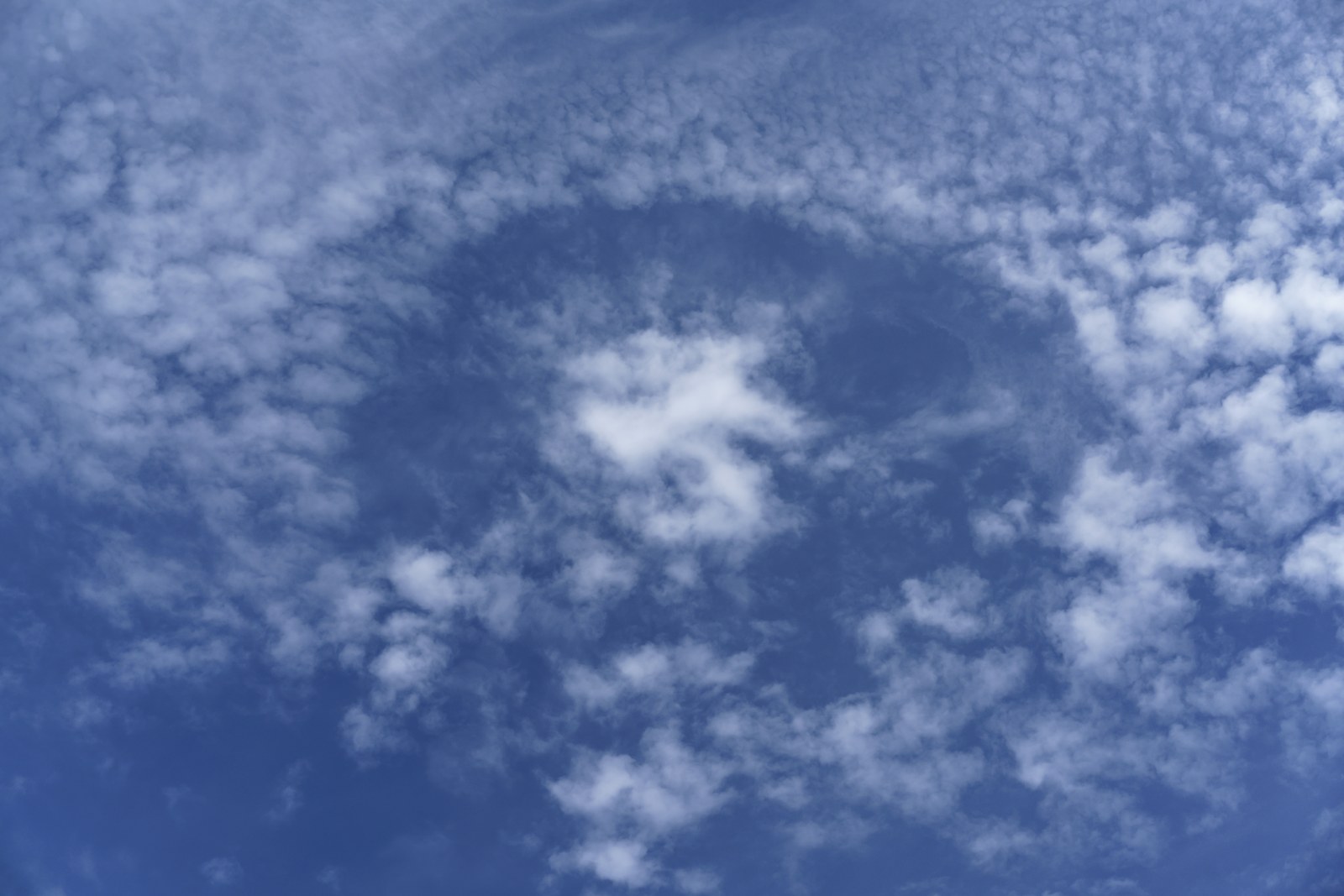
Look up on the right day and you may see something that should not be there: a neat, almost perfect circle cut into an otherwise unbroken sheet of cloud, as if someone had taken a cookie cutter to the sky. In the middle of the hole, wispy trails of ice drift downward like a curtain. The effect is so clean, so geometric, that it is easy to understand why people have blamed flying saucers. NASA’s Earth Observatory has noted that cavum clouds — to give them their formal name — “look so odd that people sometimes argue they are signatures of flying saucers or other unidentified anomalous phenomena.” They are not. They are the signature of something far more ordinary, and far more elegant: water that is colder than freezing but still liquid, and an aeroplane that disturbs it.
The cloud that should not exist
A fallstreak hole, also called a hole-punch cloud or cavum, is a large, circular or elliptical gap in a layer of mid-level cloud — most often altocumulus or cirrocumulus, sometimes altostratus or stratocumulus. The hole can be kilometres across, and it can grow larger over time. The falling ice crystals at its centre, known as fallstreaks, give the phenomenon its alternative name.
The secret of the fallstreak hole is a peculiar state of water called supercooling. The clouds in question are made of water droplets that remain liquid even at temperatures below freezing — typically around minus 15 degrees Celsius in the case of altocumulus. Pure water with very few impurities, such as dust, pollution particles, fungal spores, or bacteria, can be chilled far below zero and still remain liquid, because ice crystals normally need a speck of impurity to form around. Supercooling sounds exotic, but it occurs routinely in the atmosphere. Altocumulus clouds with supercooled tops cover about 8 percent of the Earth’s surface at any given time.
A supercooled cloud is a system in delicate balance. The droplets are liquid, but they are waiting for an excuse to freeze. When something disturbs that balance, the freezing happens fast, and it spreads. That disturbance is usually an aeroplane.
How an aeroplane punches a hole in the sky
When an aircraft flies through a cloud layer rich in supercooled water droplets, it does not carve a physical hole. Instead, it acts as a trigger that starts a chain reaction. Air expands and cools as it moves around the wings and past the propeller, a process known as adiabatic cooling. Air temperatures over jet wings often cool by as much as 20 degrees Celsius, which is more than enough to push supercooled droplets over the edge into freezing. The plane’s contrails can also introduce particles into the droplets, giving the ice somewhere to form.
Once the first ice crystals form, they begin to absorb moisture from the surrounding cloud droplets. This is the Bergeron-Findeisen process, the mechanism by which ice and liquid water interact inside mixed-phase clouds: ice crystals grow at the expense of liquid droplets, because the saturation vapour pressure over ice is lower than over water. The droplets around the new ice crystals evaporate, the ice crystals grow heavy and fall, and a clear patch opens in the cloud layer. The falling ice crystals often appear as wispy trails of precipitation called virga, hanging below the hole. The hole then grows larger over time as the freezing spreads outward through the cloud.
The shape of the hole depends on how the aircraft passed through. Planes passing at sharp angles produce small, circular cavum. At shallow angles, planes create long “canal clouds” with extended virga trails. Other factors that affect the length of a cavum include the thickness of the cloud layer, the air temperature, and the degree of wind shear. Both descending and ascending aircraft — including jets and propeller planes — can trigger the effect.
The science was nailed down in two landmark studies. Research published in 2010 by the University Corporation for Atmospheric Research and NASA, led by Andrew Heymsfield — “Aircraft-Induced Hole Punch and Canal Clouds: Inadvertent Cloud Seeding”, in the Bulletin of the American Meteorological Society — showed that aircraft passing through clouds can create these formations, with the angle of flight determining their shape. A follow-up paper in Science in 2011, “Formation and Spread of Aircraft-Induced Holes in Clouds”, confirmed the mechanism. The aeroplane, it turned out, was an inadvertent cloud seeder.
When nature does it alone
Aircraft are the most common trigger, but they are not the only one. Another way for a fallstreak cloud to form is when a cirrus cloud exists above a lower altocumulus cloud. If the cirrus starts dropping ice crystals into the altocumulus layer, it creates a domino effect: the lower cloud loses its supercooled water droplets in the same way, and a hole opens without any aircraft at all. Other disturbances can also set the process in motion. The essential ingredients are always the same three: a suitable cloud layer, supercooled water droplets, and a trigger that starts ice formation.
The phenomenon is most often seen near airports, especially in winter. Researchers looking at major airports around the world estimate that atmospheric conditions are right for cavum formation about 3 to 5 percent of the time overall, but 10 to 15 percent of the time in the winter. That seasonality is why the most famous sightings cluster in the cold months. In January 2024, a satellite image of a series of fallstreak clouds off the southwest coast of Florida appeared on NASA’s Image of the Day website, after a cold front produced the right conditions. In Victoria, Australia, a well-known example drew so much public attention that the Bureau of Meteorology had to issue an official explanation, reassuring the public that the display was a classic fallstreak hole rather than anything mysterious.
Why the saucer theory fails
It is easy to see why the fallstreak hole attracted UFO theories. A perfect circle in the clouds, appearing suddenly, with no visible cause, looks like the work of something that was there and left. The explanation, when it came, was almost disappointing in its ordinariness: a scheduled flight, a layer of cold water, and some physics. But there is a sense in which the real explanation is stranger than the saucer theory. The sky above us is full of water that is colder than freezing and yet not frozen, held in a state of suspended decision, waiting for a passing wing to tip it over the edge. Every day, aeroplanes fly through these invisible reservoirs and punch holes in them, and the holes grow, and the ice falls, and the sky repairs itself. The fallstreak hole is not a visitation. It is a glimpse of how precarious the atmosphere really is — and how much of what we see in the sky is the result of balances so delicate that a single aircraft can break them.
What is documented, and what is not
Documented facts: A fallstreak hole, formally called cavum, is a circular or elliptical gap in a layer of mid-level cloud, usually altocumulus or cirrocumulus, with falling ice crystals (fallstreaks or virga) at its centre. It forms in clouds made of supercooled water droplets — liquid water below 0 degrees Celsius, typically around minus 15 degrees in altocumulus — when a disturbance triggers rapid freezing. Aircraft are the most common trigger: air expanding and cooling around wings (by as much as 20 degrees Celsius) pushes droplets to freeze, and the resulting ice crystals absorb moisture from surrounding droplets through the Bergeron-Findeisen process, so the hole grows. Heymsfield and colleagues demonstrated the mechanism in 2010 (“Aircraft-Induced Hole Punch and Canal Clouds”, Bulletin of the American Meteorological Society) and 2011 (Science). Steep flight angles produce small circular holes; shallow angles produce long canal clouds. Conditions for cavum occur about 3 to 5 percent of the time near major airports, and 10 to 15 percent in winter. Fallstreak holes can also form naturally when ice crystals fall from a higher cirrus layer into the supercooled layer below. Altocumulus clouds with supercooled tops cover about 8 percent of the Earth’s surface at any time.
Unverified or disputed claims: Claims that fallstreak holes are the signatures of flying saucers or other unidentified anomalous phenomena have no supporting evidence; the mechanism is demonstrated and the trigger is usually a scheduled aircraft. Not every fallstreak hole has an identified aircraft, but the absence of a identified flight is not evidence of an unknown cause — natural ice seeding from cirrus above produces identical holes, and many flights are not tracked by the observer.
Sources
- https://science.nasa.gov/earth/earth-observatory/caving-clouds-153737/
- https://science.nasa.gov/earth/earth-observatory/when-clouds-cave-150847/
- https://science.nasa.gov/earth/earth-observatory/hole-punch-clouds-over-the-southeast-87262/
- https://www.geographyrealm.com/cavum-hole-punch-clouds/
- https://timsweather.au/fallstreak-hole-explained