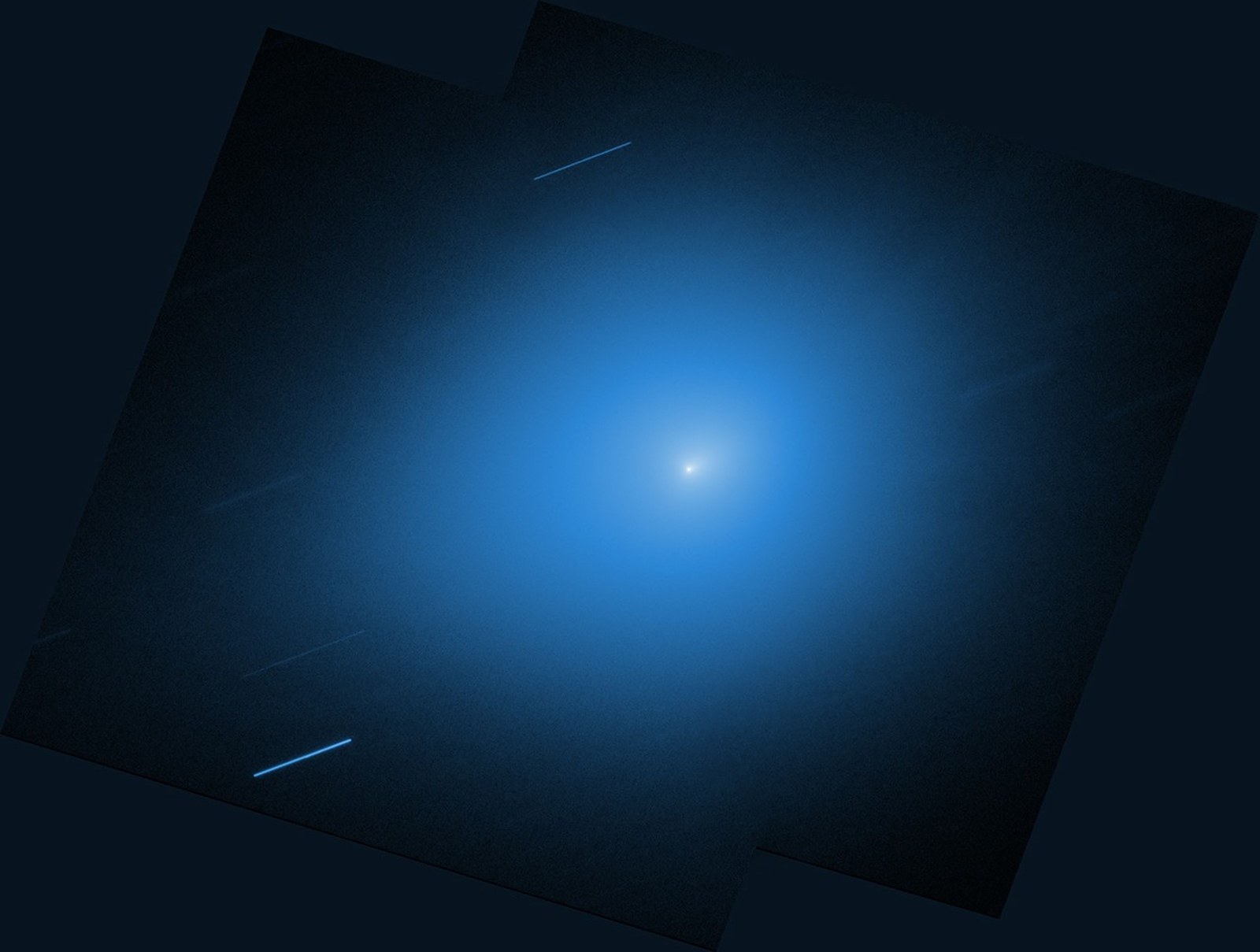
On 1 July 2025, the Asteroid Terrestrial-impact Last Alert System — ATLAS, a NASA-funded network of survey telescopes — reported a new object from its station at Río Hurtado in Chile. It was faint, fast, and moving on a path that did not belong to our Solar System. Within a day, the Minor Planet Center had confirmed it: the orbit was hyperbolic, unbound, and the object was not falling around our Sun at all. It was passing through. The announcement, MPEC 2025-N12, gave it a name that placed it in a very short list: 3I/ATLAS, also catalogued as C/2025 N1 (ATLAS). The “3I” meant it was the third confirmed interstellar object ever seen entering our Solar System, after 1I/’Oumuamua in 2017 and 2I/Borisov in 2019. Unlike the first of those visitors, this one behaved like a comet from the start — and it turned out to be older than the Sun itself.
A comet, not a mystery object
The first thing astronomers noticed about 3I/ATLAS was how normal it looked, by interstellar standards. ‘Oumuamua had arrived as a tumbling, elongated enigma with no tail and an unexplained push. 3I/ATLAS arrived with a coma — a glowing cloud of gas and dust around its nucleus — and a tail, behaving in every respect like a comet. Dozens of independent instruments observed it, and the answer from all of them was the same: it is a natural comet, formed around another star and ejected into interstellar space long ago.
That normality is what made it so valuable. A comet is a time capsule. Its ices preserve the chemistry of the place where it formed, and 3I/ATLAS formed somewhere very different from our Solar System. Its hyperbolic trajectory, with an incoming speed of about 58 kilometres per second relative to the Sun, carried it through the inner Solar System on a path that would never repeat. It came to solar conjunction — hidden behind the Sun from Earth’s point of view — on 21 October 2025, and it came closest to the Sun on 29 October 2025, at about 1.36 astronomical units, just inside the orbit of Mars. Along the way, it passed about 0.19 astronomical units — roughly 29 million kilometres — from Mars on 3 October, close enough for the orbiters and rovers at Mars to watch it go by. The ExoMars Trace Gas Orbiter, Mars Express, and the Perseverance rover all observed it, along with the JUICE probe on its way to Jupiter. It came closest to Earth on 19 December 2025, at about 1.8 astronomical units — almost twice the distance of the Sun — so it posed no threat to anyone.
Older than the Sun
The most remarkable fact about 3I/ATLAS is its age. Studies of its trajectory suggest that it likely formed around a star billions of years older than the Sun, with an age likely older than seven billion years. The Sun is about 4.6 billion years old. The comet that visited us in 2025 may have been wandering the galaxy since before our star was born, carrying ice that condensed around a star that has itself long since faded or moved on. It is, in the most literal sense, older than the world it visited.
Its chemistry tells the same story. The James Webb Space Telescope observed the comet three times between August 2025 and April 2026, bracketing the Sun pass, and its Near-Infrared Spectrograph measured water, carbon dioxide, and other volatiles in the coma. Later observations found something stranger still: the water in 3I/ATLAS contains deuterium — heavy hydrogen — at levels far above those measured in Solar System comets. ALMA and Webb measured a deuterium-to-hydrogen ratio of about 0.98 percent, far above the values typical of our own comets. Heavy water like that forms in very cold environments, and its abundance suggests that 3I/ATLAS formed in a cold, distant region of a planetary system around an old star — a place colder, and older, than anything in our own Solar System.
The comet was also shedding material at an extraordinary rate. Calculations based on reported production rates before and after perihelion indicate that 3I/ATLAS lost the equivalent of about 1.71 to 5.24 metres of its radius from gas alone during its passage through the Solar System, with dust losses adding more. It arrived as a substantial body — its solid nucleus estimated at several kilometres across, larger than ‘Oumuamua — and it left measurably smaller, its ices boiled away by a Sun that was never its own.
The claim that was not
Inevitably, 3I/ATLAS attracted the same speculation that had followed ‘Oumuamua. Within weeks of its discovery, a preprint by Hibberd, Crowl, and Loeb asked, in its title, whether the object was alien technology. The paper noted the comet’s unusually large size, its retrograde orbit, and its close passage by Mars, and suggested that the possibility of an artificial origin deserved consideration. It was a serious paper by serious authors, and it was taken seriously — and answered. Dozens of independent instruments, from Hubble to Webb to ALMA to the telescopes at Mars, observed a natural comet: a coma, a tail, carbon dioxide and water outgassing, dust, and a nucleus consistent with ice and rock. No evidence supports an artificial origin, and the consensus, from the data, is that 3I/ATLAS is what it looks like: a comet from another star system, and nothing more exotic than that.
That is worth stating plainly, because the pattern is now familiar. ‘Oumuamua was strange, and the strangeness invited speculation. 3I/ATLAS was not strange in the same way, and the speculation arrived anyway, on the strength of its size and its trajectory. The difference is that this time the observations were comprehensive, and the answer was unambiguous. The comet is natural. The mystery is not whether it is artificial, but what its chemistry can tell us about a planetary system that no longer exists, around a star billions of years older than our own.
The long goodbye
3I/ATLAS is already leaving. It is past Saturn now, moving away at more than 60 kilometres per second, and it will never come back. It will stay within reach of large ground telescopes until roughly May 2027, and from September 2027 to the end of 2028 only the largest space telescopes will be able to observe it. After that, it will be too faint for even Webb, and it will fade back into the dark between the stars, carrying with it whatever ice it has left.
The three interstellar visitors now form a small but growing family: ‘Oumuamua, the strange one; Borisov, the well-behaved comet; and 3I/ATLAS, the ancient one. Each has taught us something the others could not. ‘Oumuamua taught us that interstellar objects exist at all. Borisov taught us that they can be ordinary comets. And 3I/ATLAS taught us that they can be older than the Sun, carrying water from a colder and earlier galaxy than our own. The next visitor may be stranger still. For now, the comet of 2025 is on its way home — to a home that no longer exists, in a galaxy that keeps sending us its exiles, one at a time, for us to read.
What is documented, and what is not
Documented facts: 3I/ATLAS, also designated C/2025 N1 (ATLAS), was discovered on 1 July 2025 by the NASA-funded ATLAS survey telescope at Río Hurtado, Chile, and announced by the Minor Planet Center on 2 July 2025 (MPEC 2025-N12). It is the third confirmed interstellar object, after 1I/’Oumuamua (2017) and 2I/Borisov (2019). It follows a hyperbolic trajectory with an incoming speed of about 58 kilometres per second. It reached perihelion on 29 October 2025 at about 1.36 astronomical units from the Sun, passed about 0.19 astronomical units from Mars on 3 October 2025, and came closest to Earth on 19 December 2025 at about 1.8 astronomical units, posing no impact threat. It was observed by the Hubble Space Telescope, the James Webb Space Telescope, ALMA, ESO’s Very Large Telescope, and by missions at Mars including the ExoMars Trace Gas Orbiter, Mars Express, and Perseverance. Its age is likely older than seven billion years. Webb and ALMA measured deuterium in its water at levels far above Solar System comets, around 0.98 percent. Calculations indicate it lost the equivalent of about 1.71 to 5.24 metres of radius from gas alone during its passage. It is now receding at more than 60 kilometres per second and will remain observable by large ground telescopes until about May 2027.
Unverified or disputed claims: A 2025 preprint asked whether 3I/ATLAS could be alien technology, citing its size, retrograde orbit, and Mars flyby. No evidence supports an artificial origin; observations from dozens of independent instruments show a natural comet with a coma, tail, and cometary chemistry. The exact star system 3I/ATLAS formed around is unknown, and its age estimate — older than seven billion years — is a model-based inference from its trajectory, not a direct measurement.
Sources
- https://en.wikipedia.org/wiki/3I/ATLAS
- https://minorplanetcenter.net/mpec/K25/K25N12.html
- https://www.orbitalrecord.com/topics/solar-system/3i-atlas
- https://economictimes.indiatimes.com/news/international/us/science-in-2025-astronomers-discovered-3i/atlas-only-the-third-confirmed-interstellar-object-1-year-later-its-heavy-water-revealed-clues-to-a-cold-alien-planetary-system/articleshow/133427846.cms
- https://watchers.news/epicenter/interstellar-comet-3i-atlas-lost-meters-of-its-surface-giving-scientists-a-depth-scale-for-its-chemistry/