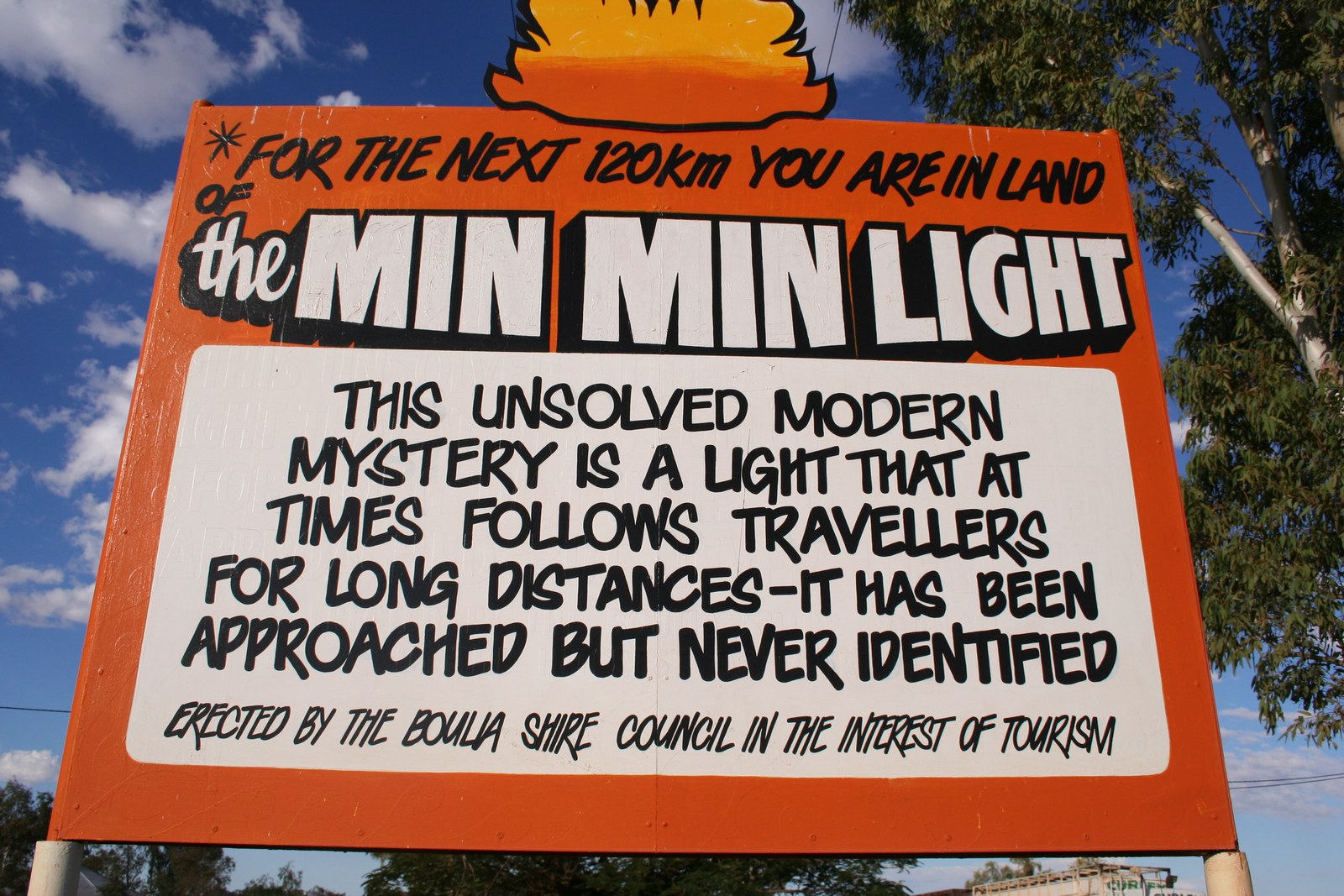
Drive west from Boulia, in the far west of Queensland, after dark, and you will pass a sign. It is orange and white, large enough to read at speed, and it says: “For the next 120 km you are in land of the Min Min Light. This unsolved modern mystery is a light that at times follows travellers for long distances — it has been approached but never identified.” It was erected by the Boulia Shire Council in the interest of tourism, and it is one of the few road signs in the world that warns you about a ghost.
The Min Min lights are glowing balls of light — white, yellow, red, blue, or green, sometimes as small as a football, sometimes as large as a watermelon — reported in the Australian outback for more than a century. They hover above the plain, move, and, most famously, seem to follow travellers, keeping pace with a horse or a car for kilometres before vanishing. They have been reported from as far south as Brewarrina in western New South Wales to as far north as Boulia in Queensland. Science has offered a strong answer for what they are. The answer does not satisfy everyone, and the lights keep being seen.
The stockman of 1918
The lights take their name from a small settlement called Min Min, about 102 kilometres east of Boulia and 273 kilometres west-south-west of Winton, in the Channel Country of western Queensland. The settlement once had a hotel on the route between Boulia and Winton. Local accounts say the hotel burned down in 1918, and that shortly afterwards a stockman travelling to Boulia was followed by a hovering light. The Boulia community’s own account repeats that core: a stockman saw the light near Min Min in 1918, and the phenomenon took the place name.
The name itself is uncertain. It could be connected to an Aboriginal language of the Cloncurry area, or it could be connected to the Min Min Hotel, where the light was observed by the stockman in 1918. Neither connection has been firmly established. What is clear is that stories about such lights appear in several Aboriginal Australian cultures, predating the European colonisation of Australia, and some Indigenous Australians hold that the number of sightings has increased alongside the arrival of Europeans in the outback. A first recorded sighting has been claimed for 1838, in the book Six Months in South Australia, though it is possible that the event described is a different phenomenon. The 1918 story, whatever its exact truth, is the starting point for the European name, and the pattern it describes — a light that appears after dark, keeps its distance, and seems to follow — is repeated in almost every account since.
The witnesses who followed were not only stockmen. Over the decades, the lights have been reported by station hands, truck drivers, and tourists, and the stories share a shape: a ball of light appears ahead or behind, moves with the traveller, sometimes approaches and sometimes retreats, and then is gone. Some accounts say the light can reduce grown men to tears. Others say it is playful. The town of Boulia, a small community in the middle of an enormous emptiness, has made the lights its own: the sign on the road in, the visitor centre, and the stories told to every traveller who stops.
The mirage that explains — almost — everything
The strongest scientific explanation comes from Professor Jack Pettigrew, a neuroscientist at the University of Queensland, who has seen the lights on a number of occasions and has written about them since 2003. Pettigrew believes the Min Min light is a Fata Morgana — a specific form of mirage caused by a stark temperature difference between layers of air, which makes remote lights or objects beyond the horizon appear visible above it, often with considerable distortion. A Fata Morgana can lift a distant light over the horizon and make it appear to float, hover, and move. In the outback, where the air is still and the temperature inversions are strong, a car headlight or a campfire tens or even hundreds of kilometres away can be refracted to an observer who cannot see the source at all.
The mirage explanation also accounts for how reports of the sightings have changed over the years. The earliest reports and Aboriginal legends describe stationary lights, which would have been refractions over the horizon of campfires. Later reports describe lights that actively move and follow travellers — which is what a refraction of car headlights over the horizon would look like, the light moving as the distant vehicle moves. Pettigrew has used geometry to show that a particular Min Min light was in fact a very bright truck headlight up to 300 kilometres away, and he has claimed to be able to create his own Min Min light under the right conditions.
It is a good explanation, and it is widely accepted as the best account of how the lights work. But it leaves questions open. It does not explain every sighting, and it does not explain why so few nights have ever been checked against the physics. The phenomenon has never been the subject of a systematic scientific survey, and the lights are, by their nature, unpredictable — they appear on some nights and not others, in a region where the nearest town can be hours away.
The other explanations
Other hypotheses have been offered. Pettigrew himself has suggested that the lights could be caused by insects swarming that have taken on bioluminescent characteristics after being contaminated by naturally occurring agents found in local fungi. Others have proposed swamp gas, fireflies, or fluorescent gas. None of these has been demonstrated, and none of them addresses the most reported feature of the lights — that they seem to follow people, keeping pace with a traveller for long distances. A mirage can appear to follow you, because the refracted light moves as you move. A swarm of insects cannot.
There is also the question of what the Aboriginal stories describe. If stories of such lights predate European settlement by centuries, then the lights cannot be only the refractions of car headlights — there were no cars. They could be refractions of campfires, which the Fata Morgana explanation allows, but the age of the stories suggests that whatever the lights are, they have been part of the landscape for far longer than the motor car. That does not make them supernatural. It makes them a natural phenomenon that people have been watching, and wondering about, for a very long time.
What is documented, and what is not
Documented facts: The Min Min light is a light phenomenon reported in outback Australia, from as far south as Brewarrina in western New South Wales to as far north as Boulia in Queensland. The lights take their name from the settlement of Min Min, about 102 kilometres east of Boulia; the origin of the name is uncertain, and may come from an Aboriginal language of the Cloncurry area or from the Min Min Hotel. Local accounts say the hotel burned down in 1918 and that shortly afterwards a stockman travelling to Boulia was followed by a hovering light. Stories about such lights appear in several Aboriginal Australian cultures, predating European colonisation. A first recorded sighting has been claimed for 1838, in the book Six Months in South Australia, though it may describe a different phenomenon. Professor Jack Pettigrew of the University of Queensland has hypothesised that the lights are a Fata Morgana — a mirage caused by temperature inversion that refracts distant lights over the horizon — and has used geometry to trace one light to a truck headlight up to 300 kilometres away. The Boulia Shire Council has erected a roadside sign describing the Min Min Light as an unsolved modern mystery.
Unverified or disputed claims: The 1918 stockman story survives as local tradition rather than as a signed contemporary statement, and neither the hotel nor the Aboriginal-language origin of the name has been firmly established. The claim that the first recorded sighting dates to 1838 is uncertain, as the event described may be a different phenomenon. The Fata Morgana explanation is widely accepted as the best account, but it has not been tested by a systematic scientific survey, and whether every sighting fits it is unknown. The insect bioluminescence hypothesis is unproven. Claims that the lights are supernatural, intelligent, or extraterrestrial have no evidential support, and reports that the lights cause memory loss or physical effects are anecdotal.