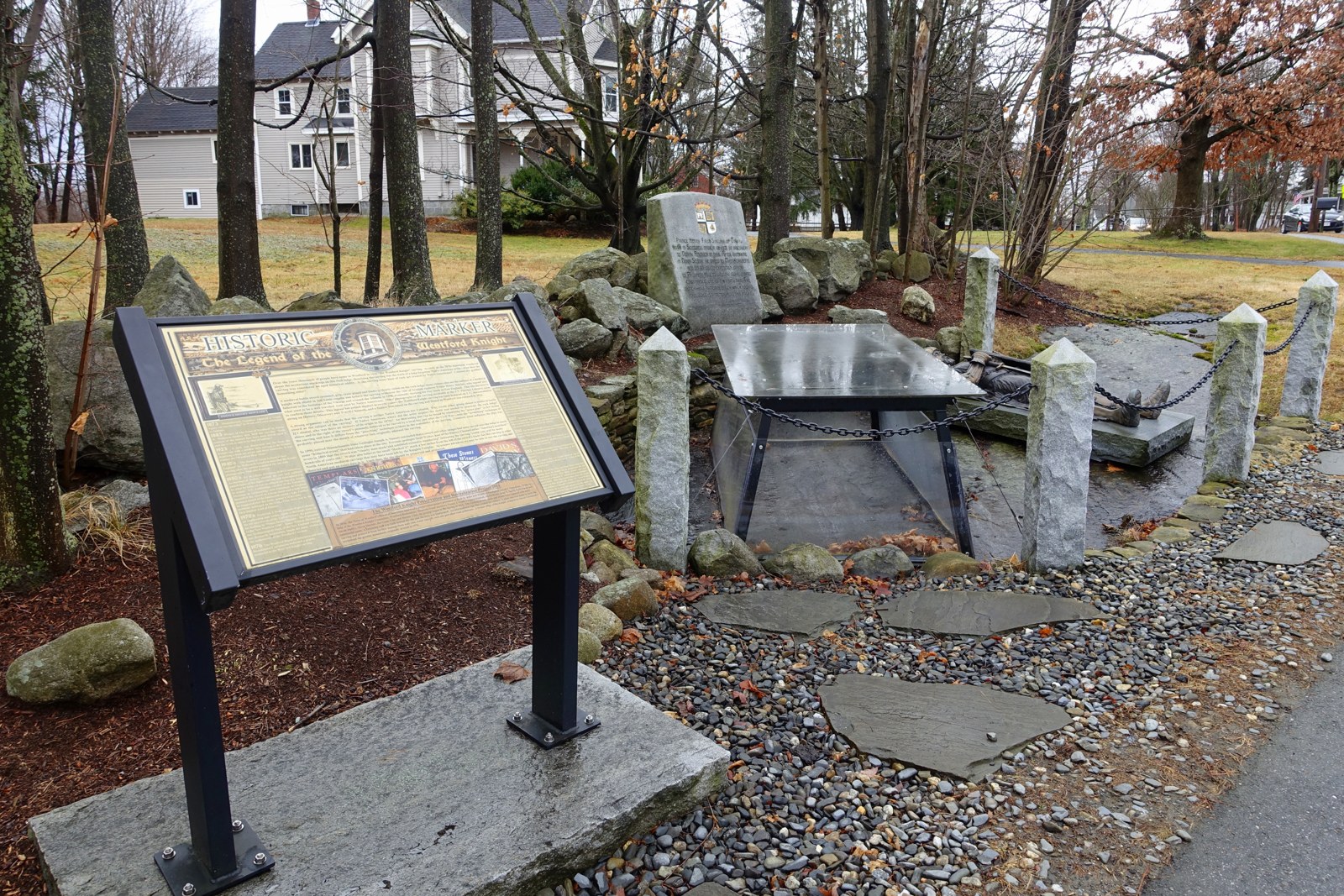
Drive along Depot Street in Westford, Massachusetts, and you will find a small fenced enclosure beside the road, an interpretive sign, a stone monument, and a low ledge of rock protected under a sheet of glass. The rock is known as the Westford Knight, or the Sinclair Rock, and for more than seventy years it has been at the centre of one of America’s most persistent historical claims: that a Scottish earl sailed to the New World in 1398, almost a century before Columbus, and that one of his knights died here and was commemorated in stone. It is a wonderful story. The question is whether the rock tells it, or whether the story was drawn onto the rock long after the fact.
The marks on the rock are faint. That is the first thing any visitor notices, and it is the heart of the whole controversy. What you see depends heavily on what you have been told to look for. Without guidance, most visitors see little more than scratches on a boulder. With guidance, some see a knight in armour, seven feet tall, wearing a helmet, carrying a shield and a sword. The gap between those two experiences is the mystery of the Westford Knight.
The First Accounts
The rock was known to local people long before anyone called it a knight. The first published account appeared in the 1870s, in Elias Nason’s Gazetteer of Massachusetts, published in 1874. Its description was modest: a broad ledge near the house of William Kitteredge bore grooves made by glaciers, and upon its surface rude outlines of a human face had been traced, the figure said to be the work of Indians. Local people knew the marking as a Native American carving, sometimes described as an “Indian smoking a pipe”. Nobody in the nineteenth century saw a medieval knight there, because nobody was looking for one.
That changed in the twentieth century. In 1946, William Goodwin, the owner of the nearby Mystery Hill attraction in New Hampshire, published a book called The Ruins of Great Ireland in New England, in which he interpreted the carving not as a human figure but as a broken Viking sword. Goodwin was part of a generation of amateur enthusiasts who believed that Europeans had reached America centuries before Columbus and left stone evidence of their presence. His reading of the rock was a stepping stone, not a destination. The knight came later.
The Knight Appears
In 1954, Frank Glynn, president of the Archaeological Society of Connecticut, located the carving and examined it with the help of T. C. Lethbridge, a British archaeologist with an interest in the same theories. Glynn chalked in a full figure on the rock, outlining what he believed he saw: a medieval knight in full armour, with sword and shield. Lethbridge suggested that the sword was not of Viking origin, as Goodwin had thought, but a hand-and-a-half wheel pommel sword of a kind common in fourteenth-century North Britain. The outline of the sword, its supporters said, had remained strong. The rest of the figure was fainter, but once chalked in, it was hard to unsee.
The identification quickly acquired a story to match it. According to its proponents, the knight was Sir James Gunn, a member of Clan Gunn and a Knight Templar, who had travelled with Prince Henry Sinclair, Earl of Orkney. Sinclair, the story goes, became interested in finding a western land after hearing a fisherman’s tale of being driven far west by storms to a temperate country. In the late 1390s, accompanied by two Venetian brothers, Nicolò and Antonio Zeno, who were experienced navigators, Sinclair sailed west. He reached Nova Scotia and New England, and sailed up the Merrimack River, where Gunn died. The carving was said to be a memorial to the fallen knight, pecked into the rock by the expedition’s armourer using one of his punches. Some accounts add that heraldic experts consulted by Lethbridge identified the arms on the knight’s shield as those of the Sinclairs of Scotland.
The theory was popularised in 1974 by Frederick J. Pohl, an American teacher and amateur historian, in his book Prince Henry Sinclair: His Expedition to the New World in 1398. Andrew Sinclair, a descendant of the earl, wrote about the site in his own books, describing a rubbing that showed a helmeted knight wearing the habit of the military orders, with his shield and sword engraved in the formal style of the late thirteenth and early fourteenth century.
The Problems With the Story
The Sinclair theory has serious difficulties, and they begin with the chronology. The Order of the Knights Templar was suppressed in 1307, publicly disbanded after the arrest of its members in France. Henry Sinclair was born around 1345, more than three decades later, and the alleged voyage took place in 1398, some ninety years after the order ceased to exist. A Knight Templar travelling with Sinclair in 1398 would have belonged to an order that had not existed for nearly a century.
The documentary evidence is no stronger. The sole source for Sinclair’s voyage is the Zeno narrative, a sixteenth-century account published some 160 years after the alleged events by a descendant of the Zeno brothers, who had every incentive to embellish his family’s history. Scholars have debated the Zeno narrative for centuries, and most regard it as unreliable as a historical record. There is no contemporary record of Sinclair’s voyage, and no unambiguous medieval European artefact has ever been found in North America from such an expedition. If Sinclair sailed to Massachusetts, he left no trace except, allegedly, this one carving.
Then there is the rock itself. David K. Schafer, a curatorial assistant for archaeology at Harvard University’s Peabody Museum of Archaeology and Ethnology, investigated the boulder and concluded that, except for the sword handle, which he accepted as a definite punch carving, the entire feature consists of naturally formed scratches caused by glaciation. The ledge is a glacial boulder, and its surface carries the parallel striations that glaciers leave as they drag stones across bedrock. The local town historian has stated that there is evidence the T-shaped inscription on the rock was made in the late nineteenth century.
What the Weathering Says
The archaeologist Kenneth Feder examined the question from a different angle in 2019, comparing the weathering on the Westford rock with the weathering on New England gravestones whose inscriptions had become indecipherable over the centuries. His conclusion was blunt: the new imagery on the Westford Knight stone either has been recently added or is entirely imaginary, and probably a bit of both. Feder argued that the Native American petroglyph described in the nineteenth century probably did exist, as did the parallel glacial striations, and that later someone used a metal rod or awl to punch the partial shape of a sword into the rock. But the full knight, in his view, was not there in the fourteenth century, nor in the nineteenth. It was created in the twentieth century, when Glynn chalked it in and the chalking guided what later visitors saw.
This is the most likely sequence, and it explains the evidence better than any other account. A glacially scratched boulder bore some faint Native American carving, described in 1873 and 1874. In the 1940s and 1950s, enthusiasts reinterpreted those marks, first as a Viking sword and then as a medieval knight, and in the process of interpreting them, they added to them. Erosion and weathering have since damaged the image further, so that later visitors have had difficulty seeing the knight without guidance. Each generation of believers has seen what the previous generation taught it to see.
Why It Endures
The Westford Knight endures because it offers something that real archaeology rarely does: a simple story with a hero, a journey and a memorial. A Scottish earl, a band of Templars, a voyage across the Atlantic a century before Columbus, a knight who died far from home and was honoured in stone — it is a tale that fits neatly into the imagination, and it flatters a particular idea of history in which Europe’s reach was longer and earlier than the textbooks allow. It also has a local anchor: a real rock, in a real town, that anyone can visit and look at. The visitor’s own eyes become the evidence, and the eyes are easily led.
The sceptical view is less romantic but more honest. The rock is a glacial boulder with natural scratches, a probable Native American petroglyph, and some later punch marks. The knight is a twentieth-century reading of those marks, not a fourteenth-century carving. The Sinclair voyage, if it happened at all, left no verifiable trace in Massachusetts. The Westford Knight is not proof of a lost expedition. It is proof of how readily we see what we want to see, and how a faint pattern on a stone can carry the weight of an entire alternative history, as long as nobody looks too closely at the stone itself.
What Is Known — and What Is Not
Documented facts: A pattern of marks on a glacial boulder in Westford, Massachusetts, was first described in print in the 1870s, in the Gazetteer of Massachusetts, as a rude figure supposed to have been cut by a Native American artist; local tradition called it an “Indian smoking a pipe”. William Goodwin reinterpreted the marks as a broken Viking sword in 1946. Frank Glynn chalked in a full medieval knight figure in 1954, after discussions with T. C. Lethbridge, who described the sword as a fourteenth-century North British type. David K. Schafer of Harvard’s Peabody Museum concluded that, apart from the sword handle, the feature consists of natural glacial scratches. Kenneth Feder’s 2019 weathering study concluded the knight imagery was recently added or imaginary. The Knights Templar were suppressed in 1307; Henry Sinclair was born around 1345, and the alleged voyage is dated to 1398.
Unverified or open to interpretation: The claim that the carving depicts Sir James Gunn, a Knight Templar who died during Prince Henry Sinclair’s 1398 expedition, is unproven and has no credibility in mainstream scholarship. The Sinclair voyage itself rests on the sixteenth-century Zeno narrative, published about 160 years after the alleged events, and is not corroborated by any contemporary record. The identification of heraldic arms on the shield as those of the Sinclairs is a claim made by proponents, not an established fact. Whether a genuine Native American petroglyph survives among the glacial scratches is plausible but not proven. A stone monument beside the rock presents the Sinclair voyage as fact; there is no evidence to support that statement.