It lasts thirty-five seconds, it is filmed in grainy black and white, and it is one of the most argued-over pieces of footage in the history of unidentified flying objects. A small white shape, oval and featureless, moves across a grey sea. The camera — the targeting pod of a Navy fighter jet — locks onto it, and the numbers on the display tick over. The aircrew can be heard reacting to what they are seeing: the object seems to be skimming the surface of the ocean at tremendous speed, too fast to be anything ordinary, too low to be anything safe. The clip is called GoFast, after the crew’s reaction to the apparent velocity of the thing in front of them. For five years it circulated as evidence of something extraordinary. Then the Pentagon confirmed that it was real. And then someone did the geometry — and the extraordinary thing turned out to be an illusion of perspective.
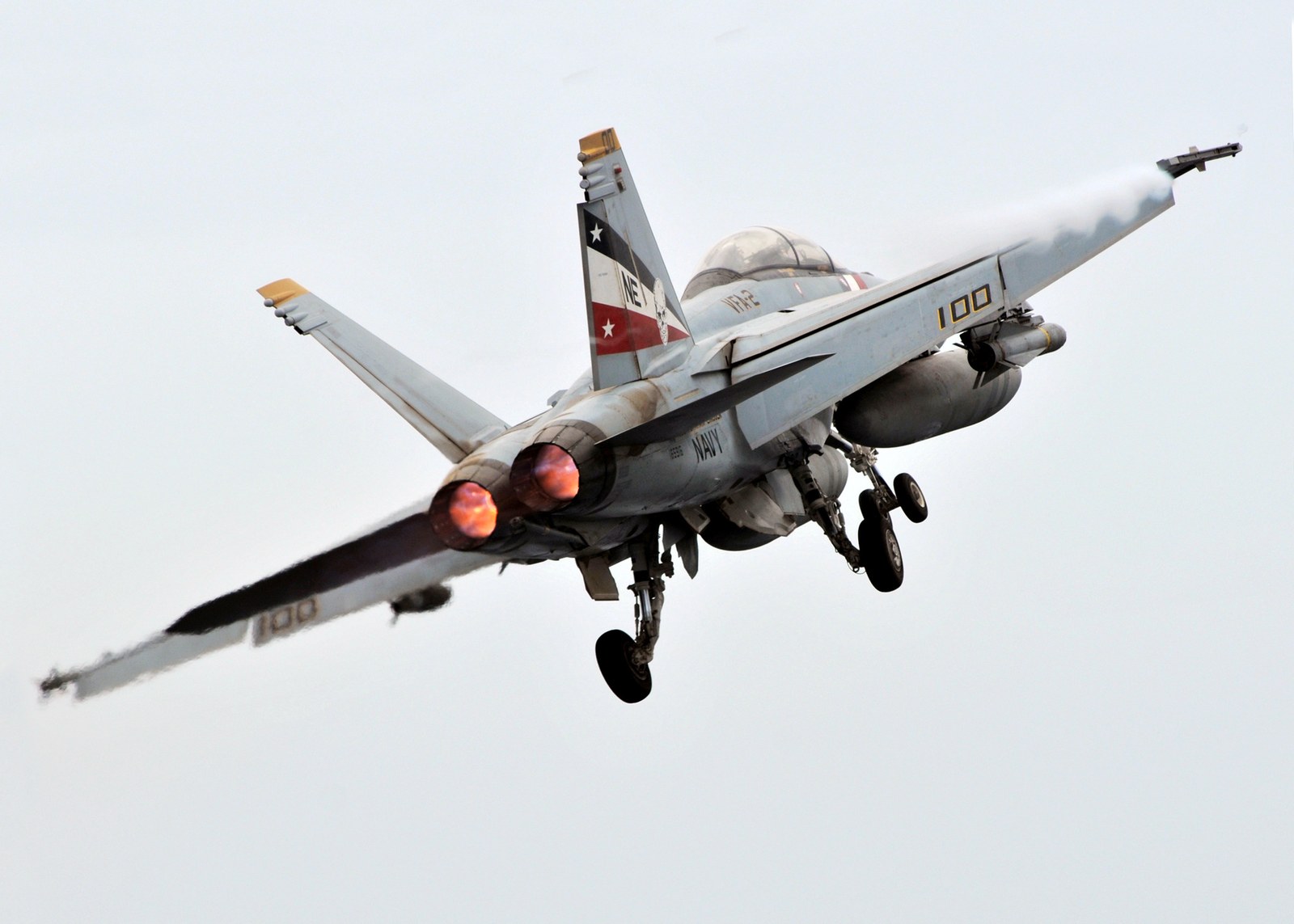
The video was recorded on 21 January 2015, by aircrew of an F/A-18F Super Hornet operating with the USS Theodore Roosevelt carrier strike group, during pre-deployment training off the east coast of the United States, in the warning area known as W-72 off Virginia Beach. The aircraft carried a Raytheon AN/ASQ-228 Advanced Targeting Forward-Looking Infrared pod — ATFLIR — a sensor that produces a magnified infrared image overlaid with targeting and navigation data. On the same day, a second aircraft recorded a second clip, nicknamed Gimbal, showing an elongated object that appeared to rotate as it moved. The two videos, together with a third clip from 2004 known as FLIR1, would become the three Pentagon UFO videos — the most famous military UAP footage ever released.
A carrier group full of unknowns
GoFast did not come out of nowhere. For nearly a year, the fighter squadrons of the Roosevelt strike group had been reporting strange objects almost daily on their upgraded radar — the Raytheon AN/APG-79 active electronically scanned array radar fitted to their Super Hornets. Pilots reported objects that appeared on radar, were seen visually, and then vanished, and one pilot reported a near-collision with an object described as a cube inside a translucent sphere. Lieutenant Ryan Graves, an F/A-18F pilot with Strike Fighter Squadron 11, took the safety case up through Navy channels, and hazard reports were filed with the Naval Safety Center. Whatever was in the training airspace, the pilots said, it was there often, and nobody knew what it was.
The videos reached the public in stages. On 16 December 2017, The New York Times published a front-page investigation revealing the existence of AATIP — the Advanced Aerospace Threat Identification Program, the classified Pentagon initiative that had studied such sightings — and published the Gimbal video for the first time. The GoFast video followed in March 2018, released by To The Stars Academy of Arts and Science, the private venture co-founded by the musician Tom DeLonge, which had obtained the clips. For more than two years, the footage circulated with its authenticity unconfirmed, argued over by believers and sceptics in equal measure.
That argument ended on 27 April 2020, when the Department of Defense formally released all three videos through the Naval Air Systems Command website. The Pentagon’s spokesperson, Sue Gough, said the release was intended “to clear up any misconceptions by the public on whether or not the footage that has been circulating was real”. It was real Navy footage, the Pentagon confirmed, and the objects in it were “unidentified aerial phenomena” that remained unidentified. The release settled the question of authenticity. It did not settle the question of what the videos showed.
What the video actually shows
The GoFast clip, watched cold, is compelling. A small white object moves from right to left across the frame, against the dark water below, and the ATFLIR display shows the targeting pod tracking it. The aircrew’s voices rise as the object appears to race along the surface. The impression is of something moving at great speed, very low over the sea, and the name the clip was given — GoFast — captures exactly what the crew thought they were seeing.
But an infrared targeting pod is not a camera in the ordinary sense, and the impression it gives can be misleading in a specific and measurable way. The pod’s display shows the world from a moving aircraft, and the apparent motion of an object in the frame is the combination of the object’s own motion and the motion of the aircraft carrying the camera. If the aircraft is moving fast and the object is moving slowly, the object can appear to race across the frame — not because it is fast, but because the camera is.
That is the argument made by Mick West, a science writer and the founder of the debunking resource Metabunk, who performed a parallax reconstruction of the GoFast footage using the pod’s own on-screen telemetry — the altitude, the range, the angles, all of which are printed on the display. West’s analysis suggested that the object was very likely slow-moving, perhaps thirty to forty knots, at an altitude of roughly 13,000 feet, and that its dramatic apparent speed was an artifact of the much faster-moving camera platform sweeping past it. At that speed and altitude, the object was consistent with something entirely ordinary: a balloon, or a bird.
The Pentagon’s own investigative office reached a similar conclusion. In 2024 and 2025, the All-domain Anomaly Resolution Office — AARO, the office created to investigate UAP reports — concluded that the GoFast object’s apparent speed was an artifact of parallax, endorsing a version of West’s reading in its own review. The object, in AARO’s assessment, was not moving fast at all. It only looked fast, because the jet that filmed it was.
What remains unresolved
The parallax explanation does not close the book on the Roosevelt encounters, and it is important to say why. GoFast is one clip, thirty-five seconds long, from a year in which pilots reported objects almost daily. The Gimbal video, recorded on the same day, has not been resolved in the same way: AARO has not published a resolution of it, and while sceptics argue that its apparent rotation is consistent with rotating infrared glare from a distant jet engine, proponents of an anomalous reading continue to dispute that. The radar returns, the visual sightings, the near-collision, the hazard reports — none of these is explained by the parallax analysis of a single video, because the parallax analysis was never meant to explain them. It was meant to explain one clip.
The Roosevelt encounters became core exhibits in the Office of the Director of National Intelligence’s preliminary assessment of June 2021, which reviewed 144 UAP reports and left 143 of them unexplained, and in the subsequent creation of AARO itself. Lieutenant Graves testified before Congress in July 2023 that the objects were real and unexplained, and that the pilots who saw them deserved to be taken seriously. He was right about the second part, whatever the first part turns out to mean. The pilots saw something, repeatedly, in controlled airspace, and the fact that one video of it can be explained by geometry does not explain the rest.
GoFast is, in the end, a lesson in how evidence works — and in how it fails. A video can be genuine, officially released, and confirmed by the Pentagon, and still show something other than what it appears to show. A camera on a fast jet makes a slow balloon look like a missile. A targeting pod’s display, read without its geometry, makes a bird look like a craft from another world. The clip is real. The speed is not. And the distance between those two facts is where the whole modern UAP debate lives: in the gap between what the footage seems to show and what the numbers say it shows, a gap that neither side has yet managed to close.
What is documented, and what is not
Documented facts: On 21 January 2015, F/A-18F Super Hornet aircrew operating with the USS Theodore Roosevelt carrier strike group recorded two infrared videos, Gimbal and GoFast, using the Raytheon AN/ASQ-228 ATFLIR targeting pod, during training off the United States East Coast in warning area W-72. The GoFast clip is about 35 seconds long and shows a small white object apparently moving at high speed low over the ocean. The Gimbal video was first published by The New York Times on 16 December 2017, alongside reporting that revealed the Pentagon’s AATIP programme; the GoFast video was released in March 2018 by To The Stars Academy. On 27 April 2020 the Department of Defense formally released all three videos — FLIR1, Gimbal and GoFast — confirming they were real Navy footage and describing the objects as unidentified aerial phenomena. Pilots including Lieutenant Ryan Graves reported near-daily encounters in the same period, filed hazard reports with the Naval Safety Center, and Graves testified before Congress in July 2023. A parallax analysis by Mick West, using the pod’s on-screen telemetry, concluded the GoFast object was likely moving at only about 30 to 40 knots at roughly 13,000 feet, consistent with a balloon or a bird; in 2024–2025 the Pentagon’s All-domain Anomaly Resolution Office endorsed this reading for GoFast. The June 2021 ODNI preliminary assessment reviewed 144 UAP reports and left 143 unexplained.
Unverified or disputed claims: That the GoFast object was an anomalous craft — the parallax analysis and AARO’s assessment indicate its apparent speed was an artifact of the camera platform’s motion, not of the object itself. That the Gimbal video shows a rotating craft — sceptics argue the rotation is consistent with infrared glare, while others dispute this; AARO has not published a resolution. That the Roosevelt encounter cluster as a whole has a single explanation — the radar returns, visual sightings and near-collision reports have not been resolved by the analysis of any single video.