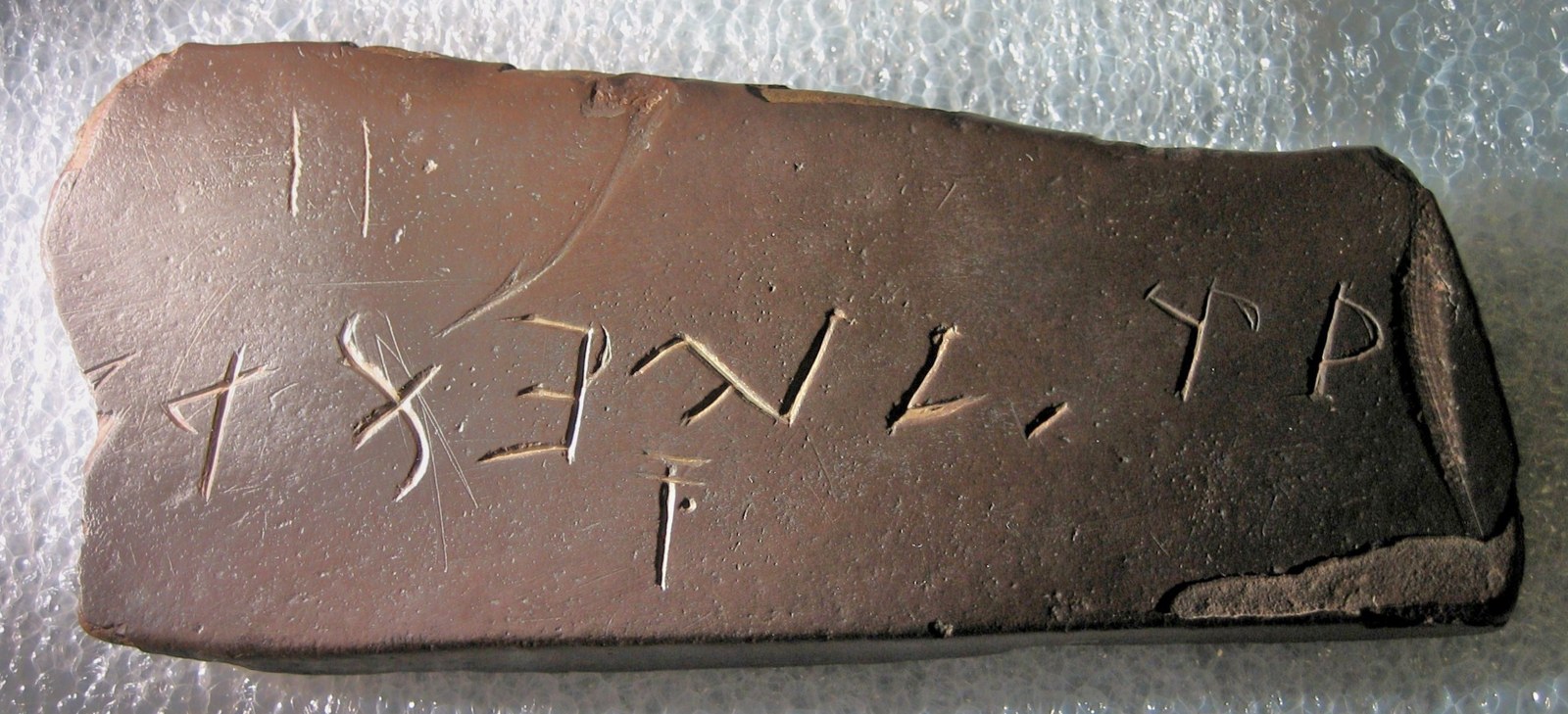
In February 1889, a field assistant named John W. Emmert was digging into a burial mound on Bat Creek, a tributary of the Little Tennessee River in Loudon County, Tennessee, when his trowel struck something unusual. Under the skull of a skeleton, in a mound being excavated for the Smithsonian Institution, lay a small stone tablet bearing a short line of incised characters. Nobody on the expedition could read them. More than a century later, nobody agrees on what they are. The Bat Creek Stone has been called Cherokee writing, ancient Hebrew, and a clumsy nineteenth-century forgery, and each of those readings has had its champions. The stone itself has not changed. What has changed is what people wanted it to say.
The excavation was part of the Smithsonian’s Mound Survey, a project run by the Bureau of Ethnology to settle a fierce nineteenth-century argument: who had built the great earthen mounds of the American Midwest and South? One side argued that the mounds were the work of a vanished, non-Native race, the so-called Mound Builders. The other side, led by the survey’s director, Cyrus Thomas, argued that the mounds had been built by the ancestors of the Native peoples then living in the region. Thomas was an entomologist by training, not an archaeologist, and he did not dig the mounds himself. He delegated the work to assistants, and Emmert was the man on the ground at Bat Creek.
A Stone Under a Skull
Emmert was working alone when he found the stone, a fact that would later become central to the controversy. He reported it to Thomas, who published it in his official report on the mound explorations in 1894, in the Twelfth Annual Report of the Bureau of Ethnology. Thomas declared that the marks on the stone were “beyond question letters of the Cherokee alphabet”, the syllabary invented by the Cherokee silversmith Sequoyah in the early nineteenth century. He did not, however, offer a translation of the inscription. No one has ever produced a convincing Cherokee reading of the marks, and the match to the Cherokee syllabary is no better than a match to English letters chosen at random.
The stone was found with other objects that complicated the picture from the start. Two brass bracelets lay with the same burial, and later analysis dated those bracelets to the eighteenth or nineteenth century — far too late for an ancient burial. That alone should have raised doubts about the context. A burial containing modern brass is not an undisturbed ancient grave. But the stone was briefly displayed as a minor curiosity, then put into storage, and for the next seventy years almost nobody paid it any attention. It sat in a drawer while the argument it would one day provoke gathered force elsewhere.
The Hebrew Reading
The stone came back to life in 1970, when the Semitic languages scholar Cyrus Gordon of Brandeis University looked at a photograph of it and noticed something Thomas had missed. If the stone was turned upside down from the orientation in which Thomas had published it, the characters looked like Paleo-Hebrew, the early form of the Hebrew alphabet used in the first and second centuries AD. Gordon read the inscription as “for Judah”, and dated it on linguistic grounds to between about AD 70 and 135. Another scholar, Robert Stieglitz, confirmed Gordon’s reading of the longer word. In 1988, radiocarbon dating of wood fragments found with the stone returned a range of AD 32 to 769, which its supporters presented as consistent with an ancient date.
Gordon’s reading electrified a particular audience. If the stone was genuinely ancient Hebrew, then someone from the Old World had reached Tennessee more than a thousand years before Columbus, and the conventional history of the Americas was wrong. Gordon himself had long argued for transatlantic contact between the ancient Mediterranean world and pre-Columbian America, and the Bat Creek Stone seemed to be the proof he had been waiting for. Books and articles followed, and the stone became a favourite piece of evidence for writers who believed in lost tribes, early Hebrew migrations and a hidden history of America.
But there were problems with the Hebrew reading too. Gordon himself acknowledged difficulties with three of the inscribed characters, which did not fit the Paleo-Hebrew alphabet cleanly. The radiocarbon date applied to wood fragments found with the stone, not to the stone itself, and wood can be old or young for reasons that have nothing to do with the object buried beside it. And the circumstances of the find — a lone excavator, a burial containing modern brass, a director who had already published the stone as Cherokee — were exactly the circumstances in which a forgery could be planted and never detected.
The Forgery Case
The case against the stone was built patiently, over decades, by the archaeologists Robert C. Mainfort Jr. and Mary L. Kwas. In a series of papers in the 1990s, they argued that the find itself was suspect, and presented evidence suggesting that Thomas and his contemporaries had recognised the stone as a fraud by the end of the nineteenth century. Thomas’s own later publications, they showed, quietly dropped the stone, and by 1898 he had probably concluded that it was forged. He never said so publicly, and Mainfort and Kwas suggested a reason: he and the Smithsonian had placed themselves in a position where they could not afford to pronounce the Bat Creek Stone a forgery after publishing it.
The decisive blow, if it was one, came in 2004. Mainfort and Kwas demonstrated that the text on the stone had been copied from an illustration in an 1870 book on Freemasonry, Robert Macoy’s General History, Cyclopedia, and Dictionary of Freemasonry, page 169. The illustration was an artist’s impression of how the biblical phrase “Holiness to the Lord” would be written in Paleo-Hebrew, based on the lettering of ancient Jewish coins. The letters on the Bat Creek Stone match that illustration almost exactly. The conclusion was plain: the forger had used the Masonic book as a source, and the stone was a nineteenth-century fake.
Who made it? The most likely suspect is Emmert himself. The general conclusion of the forgery case is that Emmert carved the inscription in order to impress Thomas and secure permanent employment on the Mound Survey. Another suggestion, offered by some writers, is that Emmert was set up by a political opponent who hoped he would be discredited when the inscription was exposed. Either way, the stone’s origin points back to the Smithsonian’s own dig, not to an ancient Hebrew visitor.
The Defence
The stone still has defenders, and their arguments deserve a fair hearing. J. Huston McCulloch, who has studied the stone in detail, points out that the match to the Masonic illustration is not perfect. In Macoy’s book, the two words of the phrase are separated by a space, as in English or modern Hebrew. On the Bat Creek Stone, the words are separated by a word divider, a short mark between words, which is the correct practice in ancient Hebrew inscriptions. McCulloch argues that there is no way this subtle detail could have been copied from Macoy’s illustration, since the illustrator got it wrong. He also notes that the Masonic illustration shows that the stone’s affinity to Paleo-Hebrew should have been recognised in 1889 by any competent student of antiquities, and finds it strange that Thomas and other archaeologists failed to see it for eighty years.
What the Stone Teaches
The Bat Creek Stone is kept today by the Smithsonian as part of its collection of archaeological frauds, a quiet end for an object that once promised to rewrite American history. Its story is not really about ancient Hebrew sailors or lost tribes. It is about how archaeology works, and how it fails. A single object, found by one man working alone, was published by a director who needed it to say something it did not say. It was then ignored for decades, rediscovered by a scholar who needed it to say something else, and finally traced to a book that had been sitting on library shelves all along.
The stone also illustrates a pattern that runs through this whole series of mysteries. An extraordinary claim needs extraordinary evidence, and the Bat Creek Stone never had it. Its context was compromised from the moment it was found. Its first reading was wrong. Its second reading depended on turning it upside down. Its defenders have one good detail, the word divider, and its critics have a printed source that explains almost everything else. That is not a mystery with two equal sides. It is a forgery with a lingering question mark, and the question mark is smaller than the stone’s supporters would like it to be.
What Is Known — and What Is Not
Documented facts: The Bat Creek Stone was excavated in February 1889 by John W. Emmert, working alone for the Smithsonian’s Mound Survey under Cyrus Thomas, from a burial mound on Bat Creek in Loudon County, Tennessee. Thomas published it in 1894, in the Twelfth Annual Report of the Bureau of Ethnology, declaring the marks “beyond question letters of the Cherokee alphabet”, without offering a translation. Two brass bracelets found with the same burial were later dated to the eighteenth or nineteenth century. In 1970, Cyrus Gordon of Brandeis University argued that the inscription, inverted from Thomas’s orientation, read as Paleo-Hebrew, “for Judah”. In 2004, Robert C. Mainfort Jr. and Mary L. Kwas showed that the inscription closely matches an illustration in Robert Macoy’s 1870 General History, Cyclopedia, and Dictionary of Freemasonry. The Smithsonian retains the stone as part of its collection of archaeological frauds.
Unverified or open to interpretation: The claim that the inscription is genuine ancient Paleo-Hebrew is not accepted by mainstream archaeology. The radiocarbon range of AD 32 to 769 applies to wood fragments found with the stone, not to the stone itself, and does not prove the inscription is ancient. The suggestion that Emmert forged the stone to impress Thomas and secure employment is the leading explanation, not a proven fact; an alternative suggestion is that he was set up by a political opponent. The word divider on the stone, which differs from the Masonic illustration, is a genuine detail cited by defenders of authenticity, but it does not outweigh the other evidence for most scholars. No Cherokee reading of the inscription has ever been proposed.