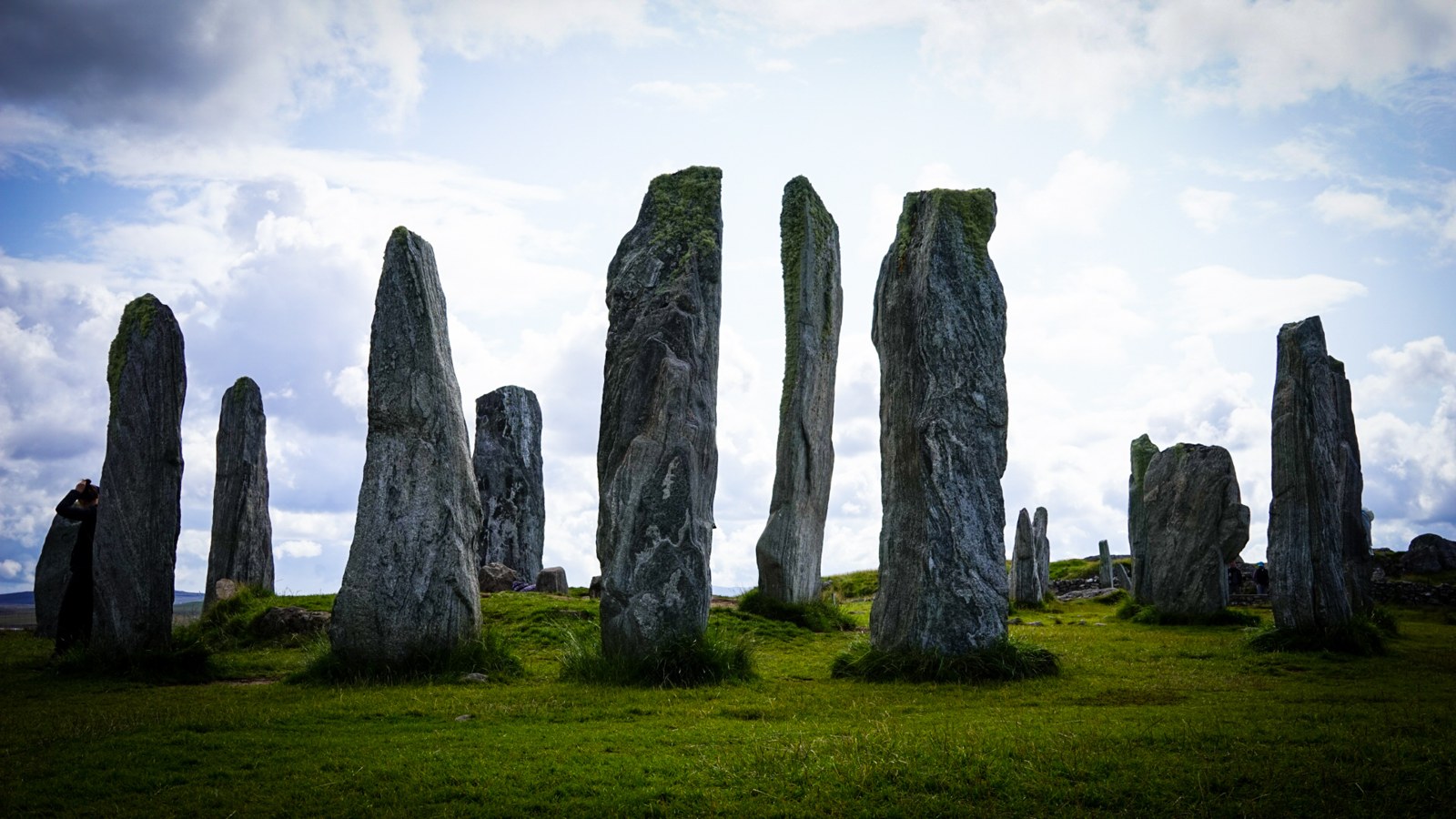
Stand on the low ridge above Loch Roag on the west coast of the Isle of Lewis, in Scotland’s Outer Hebrides, and the first thing you notice is the wind. It comes off the Atlantic without interruption, bending the grass and carrying the smell of salt and peat. The second thing you notice is the stones. Fifty or so great slabs of grey rock stand in a cross-shaped pattern on the ridge, some of them nearly five metres tall, their surfaces banded and weathered by five thousand years of Hebridean weather. This is Callanish, known in Gaelic as Calanais, and it is one of the most impressive Neolithic monuments in Britain. It is also, if the astronomers are right, one of the oldest observatories in the world.
The stones are made of Lewisian gneiss, a metamorphic rock that forms much of the Outer Hebrides and is among the oldest rock in Britain, formed billions of years ago deep in the Earth’s crust. The builders did not import their material. They quarried it locally, shaped it roughly, and raised it on the ridge with whatever ropes, levers and manpower a Neolithic community could muster. The result has outlasted every building its makers ever lived in, and every other trace of their daily lives.
A Cross in Stone
The monument archaeologists call Calanais I is arranged as a circle with lines of stones radiating from it. At its heart is a circle of thirteen stones, about 11.4 metres across, surrounding a central monolith that stands 4.8 metres high, roughly sixteen feet, and about 0.8 metres west of the true centre of the circle. From the circle, rows of stones run out in four directions, forming a rough cross when seen from above: a long avenue to the north, and shorter arms to the east, west and south. The northern avenue is the longest, and it is the avenue that matters most for the monument’s famous alignment.
The circle was set up between about 2900 and 2600 BCE, in the late Neolithic period, according to excavations carried out by the archaeologist Patrick Ashmore in 1980 and 1981. That makes the stones older than the great sarsen circle at Stonehenge, which was raised around 2500 BCE, though the first earthwork enclosure at Stonehenge was built around 3000 BCE, so comparisons of age depend on which phase of each monument is meant. Some time after the circle was raised, a small chambered tomb, 6.4 metres long, was inserted into its eastern part, squeezed between the eastern stones and the central monolith. Pottery fragments found in the tomb show that it was used for several centuries.
The site remained a focus for ritual activity for a very long time. Historic Environment Scotland, which cares for the monument, notes that it was used for ceremonial purposes for at least two thousand years, through the Neolithic and into the Bronze Age. Around 1500 to 1000 BCE the complex fell out of use, and the tomb was looted in the Bronze Age. Peat then slowly covered the lower parts of the stones, until in 1857 the landowner, Sir James Matheson, ordered peat up to 1.5 metres deep to be cleared away, revealing the chambered tomb and the true height of the stones. The monument was taken into state care in 1885 and is now a scheduled monument in the care of Historic Environment Scotland, with a visitor centre run by the community trust Urras nan Tursachan.
The Moon’s Long Cycle
Callanish is famous for one alignment above all others: the moon. Every 18.6 years, the moon reaches the extreme limits of where it rises and sets on the horizon, an event called the major lunar standstill. The moon’s orbit is tilted by about five degrees to the path the sun follows across the sky, and the direction of that tilt turns slowly, completing a full turn every 18.6 years. At the extremes of that cycle, the moon rises and sets at its furthest north and south, and from Callanish, seen from the northern end of the avenue during a standstill, the southern moon barely clears the hills before setting again. It appears to skim low along the ridge of hills to the south, a range known in Gaelic as Cailleach na Mòinteach, the Old Woman of the Moors, and in English as the Sleeping Beauty, because its outline resembles a woman lying on her back. At a major standstill, the moon appears to rise from that outline, travel along it, and shine into the centre of the circle.
The alignment was first argued in detail by the engineer Alexander Thom, who surveyed Callanish and other Scottish megaliths in the 1960s and 1970s and claimed that sites such as this one were precise lunar observatories. Patrick Ashmore, who excavated the site, suggested that the alignment was deliberate, and that people able to predict the standstill would have gained authority within their community. To predict an event that comes only once every eighteen and a half years requires watching the sky for longer than a single lifetime. It requires records, memory and institutions that can pass knowledge from one generation to the next. If the builders of Callanish did that, they were astronomers in a serious sense, whatever else they were.
The most recent major lunar standstill peaked in late 2024 and early 2025, and the next is expected around 2043. The effect is visible for many months on either side of the peak, not only on a single night, which means that the standstill was a season rather than a moment, a period of months in which the moon behaved in a way it would not behave again for nearly two decades. That long visibility makes the alignment easier to observe and harder to dismiss as coincidence, though the debate about Thom’s claims has never fully ended.
What We Do Not Know
For all its fame, Callanish keeps its secrets. We do not know the names of its builders, or what they called the place, or what ceremonies they performed among the stones. We do not know whether the lunar alignment was the monument’s purpose from the beginning, or whether it emerged later as the site was extended and the northern avenue was added. The chambered tomb came later still, which means the monument was not built to a single plan but grew and changed over centuries, as each generation added to what the last had left.
The folklore that clings to the stones is younger than the monument by millennia, but it is part of the site’s story. Local tradition says the stones were once giants who refused to convert to Christianity and were turned to stone by Saint Kieran, and that at sunrise on midsummer morning the “Shining One” walks along the avenue. None of this can be verified, and none of it needs to be true to be worth recording.
The wider landscape matters too. Callanish is the central site in a landscape of more than twenty prehistoric monuments on Lewis, including smaller stone circles nearby, known as Calanais II and III, and standing stones scattered across the moor. The people who built Callanish did not raise a single monument in isolation. They marked a whole landscape, and Callanish was its centre. That landscape is still there, and it is still possible to walk from one monument to another across the same moorland the builders walked, though the peat, the wind and the weather have changed less than the world around them.
A Place That Rewards Patience
There is something fitting about a monument whose most famous event comes only once every eighteen and a half years. Callanish does not reward a quick visit. Its stones are impressive in any weather, but the alignment that made it famous is a slow event, a matter of months and seasons rather than a single sunset. The builders, if they watched the moon as Thom and Ashmore believed, were patient people. They watched a cycle longer than a childhood, and they built in stone so that the watching could continue after they were gone.
That patience is the real lesson of Callanish. Five thousand years ago, on a treeless island at the edge of the Atlantic, a small community raised stones that still stand, aligned them with a cycle of the moon that takes nearly two decades to complete, and used the place for ceremonies for two thousand years. We do not know their language, their gods or their names. We know they looked up, and they remembered what they saw, and they built something that would let their grandchildren look up in the same way. The stones are still there. The moon still comes back. The rest is silence, and the silence is part of the monument.
What Is Known — and What Is Not
Documented facts: The Callanish Stones, or Calanais I, stand on a low ridge above Loch Roag on the west coast of the Isle of Lewis in the Outer Hebrides. The central circle of thirteen stones, about 11.4 metres across, with a central monolith 4.8 metres high, was set up between about 2900 and 2600 BCE, according to excavations by Patrick Ashmore in 1980 and 1981. The stones are local Lewisian gneiss, and the monument is cross-shaped, with a long northern avenue and shorter arms. A chambered tomb 6.4 metres long was inserted into the eastern part of the circle some time after it was built and was used for several centuries. Peat up to 1.5 metres deep was cleared in 1857 on the orders of Sir James Matheson, revealing the tomb and the true height of the stones. The site was taken into state care in 1885 and is now in the care of Historic Environment Scotland. The major lunar standstill recurs every 18.6 years; the most recent peak fell in late 2024 and early 2025.
Unverified or open to interpretation: That the monument was deliberately designed as a lunar observatory is the leading interpretation, advanced by Alexander Thom and supported by Ashmore, but the precise intentions of the builders are unknown, and it is not clear whether the alignments were built at the same time as the circle or added later. The purpose of the ceremonies held at the site, and the meaning of the monument to its builders, are unknown. Local folklore, including the story of giants turned to stone and the “Shining One” walking the avenue at midsummer, is tradition, not documented history. Claims about the exact number of stones in the whole complex vary, at around fifty, because some stones are fallen or fragmentary.
Sources
- https://en.wikipedia.org/w/index.php?title=Callanish_Stones&oldid=1375820865
- https://www.connollycove.com/the-callanish-stones/
- https://www.connollycove.com/callanish-stones-scotlands/
- https://www.stonebothering.com/2025/09/callanish-stones-scotland.html
- https://portal.historicenvironment.scot/apex/f?p=1505:300:::::VIEWTYPE,VIEWREF:designation,SM90054
- https://commons.wikimedia.org/wiki/File:Neolithic_Callanish_Stones.jpg