On 27 December 2024, a telescope in Chile spotted a faint moving dot against the stars. The telescope belonged to ATLAS — the Asteroid Terrestrial-impact Last Alert System, a NASA-funded network built to give warning of exactly this kind of object — and the dot was an asteroid, 40 to 90 metres across, on an orbit that brought it near the Earth. It was given the catalogue name 2024 YR4, and at first it looked like one more entry in a long list: a near-Earth asteroid, a little larger than most, on a four-year orbit around the Sun, which had already passed close to Earth two days earlier, on Christmas Day 2024, at a distance of about 830,000 kilometres. Nothing to worry about. Then the astronomers calculated where it would be on 22 December 2032, and the story changed.
The chance that 2024 YR4 would strike the Earth on that date, the calculations said, was about 3 per cent. Three in a hundred. For an asteroid, that is an enormous number. Most newly discovered near-Earth objects carry impact probabilities measured in fractions of a per cent, and those probabilities fall to zero within days as more observations come in. A probability of 3 per cent, persisting for weeks, was something else entirely. In February 2025, 2024 YR4 was raised to level 3 on the Torino Scale — the scale astronomers use to communicate impact risk to the public — the highest rating given to any asteroid since Apophis reached level 4 in 2004. The world, briefly, had a date with a rock. And then, as so often happens with asteroids, the telescopes kept watching, and the date went away.
What the Torino Scale actually means
To understand the scare, it helps to understand the scale. The Torino Scale, proposed in the late 1990s and presented at a conference in Turin, Italy, in 1999, runs from 0 to 10 and combines two things: how likely an impact is, and how much damage it would do. Level 0 is “no hazard”. Level 1 is “normal” — a routine discovery, meriting no public concern. Level 3, where 2024 YR4 briefly sat, is labelled “meriting attention by astronomers”: a close encounter, with a chance of impact of 1 per cent or greater, capable of localised destruction. It is not a prediction. It is a flag, raised so that telescopes keep watching and the orbit gets measured properly.
The Torino number captures public attention, but specialists use a different scale — the Palermo Scale, a logarithmic working tool that compares an object’s risk to the background risk from objects of the same size. On the Palermo Scale, 2024 YR4 ranked lower than some earlier cases, mostly because it was relatively small. Even at its worst moment, the risk was modest next to the natural background for objects of that size. A 40-to-90-metre asteroid, if it struck, would cause localised destruction — the flattening of a city, or a crater in the countryside — but not a global catastrophe. The 2013 Chelyabinsk meteor, which injured more than a thousand people in Russia, was about 20 metres across. The Tunguska event of 1908, which flattened 2,000 square kilometres of Siberian forest, was caused by an object of perhaps 50 to 60 metres. 2024 YR4 was in that class: dangerous to a region, not to the world.
The six-week scare
The scare lasted, in its acute form, about six weeks. In January 2025, as observations accumulated, the estimated chance of an Earth impact on 22 December 2032 climbed, peaking at about 3 per cent in early February. The asteroid was one of the most closely watched objects in the sky, with telescopes around the world — and the James Webb Space Telescope, the most powerful telescope ever flown — tracking it to refine its orbit. On 20 February, the Torino rating fell to level 1. On 24 February, NASA announced that the asteroid posed no significant threat to Earth in 2032 or beyond, and the rating returned to 0. The probability of an Earth impact, as listed by NASA’s Center for Near-Earth Object Studies, fell to about 0.005 per cent — one in twenty thousand — and kept falling. The Earth was safe.
But the story was not quite over. As the Earth risk collapsed, a second risk appeared: the Moon. In April 2025, calculations showed that 2024 YR4 had a roughly 3.8 per cent chance of striking the Moon on the same date, 22 December 2032. A lunar impact would not have threatened anyone on Earth directly — the Moon has no atmosphere to protect, and no one living on it — but it would have been a spectacular event, throwing up a crater and a cloud of debris, and astronomers took it seriously. For almost a year, the Moon question remained open, waiting for better data.
That data came from the James Webb Space Telescope. Using observations collected on 18 and 26 February 2026, scientists at NASA’s Jet Propulsion Laboratory, working with a team led by Andy Rivkin at the Johns Hopkins University Applied Physics Laboratory, refined the asteroid’s orbit with centimetre-level precision — a measurement that would normally have taken until 2028, achieved two years ahead of schedule. On 5 March 2026, NASA announced the result: 2024 YR4 will not strike the Moon in 2032. It will pass the lunar surface at a distance of about 21,200 kilometres. The last risk was gone.
What we learned from a rock
The JWST observations did more than settle the orbit. Measurements of the asteroid’s mid-infrared thermal emission, gathered by Webb on 26 March 2025, refined its size to between 53 and 67 metres — roughly fifteen to twenty storeys high. That is smaller than the upper end of the first estimates, and it matters, because the damage an asteroid can do scales steeply with its size. A 60-metre rock is a serious object. It is not a civilisation-ender. It is the kind of object that planetary defence is built for — and the kind that, as it happens, we now know how to move.
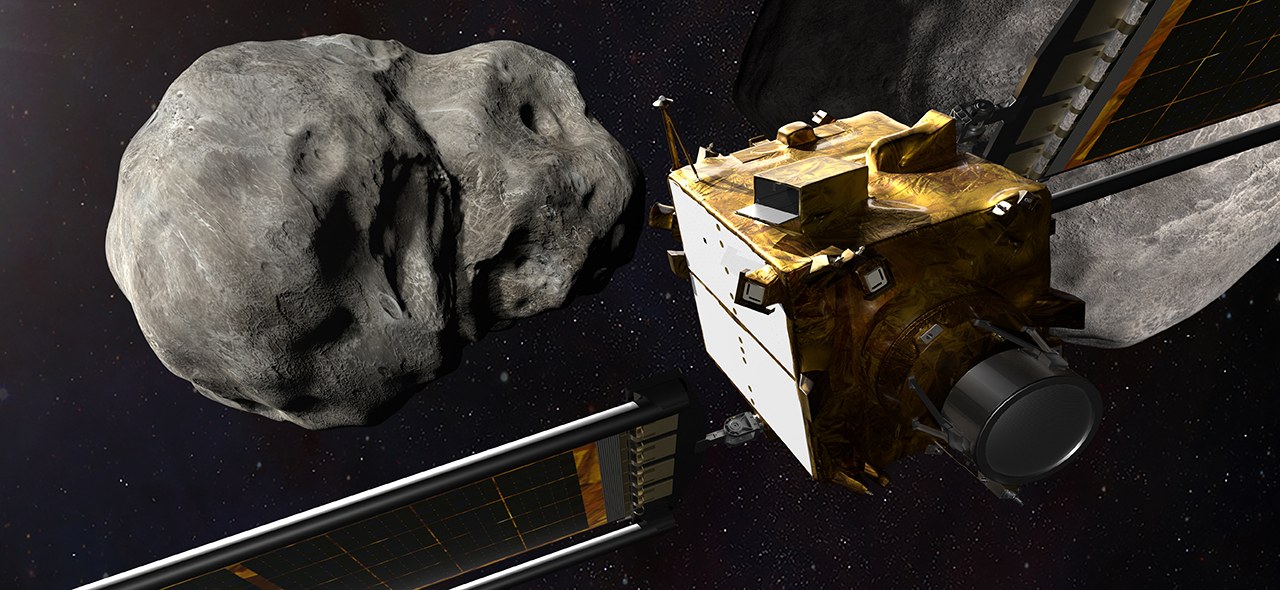
That last point is the real legacy of 2024 YR4. In 2022, NASA’s DART mission — the Double Asteroid Redirection Test — slammed a spacecraft into the asteroid Dimorphos and changed its orbit, proving that a kinetic impactor can deflect a threatening object. 2024 YR4 never needed deflecting, but the fact that we could have deflected it, had the odds not collapsed on their own, changed the character of the scare. For the first time in history, a Torino level 3 asteroid arrived in an era when humanity had a tested method for dealing with one. The scare was real, the risk was real, and the response was ready.
As of late 2026, NASA’s published assessment is unchanged: 2024 YR4 poses no significant impact risk to Earth in 2032 or beyond, and it will not strike the Moon. The asteroid will keep coming back every four years, and astronomers will keep watching it, because that is what they do with objects that once reached level 3. But the date that briefly frightened the world — 22 December 2032 — is now just a date on which a small rock will pass by, at a safe distance, and carry on into the dark.
What is documented, and what is not
Documented facts: Asteroid 2024 YR4 was discovered on 27 December 2024 by the NASA-funded ATLAS survey telescope in Chile. It is about 53 to 67 metres across, by James Webb Space Telescope measurements, and completes an orbit around the Sun roughly every four years. It passed close to Earth on 25 December 2024 at about 830,000 kilometres. In early 2025 its estimated chance of striking Earth on 22 December 2032 peaked at about 3 per cent, and it was raised to level 3 on the Torino Scale — the highest rating for any asteroid since Apophis reached level 4 in 2004. On 20 February 2025 the rating fell to level 1, and on 24 February 2025 NASA announced the asteroid posed no significant Earth-impact threat in 2032 or beyond; the rating returned to level 0, with an Earth impact probability of about 0.005 per cent. A chance of a lunar impact, estimated at about 3.8 per cent in April 2025, was ruled out on 5 March 2026, when NASA announced, using JWST observations from 18 and 26 February 2026, that the asteroid will pass about 21,200 kilometres from the Moon. As of late 2026, NASA’s published assessment is that 2024 YR4 poses no significant impact risk to Earth in 2032 or beyond. NASA’s DART mission in 2022 demonstrated that a kinetic impactor can change an asteroid’s orbit.
Unverified or disputed claims: Any claim that 2024 YR4 will strike the Earth or the Moon in 2032 — both possibilities have been ruled out by NASA on the basis of refined orbital measurements. Early reports describing the asteroid as 40 to 90 metres across were superseded by the JWST estimate of 53 to 67 metres. Claims that the asteroid was ever a global threat are incorrect; at its largest estimated size it could have caused localised destruction, not a global catastrophe.
Sources
- https://earthsky.org/space/asteroid-2024-yr4-odds-hit-earth-torino-scale-2032/
- http://umatechnology.org/nasas-asteroid-impact-in-7-years-headline-explained-what-2024-yr4-and-the-simulations-actually-show/
- https://www.thecountdown2029.com/torino-vs-palermo-scale
- https://www.newsy-today.com/james-webb-telescope-confirms-no-impact-from-asteroid-2024-yr4/
- https://starwalk.space/en/news/should-you-worry-about-an-asteroid-hitting-earth