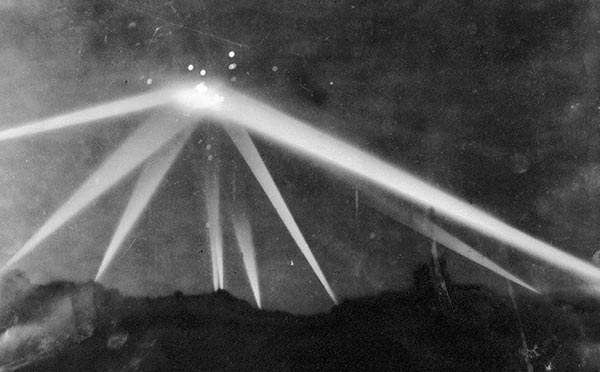
Eleven weeks after Pearl Harbor, the city of Los Angeles went to war with its own sky. In the early hours of 25 February 1942, air-raid sirens woke the city, searchlights swept the darkness, and anti-aircraft batteries opened fire. For more than an hour, guns across Los Angeles County poured over 1,400 rounds of ammunition into the night at targets that were never identified, never shot down, and never found. By daylight there was no enemy, no wreckage, and no bomb damage — only five dead civilians, damaged rooftops, and a photograph that would become one of the most famous images in UFO history. The Army called it a false alarm. The Secretary of War said fifteen enemy planes had attacked. The Air Force, forty years later, said it was weather balloons. None of those answers has ever quite stuck.
A coast on edge
The fear was not invented. On 23 February 1942, two days before the barrage, a Japanese submarine, I-17, had surfaced off Santa Barbara and shelled the Ellwood oil field, the first attack on the continental United States since the War of 1812. The shelling did little damage, but it did something worse: it proved that the enemy could reach California. Los Angeles, the centre of the American aircraft industry, was suddenly a front-line city, and its people knew it.
On the evening of 24 February, naval intelligence warned units along the California coast to expect a possible Japanese attack within hours. Radar stations were on alert. Gun crews were at their posts. When the alarm came, the city was already holding its breath.
At about 2:15 a.m. on 25 February, Army radar picked up an unidentified contact roughly 120 miles west of Los Angeles, moving toward the coast. Air-raid sirens sounded, a citywide blackout was ordered, and hundreds of thousands of residents poured into the streets to watch the searchlights. At about 3:16 a.m., batteries of the 37th Coast Artillery Brigade, headquartered at Fort MacArthur in San Pedro, opened fire. The shooting came in waves, from Santa Monica to Long Beach, and it went on for over an hour. When the cease-fire was finally ordered, the gunners had expended approximately 1,440 rounds of 12.8-pound anti-aircraft shells, along with .50-calibre machine-gun fire. The all-clear was not sounded until 7:21 a.m.
The morning after
By daylight, the facts were stark and strange. No bombs had been dropped. No planes had been shot down. No enemy ships lay off the coast, and no wreckage was found anywhere in the city. The Army’s Western Defense Command issued a statement admitting that “although reports were conflicting and every effort is being made to ascertain the facts, it is clear that no bombs were dropped and no planes were shot down.”
The cost on the ground was real. Five civilians died as a result of the night: three were killed in automobile accidents on the blacked-out streets, and two suffered fatal heart attacks attributed to the stress of the bombardment. Falling shell fragments damaged houses, cars, and streets across the city. Los Angeles had shelled itself.
Then the officials began to disagree in public. On the morning of 25 February, Secretary of the Navy Frank Knox held a press conference and called the whole episode a false alarm, the product of “war nerves”. That afternoon, Secretary of War Henry Stimson contradicted him, insisting that as many as fifteen unidentified aircraft had been over the city. Stimson later retreated from that claim. The 14th Interceptor Command stated that no American fighter planes had been scrambled during the incident, a curious detail given the apparent seriousness of the alert. A confidential 1944 Army Inspector General memo could not clearly determine what the gunners had fired at.
The photograph
The image that made the Battle of Los Angeles famous appeared on the front page of the Los Angeles Times on 26 February 1942. It shows searchlight beams converging in the night sky on a bright shape, an object that seems to hang in the beams above the city. The photograph was reproduced for decades in UFO books and magazines as proof that a solid object had been over Los Angeles that night.
The photograph, it turns out, had been retouched. In 2011, Los Angeles Times staff member Larry Harnisch compared the published image with the original negative and demonstrated that the newspaper had heavily altered it: the object visible in the published version was, in the original, far less distinct, and the smooth contours that UFO researchers had studied for years were an artifact of the retouching. Harnisch’s demonstration substantially weakened the photographic case for a solid object. It did not answer the underlying question of what the 37th Coast Artillery had fired at for over an hour.
Witnesses, meanwhile, had described different things. Some reported a single large object, variously described as bell-shaped, oblong, or round, estimated at anywhere from 16 to 80 feet across, moving slowly at altitudes between 9,000 and 18,000 feet. Others reported several smaller objects, or nothing but searchlights and shell bursts. The descriptions were inconsistent enough that they point less to a single craft than to a sky full of light, smoke, and confusion, in which each observer saw something different.
The official explanations
The most authoritative retrospective analysis came in 1983, when the Office of Air Force History reviewed the case. Its conclusion was that meteorological balloons, released by the Army itself before the barrage to measure wind conditions, had most likely triggered the initial radar contact and the visual sightings. The balloons, silvery and lit by searchlights, could have looked like aircraft to nervous gunners, and once the firing started, the shell bursts and searchlights created their own targets: gunners fired at the bursts, the bursts drew more fire, and the barrage fed itself for over an hour.
The balloon explanation has strengths. Balloons were indeed released that night. A balloon at altitude, caught in searchlights, can look uncannily like a solid object. And the pattern of the firing — waves of shooting that spread from battery to battery — fits a chain reaction of nervous gunners rather than a coordinated engagement with a real target.
It also has weaknesses. A balloon drifts with the wind and does not hover in place for an hour while being shot at. The radar contact was reported 120 miles offshore, moving toward the coast, which is a long way for a weather balloon to travel unnoticed. And the explanation does not account for the witnesses who described an object moving slowly and deliberately, or for the radar operators who tracked a contact that behaved like an aircraft.
Other explanations have been proposed: a Japanese balloon, a stray civilian aircraft, a flock of birds, a mirage. None has been proven, and the 1983 review itself was careful to say that the balloons were the most likely trigger, not a proven cause.
How a false alarm became a UFO case
The Battle of Los Angeles did not become a UFO case in 1942. In 1942 it was a military embarrassment, and the government was eager to move on. It became a UFO case in the late 1950s, when UFO writers rediscovered the incident and the photograph and reframed the night as an encounter with an unknown craft. The reframing worked because the official record was genuinely contradictory: two cabinet secretaries had given opposite accounts on the same day, the Army had admitted it did not know what it had fired at, and the photograph seemed to show an object in the searchlights.
The case endures because it sits at the intersection of two real things. The first is a documented military event: a city fired 1,440 rounds at its own sky, killed five of its own people, and found nothing. The second is a genuine mystery: what the radar saw, and what the gunners saw, has never been established with certainty. The balloon explanation is the best available, and it may be right. But the record leaves room for doubt, and doubt is where legends grow.
What is documented, and what is not
Documented facts: On the night of 24–25 February 1942, radar detected an unidentified contact about 120 miles west of Los Angeles; air-raid sirens sounded and a blackout was ordered. At about 3:16 a.m., the 37th Coast Artillery Brigade opened fire, expending approximately 1,440 rounds over more than an hour; the all-clear sounded at 7:21 a.m. No bombs were dropped and no aircraft were shot down. Five civilians died (three in traffic accidents during the blackout, two from heart attacks), and falling shell fragments caused property damage. Secretary of the Navy Frank Knox called it a false alarm; Secretary of War Henry Stimson said up to fifteen aircraft had appeared, then retreated from the claim. A 1983 Office of Air Force History review concluded that meteorological balloons most likely triggered the incident. The Los Angeles Times photograph of 26 February 1942 was heavily retouched, as demonstrated by Larry Harnisch in 2011.
Unverified or disputed claims: The claim that a solid unknown craft hovered over Los Angeles rests on inconsistent witness descriptions and on the retouched photograph, and it is not supported by any wreckage or radar record. The claim that the gunners fired at weather balloons is the official conclusion, but it does not fully account for the radar contact’s reported movement or for witnesses who described a slow, deliberate object. The claim that fifteen enemy aircraft attacked the city was made by Secretary Stimson on the day and withdrawn; the Japanese military later stated it had never flown aircraft over Los Angeles during the war.
Sources
- https://www.history.com/articles/world-war-iis-bizarre-battle-of-los-angeles
- http://www.laalmanac.com/history/hi07s.php
- https://anomalydesk.com/battle-of-los-angeles.html
- https://www.theufolibrary.com/incidents/battle-of-los-angeles-1942