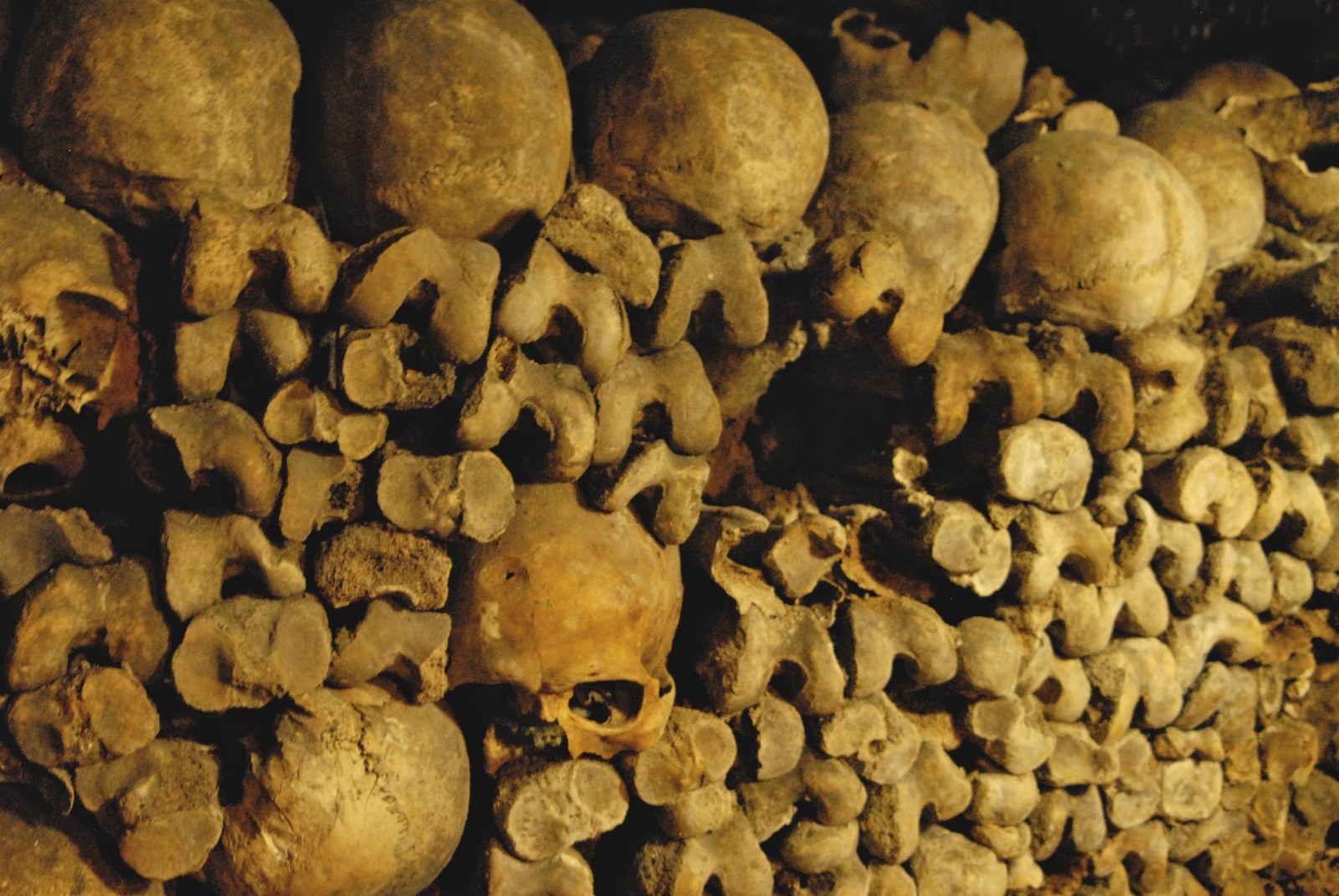
Twenty metres beneath Paris, down a spiral staircase of 131 steps, the air settles at a constant 14 degrees Celsius. The walls here are not made of stone. They are made of people: skulls set in neat rows, thigh bones stacked like firewood. This is the Catacombs of Paris, an ossuary holding the remains of roughly six million people.
A City That Ran Out of Room for Its Dead
Paris did not build the Catacombs as a monument, but because it had run out of places to put its dead. The worst of its cemeteries was the Cemetery of the Holy Innocents, near the Les Halles markets, which had received the dead of around twenty parishes for almost a thousand years. One estimate puts the total at about two million burials in a plot smaller than a city block, and the ground had risen metres above the streets from bodies buried on top of one another.
By the late 18th century it was a public health emergency. In 1780, after heavy rain, a retaining wall gave way and decomposing remains spilled into a neighbouring cellar on the Rue de la Lingerie. The cemetery was ordered closed that year, and burials inside the city were later banned — but that left the problem of the dead already buried there, and of dozens of other overcrowded graveyards across Paris.
From Quarry to Ossuary
The answer lay beneath the city’s southern edge, where masons had cut pale Lutetian limestone from the bedrock since Roman times. The empty quarries had become a danger in themselves. In 1774, a street collapse swallowed several houses, and in 1777 Louis XVI created the Inspection Générale des Carrières, a quarries inspectorate, to shore up the hollow ground. Its inspector general, Charles-Axel Guillaumot, proposed turning one section of the quarries near the Barrière d’Enfer, the southern toll gate, into a vast municipal ossuary.
On 7 April 1786, the former Tombe-Issoire quarries were consecrated as the Paris Municipal Ossuary. That evening, the first carts set out from the Cemetery of the Holy Innocents, draped in black and carrying remains across the city by night. Emptying the Innocents alone took about two years, and bones from other cemeteries followed for decades, into the 1860s. By the time they ended, the remains of an estimated six to seven million people had been moved underground. The name “catacombs” came later, borrowed from the ancient burial tunnels of Rome.
The Empire of Death
For its first two decades, the ossuary was little more than a storehouse for bones, piled in the galleries with no order. That changed under Louis-Étienne Héricart de Thury, who took over the Inspection des Carrières in 1810 and had the bones arranged into the orderly walls of skulls and long bones seen today, each section marked with the cemetery the remains came from and the year of transfer. He added carved inscriptions in French and Latin, with verses on mortality, turning a storage pit into a monumental museum of mortality.
The most famous inscription stands at the ossuary entrance: “Arrête! C’est ici l’empire de la Mort” — “Stop! This is the empire of death.” The ossuary opened to visitors by appointment in 1809, and regularly to the public since 1874. Today the official route runs for about 1.7 kilometres from Place Denfert-Rochereau, descending roughly 20 metres below street level. The ossuary is only a small part of a far larger network — the old quarry galleries are generally estimated at roughly 200 to 300 kilometres in total — and the rest is dark, partly flooded and officially forbidden.
Philibert Aspairt: The One Man Buried in the Catacombs
The Catacombs hold the bones of millions, but only one person is recorded as having died inside them. Philibert Aspairt, a doorkeeper at the Val-de-Grâce hospital during the French Revolution, entered the quarry galleries through a staircase in the hospital courtyard on 3 November 1793 and never returned. He was 61.
His body was not found until 30 April 1804, eleven years later, only a few metres from a staircase leading to an exit. He was identified by the hospital key ring on his belt and the buttons on his jacket. He was buried where he was found, and a tomb was raised on the spot, in the restricted network beneath what is now the rue Henri Barbusse. Its inscription reads: “To the memory of Philibert Aspairt, lost in this quarry on 3 November 1793, found eleven years later and buried in the same place on 30 April 1804.”
Much about Aspairt remains uncertain. His birth certificate, in the archives of Ravel-Salmerange, records him as Philiber Asper, born on 13 April 1732. The documents disagree: the tomb gives his burial date as 30 April 1804, a Paris death certificate is dated 2 May 1804, and he is described as both a hospital doorkeeper and a quarryman. Why he entered the tunnels is not proven — some accounts say he sought wine or liquor in an underground cellar — and the cause of his death was never determined, though losing his light in the darkness is the likeliest explanation. Ghost hunters claim his spirit still wanders the galleries, but there is no evidence for the haunting. There is solid evidence for the man, his disappearance and his lonely grave, and that is haunting enough.
Ghost Stories and the Cataphiles
The Catacombs have attracted ghost stories for as long as they have attracted visitors: whispering voices in empty galleries, a sense of being followed, shadowy figures at the edge of lamplight. None of these reports has been verified, and the conditions underground — total darkness, echoing stone, constant cold — offer simpler explanations.
One widely shared story tells of a man who entered the forbidden tunnels with a video camera and was never seen again, his camera supposedly found later with disturbing footage on it. This is a modern urban legend: no such disappearance is documented, and no such footage has ever been produced.
What is real is the subculture of the cataphiles: urban explorers who enter the forbidden network illegally, through manholes, sewers, Metro tunnels and sympathetic basements, mapping galleries, holding parties and even running an underground cinema. Entering the quarries without authorisation has been illegal since 2 November 1955, and those caught by the special police patrol, nicknamed the “cataflics”, face a fine of 60 euros. The dangers are real: flooding, cave-ins, hidden wells, ageing cables and, above all, getting lost in unmarked passages that all look the same.
Three Days Lost: The Teenagers of 2017
In June 2017, the danger became a news story around the world. Two teenage boys, aged 16 and 17, entered an off-limits section of the tunnels and became lost in the pitch-black maze, spending three days underground before rescuers found them, guided by specially trained search dogs. A Paris fire service spokesman said, “It was thanks to the dogs that we found them.” Both boys were taken to hospital and treated for hypothermia, narrowly escaping the fate of Philibert Aspairt more than two centuries earlier.
The rescue was a reminder that the Catacombs are not a stage set: at a steady 14 degrees Celsius, days underground without food, water or warm clothing can bring on hypothermia. No one has ever become lost on the official route; the danger lies entirely beyond the lit path, in unmapped galleries with no signs, no lights and no easy way back.
A Place of Memory, Not Just Fear
It is easy to treat the Catacombs as a horror attraction, but the ossuary was created as an act of public health and civic memory, and its most striking feature is not horror but order: bones arranged with care, inscriptions about mortality, plaques naming the parishes the dead came from. Six million people, most of them nameless, were given a single shared resting place beneath the city they built. The ghost stories will continue, and the cataphiles will keep slipping through manholes into the dark. But the place needs no invented horrors: a city buried its dead beneath its own streets, arranged them into walls, and wrote above the door that this was the empire of death. More than two centuries later, the door is still open, the steps still descend, and the bones are still there, waiting in the dark.
What is documented, and what is not
Documented facts: The Catacombs are an ossuary in former limestone quarries about 20 metres beneath Paris, created from 1786 to relieve overcrowded cemeteries, above all the Cemetery of the Holy Innocents, closed in 1780. The Tombe-Issoire quarries were consecrated as the Paris Municipal Ossuary on 7 April 1786, and the remains of an estimated six to seven million people were transferred there over the following decades. From 1810, Louis-Étienne Héricart de Thury arranged the bones into the walls seen today, and the inscription “Arrête! C’est ici l’empire de la Mort” stands at the ossuary entrance. The public route is about 1.7 kilometres; the wider quarry network is estimated at roughly 200 to 300 kilometres. Philibert Aspairt, a Val-de-Grâce hospital doorkeeper, disappeared in the quarries on 3 November 1793; his body was found on 30 April 1804 and buried where it lay — the only officially confirmed death inside the Catacombs. Entering the quarries without authorisation has been illegal since 2 November 1955, with a fine of 60 euros. In June 2017, two teenagers aged 16 and 17 spent three days lost in the off-limits tunnels before firefighters with search dogs rescued them; both were treated for hypothermia.
Unverified or disputed claims: There is no scientific evidence that the Catacombs are haunted; reports of ghostly voices, apparitions and Aspairt’s spirit are unverified legend. The widely shared story of a man who vanished leaving behind a video camera with disturbing footage is an urban legend with no documented disappearance behind it. Aspairt’s motive for entering the tunnels — a search for wine or liquor, in some accounts — is not proven, and documents disagree on his surname’s spelling, his profession and his burial date. Claims that specific famous individuals such as Marat and Robespierre lie there cannot be verified, because the remains were mixed together during the transfers.
Sources
- Catacombs of Paris — Wikipedia: https://en.wikipedia.org/wiki/catacombs_of_Paris
- Philibert Aspairt — Wikipedia: https://en.wikipedia.org/wiki/Philibert_Aspairt
- Cataphile — Wikipedia: https://en.wikipedia.org/wiki/Cataphile
- Official site of the Catacombs of Paris: https://www.catacombes.paris.fr/en
- Smithsonian Magazine, “Beneath Paris’ City Streets, There’s an Empire of Death Waiting for Tourists”: https://www.smithsonianmag.com/travel/paris-catacombs-180950160/
- Emirates 24|7 (Agence France-Presse, 15 June 2017), “Teenagers rescued after 3-day ordeal in Paris catacombs”: https://www.emirates247.com/news/teenagers-rescued-after-3-day-ordeal-in-paris-catacombs-2017-06-15-1.654584
- Kuwait Times (Agence France-Presse), “Paris Catacombs: Stuff of fascination and TV series”: https://kuwaittimes.com/article/9464/lifestyle/movies-music/paris-catacombs-stuff-of-fascination-and-tv-series/
- Cranium Corporation, “The Ossuary at the Catacombs of Paris”: https://craniumcorporation.org/2016/01/03/the-ossuary-at-the-catacombs-of-paris-an-underground-commemoration-space-and-exhibitionary-experience-2016/
- Factum Obscura, “Exploring Paris Catacombs: History and Modern Legends”: https://www.factumobscura.com/in-depth/the-paris-catacombs-origins-transformation-and-enduring-fascination/