A Voice Locked in Clay
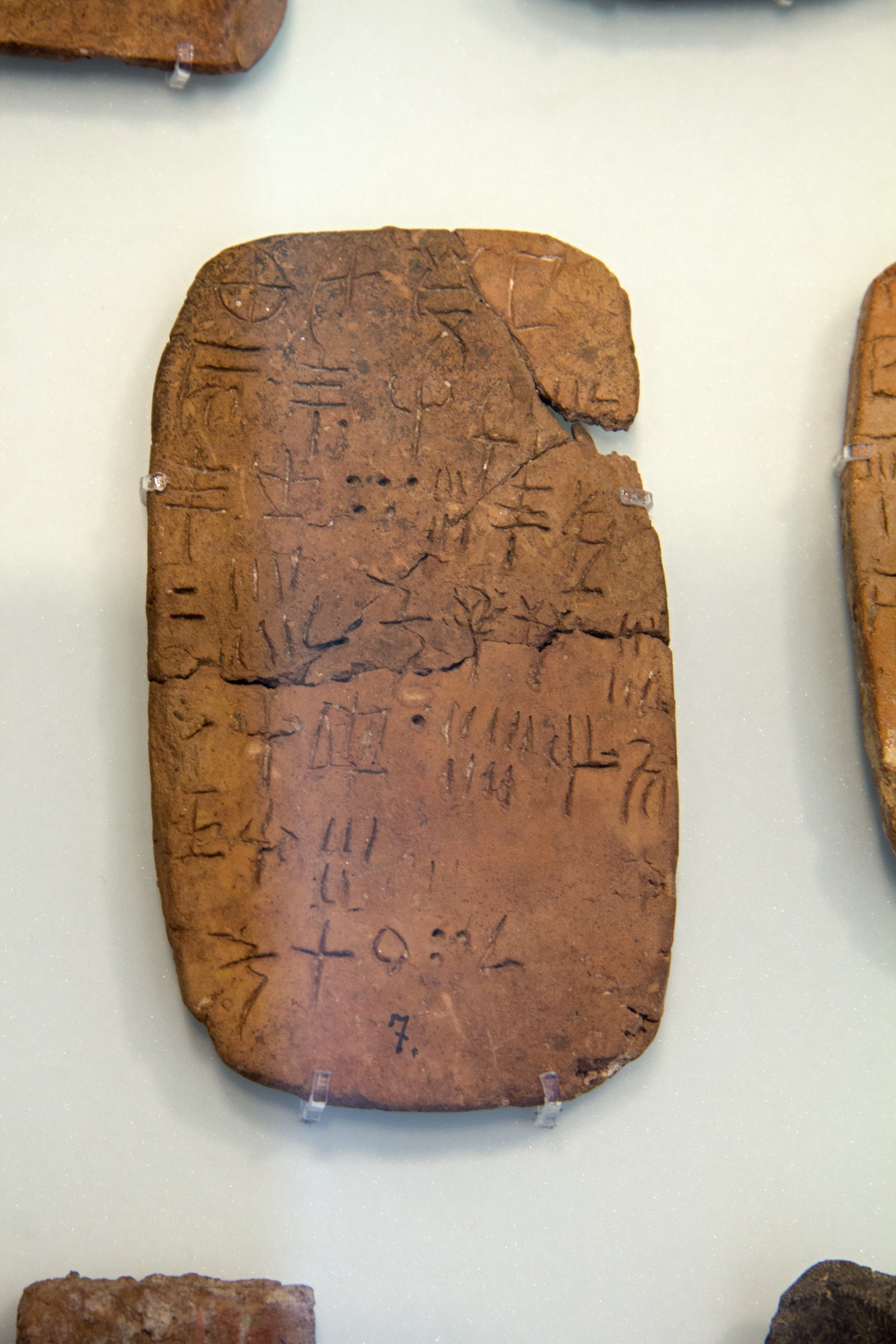
In the Archaeological Museum of Heraklion, on Crete, there are small brown clay tablets covered in neat rows of marks. The marks are clearly writing: they record numbers and pair signs with pictures of jars, grain and animals. Yet no living person can read a single sentence of them.
This is Linear A, the writing of the Minoans, the Bronze Age people who built the great palaces of Crete. It was used from about 1800 to 1450 BCE, and around 1,400 inscriptions survive, mostly on clay tablets. Scholars can describe the script in detail, but after more than a century of trying, they cannot read it.
The Discovery at Knossos
Linear A came to modern attention in 1900, when the British archaeologist Arthur Evans began excavating the palace at Knossos, on the north coast of Crete. Evans had come chasing the world of Greek myth, the labyrinth and the Minotaur, and found a vast Bronze Age palace complex, with storerooms, frescoes and archives of clay tablets.
The tablets bore three kinds of writing: pictographic signs Evans called Cretan hieroglyphs, and two scripts of simple linear strokes, which he named Linear A and Linear B. The name was descriptive — the signs were straight lines incised into wet clay with a stylus. Evans published his first great study, Scripta Minoa, in 1909, and spent the rest of his life on the scripts without deciphering either — and wrongly believing both recorded the same language, that of the Minoans.
What Linear A Actually Is
Linear A is a logosyllabic script. Most signs stand for syllables, sounds like da, ka or ti, rather than single letters. Others are logograms, symbols for whole words or things, such as a jar, a measure of grain or an animal. There are also signs for numbers and quantities.
The script contains more than 300 signs if regional variants and one-off signs are counted, but at its core is a working set of about 90 syllabic signs used across Crete throughout the script’s life. It was normally written left to right.
Most inscriptions are on clay tablets, the paperwork of the Minoan palaces, but the script also appears on sealings, offering tables, pottery and jewellery, at Knossos, Phaistos, Hagia Triada, Malia and Zakros, and beyond Crete at Akrotiri on Thera, on Kea, Kythera and Melos, with isolated finds from mainland Greece, Cyprus and Turkey.
The surviving corpus is small. The standard edition, the five-volume Recueil des inscriptions en linéaire A (GORILA), published by Louis Godart and Jean-Pierre Olivier between 1976 and 1985, catalogued 1,427 inscribed objects carrying about 7,150 signs. A 2024 supplement by Maurizio Del Freo and Julien Zurbach added 107 documents and 427 signs, bringing the total to 1,534 inscriptions and 7,574 signs.
The Business of a Palace
Most of what survives is administrative. The Minoan palaces were the economic centres of their regions, collecting, storing and redistributing produce and goods, and the Linear A tablets are, for the most part, the records of that system.
A typical tablet lists quantities of commodities — wheat, barley, wine, oil, figs and wool — paired with numbers and with signs scholars believe are personal names or place names. Some record rations issued to workers; others record deliveries or storeroom contents. The logograms make the subject matter clear even when the words cannot be read: a tablet with the sign for a jar and a number beside it is plainly counting jars of something. Which jars, and for whom, is what we cannot know.
Some inscriptions seem religious: stone libation tables carry texts repeating certain sign groups, suggesting formulaic ritual language. The corpus contains no long narratives, no annals, no laws, no literature and no letters — either the Minoans wrote such things on perishable materials, or their writing served almost entirely administration and ritual. The clay tablets survived because they were baked hard, often by accident, in the fires that destroyed the palaces.
The Sister Script That Was Read
The story of Linear A cannot be told without Linear B, the script that replaced it. After about 1450 BCE, Linear A disappears from Crete and Linear B takes its place. The two are closely related, sharing roughly seventy per cent of their signs, and Linear B is generally understood to have developed out of Linear A, adapted by the Mycenaean Greeks who took control of Crete.
For half a century, both scripts were unreadable. Then, in 1952, the British architect Michael Ventris announced that Linear B recorded an early form of Greek, one of the great intellectual achievements of the twentieth century. He had built on the work of the American scholar Alice Kober, who had identified repeating patterns of signs in Linear B that revealed the grammar beneath the script.
The decipherment of Linear B changed everything and nothing for Linear A. Because the two scripts share so many signs, scholars could apply Ventris’s Linear B sound values to the matching signs in Linear A — and sound it out, in a limited sense. But the words that emerge are not recognisable: not Greek, and not words in any other known language either.
This is the crux of the problem: deciphering a script and understanding a language are two different things. Linear B could be deciphered because its language turned out to be Greek, a language scholars already knew. Linear A resists because its language, the language of the Minoans, is unknown. It does not appear to be Indo-European, and it may belong to no known language family at all. Without a known language to match the sounds against, the sounds alone are not enough.
Why It Has Never Been Cracked
The difficulties pile up. First, there is no bilingual text: the Rosetta Stone carried the same decree in Greek and in Egyptian, but no equivalent has ever been found for Linear A.
Second, the corpus is small and repetitive: roughly 7,500 signs, against tens of thousands for Linear B. Much of it consists of similar administrative lists, and most inscriptions are only a few signs long — enough to establish how the script works, but not enough to reconstruct a grammar or a vocabulary from scratch.
Third, the language itself may have left no descendants. Some scholars have connected it with Eteocretan, meaning “true Cretan”, attested in a handful of later inscriptions from eastern Crete — but those are themselves undeciphered, so this only moves the problem. Other proposed links, with Semitic, Anatolian and Caucasian families among them, have won no general acceptance.
Modern Attempts, and Why They Stall
The work has not stopped. The 2024 supplement added new material, and in 2026 the scholar Brent Davis published a book-length study, The Undeciphered Aegean Scripts, on the phonology, morphology and syntax of Linear A. Computational methods have been brought to bear as well, testing how sign sequences behave and whether they resemble any known language family.
These efforts have produced real knowledge: we understand the script’s structure better than Evans ever did, and we can say with confidence what many tablets are about. What they have not produced is a decipherment. Computational analysis can sort signs and test proposed readings, but none of that establishes what a Minoan scribe meant by a word more than three thousand years ago.
The Civilisation Behind the Script
Perhaps the most haunting aspect of Linear A is what it implies about its makers. The Minoans were the first great civilisation of Europe: they built multi-storey palaces with running water, painted frescoes of bulls and dolphins, sailed across the Mediterranean, and traded with Egypt and the Near East. Their writing is the one part of their world that refuses to speak.
The end of Linear A is itself part of the mystery. Around 1450 BCE, the palaces of Crete were destroyed — by the eruption of the volcano on Thera, by earthquakes, or by Mycenaean takeover, scholars disagree — and the script that had served the palaces for centuries vanished, replaced by Linear B.
That is the real enigma of Linear A: the written record of a people whose language has no living relatives, preserved in fragments too few and too short to rebuild it from. The tablets in the Heraklion museum are not hiding their meaning; they are displaying it, in plain sight, in a language nobody alive speaks.
What is documented, and what is not
Documented facts: Linear A was the writing system of the Minoans on Crete, used from about 1800 to 1450 BCE. Arthur Evans first encountered it at Knossos in 1900 and named it in his 1909 work Scripta Minoa. The corpus catalogued in GORILA comprises 1,427 inscribed objects with about 7,150 signs, extended by a 2024 supplement to 1,534 inscriptions and 7,574 signs. The script is logosyllabic, with a core group of about 90 frequently occurring syllabic signs among more than 300 in total, plus logograms, numerals and metrical signs. Inscriptions survive from Knossos, Phaistos, Hagia Triada, Malia and Zakros, and from sites beyond Crete including Akrotiri on Thera. Most surviving texts are administrative records of commodities and quantities. Linear B, adapted from Linear A, was deciphered by Michael Ventris in 1952 and proved to record an early form of Greek. Applying Linear B sound values to Linear A produces no recognisable words in any known language. No bilingual Linear A text has been found, and no generally accepted decipherment exists.
Unverified or disputed claims: The identity of the language behind Linear A is unknown, and proposals linking it to Semitic, Anatolian, Caucasian or other language families are unproven. The suggestion that the language is Eteocretan is a hypothesis, since Eteocretan itself is undeciphered. Claims that Linear A has been deciphered, by researchers or by artificial intelligence, have not been accepted by specialists. The cause of the destruction of the Minoan palaces around 1450 BCE, and of the disappearance of Linear A, is disputed — volcanic eruption, earthquake and Mycenaean takeover are all proposed. Whether Cretan hieroglyphs and Linear A recorded the same language or different languages is still unclear. Any translation of a specific Linear A text, beyond identifying its likely subject matter from logograms and numbers, should be treated as speculation.
Sources
- Linear A — Wikipedia: https://en.wikipedia.org/wiki/Linear_A
- “Without a Rosetta Stone, can linguists decipher Minoan script?” — Aeon: https://aeon.co/essays/without-a-rosetta-stone-can-linguists-decipher-minoan-script
- “Can AI Crack the Minoan Linear A Script?” — Spoken Past: https://spokenpast.com/articles/can-ai-crack-linear-a-script/
- Linear A — New World Encyclopedia: https://www.newworldencyclopedia.org/entry/Linear_A
- Loh, J.S.C. and Perono Cacciafoco, “Minoan Cryptanalysis: Computational Approaches to Deciphering Linear A” — MDPI: https://www.mdpi.com/2078-2489/15/2/73
- Linear A tablet from Hagia Triada, Archaeological Museum of Heraklion — Wikimedia Commons: https://commons.wikimedia.org/wiki/File:Minoan_Linear_A,_Crete,_AMH,_145099.jpg