In the spring of 1997, the deep Pacific was listening. A network of autonomous hydrophones — underwater microphones anchored to the seafloor across the equatorial Pacific — was recording everything the ocean had to say: earthquakes, erupting seamounts, the songs of migrating whales, and the long, low groans of ice breaking apart at the bottom of the world. On 19 May, the instruments picked up something new. A sound that began at one pitch and fell, slowly and steadily, for about seven minutes, as if something enormous were decelerating and coming to rest. The researchers who heard it gave it a plain, descriptive name: Slow Down.
The ocean’s listening posts
To understand Slow Down, you have to understand the instruments that caught it. In the early 1990s, the Pacific Marine Environmental Laboratory — PMEL, a division of the US National Oceanic and Atmospheric Administration based in Newport, Oregon — began turning the deep ocean into something you could listen to. The programme, led in its early years by researcher Christopher Fox, built on a Cold War inheritance: the US Navy’s SOSUS network of hydrophones, designed to listen for submarines, had shown that low-frequency sound could travel extraordinary distances underwater through a natural channel called the SOFAR channel, where the speed of sound is at its minimum and sound waves are trapped and carried for thousands of kilometres.
In 1996, PMEL added its own array of autonomous hydrophones in the equatorial Pacific — instruments that recorded on their own and were recovered periodically for analysis. The array could eavesdrop on undersea earthquakes, erupting seamounts, and whale songs across entire ocean basins. It could also hear things nobody expected. The most famous was the Bloop, recorded in the summer of 1997, an ultra-low-frequency sound strong enough to register on hydrophones more than 5,000 kilometres apart, later matched to the acoustic signature of an icequake — a great iceberg cracking apart near Antarctica. Slow Down was recorded in the same season, by the same array, and it belongs to the same small family of named sounds.
A sound that falls
Slow Down is named for its shape. On a spectrogram — a visual map of sound, with time running one way and frequency the other — the signal appears as a long, descending line. It begins at a higher frequency and falls gradually over roughly seven minutes. That duration is part of what makes it strange. Most natural sounds in the ocean are short: a crack, a boom, a rumble that lasts seconds. A sound that descends steadily for seven minutes suggests a prolonged mechanical process rather than a sudden event — something large, under sustained stress, slowly changing as it moves or settles.
The obvious question was what could make such a sound. A whale does not sing for seven minutes in a falling tone. An earthquake does not descend in pitch. A ship’s propeller has a different signature entirely. The sound was loud, low, and long, and it came from very far away — the equatorial Pacific array hears across whole ocean basins, and the source was evidently somewhere in the Southern Ocean, thousands of kilometres from the nearest hydrophone.
The iceberg explanation
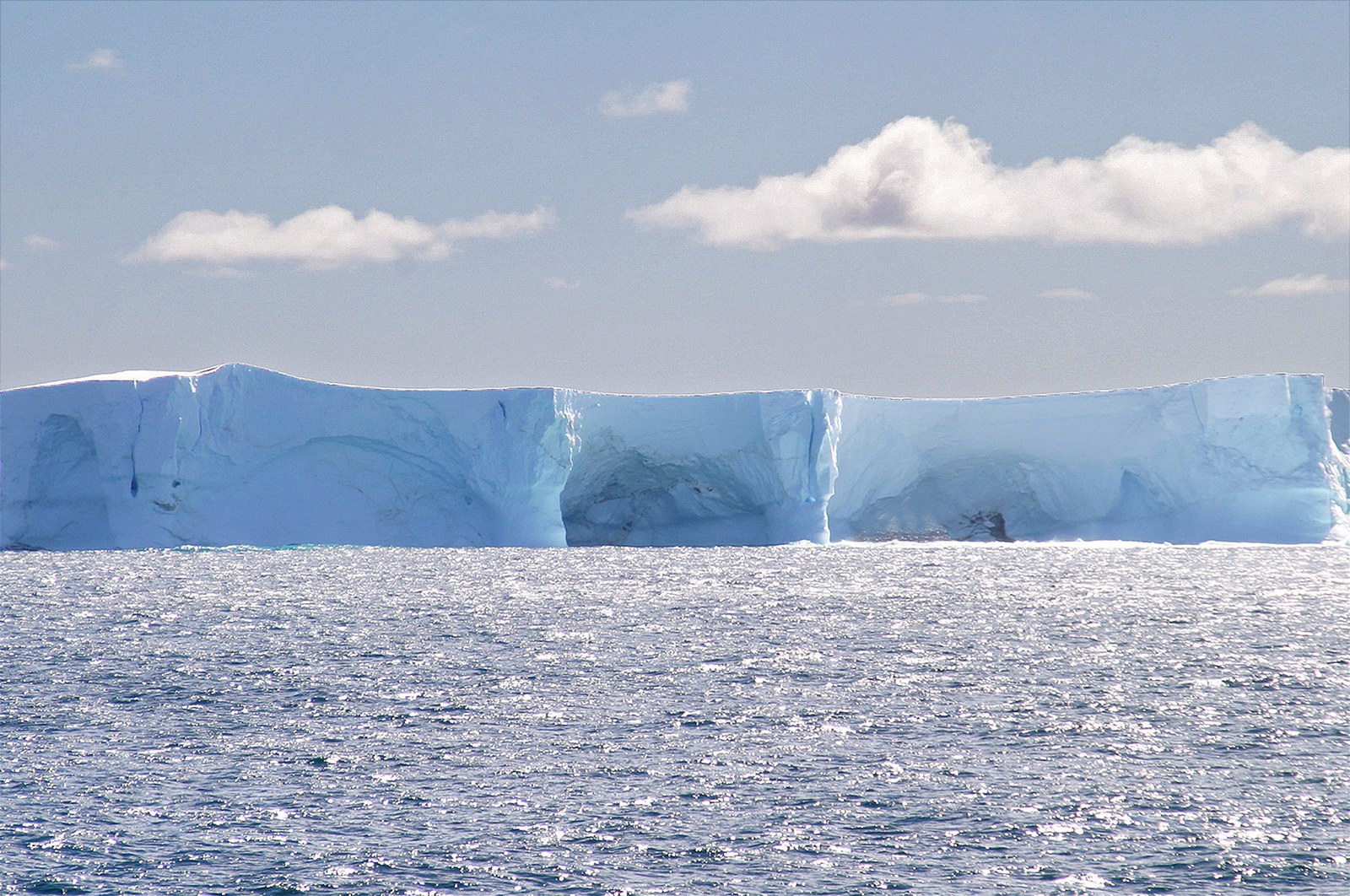
NOAA’s favoured explanation is an iceberg coming to rest. When a massive iceberg drifts into shallow water and runs aground, or when a great ice mass drags slowly over the seafloor, the friction and deformation produce long, sweeping acoustic signals. As the ice settles — as the system relaxes, in the language of the researchers — the emitted acoustic energy decreases in frequency. The sound of a mountain of ice grinding to a stop over seven minutes is, in other words, exactly what Slow Down sounds like.
The explanation fits the family. NOAA’s archive of named sounds tells a consistent story of Antarctic ice. The Bloop, the most famous of them, was matched to icequakes by a team led by NOAA marine geophysicist Robert Dziak, who found that its rising, sweeping signature matched the sounds of calving ice recorded between 2005 and 2010 — including the sounds of iceberg A53a, some 1,100 square kilometres when it broke away in the Weddell Sea, drifting north, grounding in the Bransfield Strait, and falling apart in the Scotia Sea in early 2008, right inside the hydrophone array. “Train”, recorded on 5 March 1997, rises to a steady frequency and was traced to a very large iceberg aground in the Ross Sea near Cape Adare. “Upsweep”, a seasonal sound present since PMEL began recording in August 1991, rises and falls in intensity around spring and autumn and is also thought to be ice-related. Slow Down is the falling member of the family, the sound of ice settling rather than ice breaking.
The family of sounds
Slow Down was not the only voice the array heard that decade, and the siblings help explain it. “Train”, recorded on 5 March 1997, rises to a steady frequency and was traced to a very large iceberg aground in the Ross Sea near Cape Adare — the sound of ice held fast against the seafloor, humming at a constant pitch. “Upsweep”, present since PMEL began recording in August 1991, is a seasonal sound that rises and falls in intensity around spring and autumn, and is also thought to be ice-related. Each of these sounds is a different movement of the same instrument: ice under stress, ice breaking, ice settling, ice held fast. Together they form a small catalogue of what the frozen south sounds like from thousands of kilometres away, and Slow Down is the movement in which the music winds down.
There is something quietly remarkable about the whole enterprise. The hydrophone programme that caught Slow Down was built on a Cold War inheritance — the US Navy’s SOSUS network, designed to listen for submarines — and it was turned, in the 1990s, toward listening to the planet itself. The researchers who ran it, led in the early years by Christopher Fox, were not looking for mysteries. They were mapping earthquakes and volcanoes. The mysteries found them, because the ocean is louder, stranger, and more articulate than anyone had assumed. A seven-minute descending tone, recorded by instruments anchored to the seafloor of the equatorial Pacific, turned out to be the sound of a mountain of ice coming to rest at the bottom of the world. That is the kind of discovery that only happens when you build an instrument to listen and then, patiently, listen.
Why the case is not quite closed
If the explanation is so good, why does Slow Down still count as a mystery? The answer is precision. NOAA leans toward the iceberg-grounding explanation, but the identification is not certain, because the Southern Ocean is remote and no instrument was close enough to see the ice break or ground. The source of Slow Down has never been tied to a particular iceberg at a known place on a particular day. The explanation is a match of pattern and power rather than a direct observation — the only one consistent with everything the hydrophones have recorded, but a match nonetheless.
There is another wrinkle. Slow Down has been heard several times a year since its first recording. That recurrence is consistent with icebergs grounding repeatedly in the Southern Ocean, which they do. But it also means the sound is not a one-off event that can be pinned to a single dramatic grounding. It is a recurring feature of the ocean’s soundscape, a class of event rather than a single incident, and each occurrence is as hard to locate as the first.
That is the honest state of the case. Slow Down is probably the sound of a great iceberg grinding to a halt on the Antarctic seafloor, thousands of kilometres from the microphones that heard it. The physics fits, the family fits, and no competing explanation fits better. But the ocean is large, the ice is far away, and the sound itself is the only witness. Until a hydrophone array is close enough to catch a grounding in the act — hearing the sound while watching the ice — Slow Down will remain what it has been since 1997: a seven-minute fall in pitch, a probable explanation, and a reminder of how much of the planet’s noise we still hear without seeing.
What is documented, and what is not
Documented facts: Slow Down was recorded on 19 May 1997 by NOAA’s Equatorial Pacific Ocean autonomous hydrophone array, operated by the Pacific Marine Environmental Laboratory. Its frequency decreases gradually over about seven minutes. NOAA considers a large iceberg coming to rest against the seafloor, or a large ice mass dragging over land, the highly probable explanation. The sound has been heard several times a year since its first recording. Related sounds from the same array include the Bloop (summer 1997, matched to Antarctic icequakes, heard across more than 5,000 km), Train (5 March 1997, traced to a very large iceberg aground in the Ross Sea near Cape Adare), and Upsweep (present since PMEL began recording in August 1991, seasonal). Low-frequency sound travels thousands of kilometres through the ocean’s SOFAR channel.
Unverified or disputed claims: The iceberg-grounding explanation for Slow Down has not been confirmed by direct observation of a specific iceberg grounding at a known location; it rests on matching the sound’s acoustic profile to the physics of ice deformation. No competing explanation — biological, geological, or artificial — has been shown to fit the signal, but the absence of a direct observation means the case is best described as highly probable rather than proven. Claims that Slow Down is the sound of an unknown sea creature have no supporting evidence and are inconsistent with the signal’s duration and frequency behaviour.
Sources
- https://www.michelegargiulo.com/blog/the-bloop-mysterious-ocean-sound
- https://www.alonereaders.com/article/details/3756/strange-noaa-sounds-explained-julia-slow-down-and-the-science-behind-ocean-mysteries
- https://www.thisunexplaineduniverse.com/articles/the-bloop
- https://thesea.org/the-loudest-ocean-sound-came-from-an-icequake/