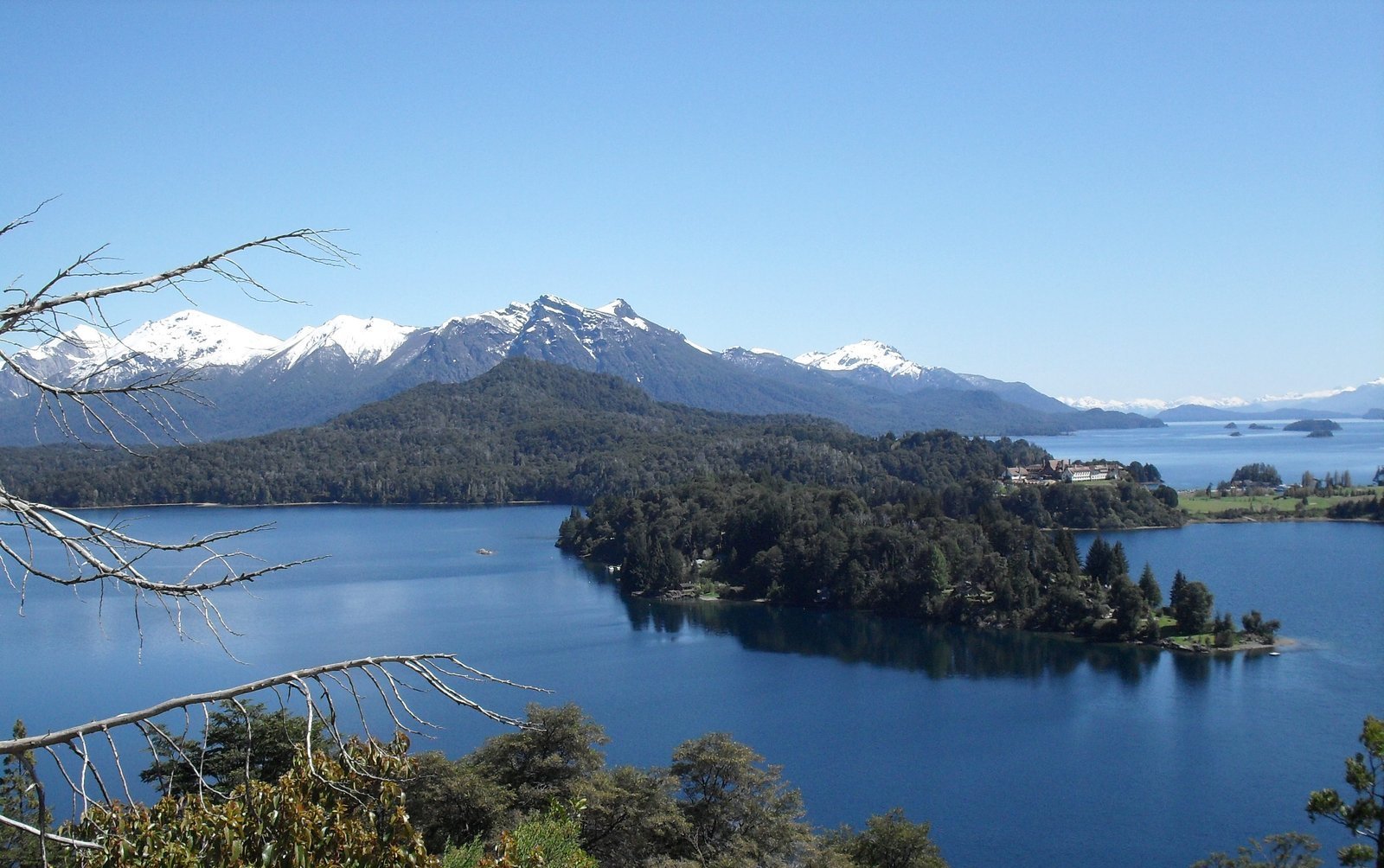
Lake Nahuel Huapi lies in the Argentine Patagonia, on the border of the provinces of Río Negro and Neuquén, at the foot of the Andes. It covers 557 square kilometres and reaches a depth of 464 metres. Its name comes from the Mapudungun language, and means “island of the jaguar”. The lake is one of the most beautiful in South America, and it is said to contain a monster. The creature’s name is Nahuelito — little Nahuel — and its story is older, stranger and better documented than most lake-monster legends. Eleven years before the Loch Ness Monster came to the world’s attention, the search for the Patagonian plesiosaur was already international news.
The old stories
The indigenous peoples of Patagonia, the Tehuelche among them, told stories of a huge creature swimming beneath the surface of the region’s lakes long before Europeans arrived. The legend, in its modern form, begins with reports collected in the late nineteenth century. From 1897, Dr Clemente Onelli, the director of the Buenos Aires Zoo, began receiving sporadic reports of a strange creature inhabiting the Patagonian lakes. Onelli was a serious man — a naturalist, not a showman — and he took the reports seriously. He filed them away and waited.
The first sighting to be recorded in detail came from a man named George Garrett. Garrett worked for a company near Nahuel Huapi, and in 1910, while sailing on the lake and about to disembark, he saw a creature about 400 metres away. Its visible part measured between five and seven metres long and protruded about two metres above the water. Garrett kept the story to himself for twelve years. He made it public only in 1922, when he told it to the Toronto Globe. The newspaper published his account on 6 April 1922, at the height of the Patagonian plesiosaur controversy.
The prospector’s letter
The controversy began with a letter. In January 1922, an American gold prospector named Martin Sheffield, who had settled in Patagonia in 1880, wrote to Onelli from Esquel. Sheffield reported huge tracks and crushed bushes and undergrowth leading to the shore of a lagoon, and an animal in the middle of the lake with “a huge neck like a swan”, moving like a crocodile. He was vague about exactly where the lagoon was.
Onelli read the letter as evidence of a surviving giant ground sloth — a mylodon, the enormous prehistoric mammal whose remains had been found in Patagonian caves. He said so in a note that ran in the newspaper La Nación on 6 March 1922. The paper set a question under the headline: could it be a plesiosaur? That subheading did the rest. Within days, the story was no longer about a sloth. It was about a living dinosaur in a Patagonian lake.
Onelli decided to mount an expedition. The idea of uncovering a new large species was still taken seriously in 1922 — the hunt for the yeti was a generation away, but the age of the great natural-history expeditions was not yet over. Onelli, however, was ill, and he did not go himself. The expedition left Buenos Aires on the night of 23 March 1922, led in the field by Emilio Frey, with the zoo’s superintendent José Cihagi, a champion marksman, a taxidermist from La Plata, the zoo’s administrator and two reporters. Onelli had planted a false itinerary in the newspapers to shake off followers.
The expedition
The expedition reached Nahuel Huapi on 30 March. Frey had already written to Onelli from Bariloche with something better than anything the expedition would find: the people around Lago Correntoso, just north of the big lake, had seen a large animal in the water more than once, at certain times of the year. They called it el Cuero — the hide — and said it was like a sea octopus.
The expedition carried dynamite, to mine the lake, and elephant rifles. That was its undoing in the press. Dr Albarracín, president of the Society for the Protection of Animals, petitioned the Minister of the Interior to refuse the expedition’s permits, on the grounds that the creature in question came under laws forbidding the hunting of rare animals. The expedition, already far into the Patagonian lake region, stopped until the permit question was settled, and the confusion and the press criticism seriously damaged its image.
On 17 April, the party drove south to El Hoyo de Epuyén and reached Sheffield’s lagoon on the 20th, where they found his wife and children. They searched the lagoon and the lakes. They found nothing. In July 1922, Leonard Matters wrote in Scientific American that the plesiosaur, “if it ever existed, appears to have fled to parts unknown.”
Back in Buenos Aires, Onelli received a message from Bariloche: the plesiosaur had been captured. It was a joke. At the Bariloche carnival the following February, a sawmill owner named Primo Capraro built a plesiosaur on a Ford truck chassis out of timber and sacking, rigged it to move, and paraded it through town with a man playing Don Clemente carrying a syringe. The town was laughing at the expedition, and at itself.
The name
The idea stayed in Bariloche without a name for nearly fifty years. Then, in 1970, a journalist printed a supposed sighting under a headline that gave it one: Nahuelito. The diminutive turned out to be the whole trick. Not a plesiosaur, not a surviving sloth, not the hide in the shallows — just little Nahuel, the lake’s own, half monster and half pet. The name stuck, and it changed the creature. A plesiosaur is a scientific claim. Nahuelito is a mascot. The town has never once discouraged the legend. Nahuelito’s plesiosaur face is on signs, souvenirs and murals all over Bariloche.
Onelli died in October 1924, two years after the expedition. He never found his creature. In 2001, the grandson of Hesketh Prichard — the explorer who had searched Patagonia for the giant sloth a century earlier — came out to mark the centenary of his grandfather’s failure, and repeated it. The naturalists who bothered to check concluded that the creature was probably an otter.
What the sightings describe
The descriptions of Nahuelito are consistent with a large, long-necked animal: a serpentine body, a swan-like neck, humps breaking the surface, a creature five to seven metres long. The sightings are also consistent with something else: otters, swimming in line; floating logs; waves; and the peculiar optics of a large, deep, cold lake seen from a distance. Lake Nahuel Huapi is 557 square kilometres. A log at 400 metres, seen through binoculars by a man who has just been told about a monster, can be anything.
The 1922 expedition is the most interesting part of the story, because it shows how a legend is made. There was a real letter, from a real prospector, about a real animal he said he had seen. There was a real naturalist who took it seriously. There was a real expedition, with real money, real rifles and real dynamite. And there was a newspaper subheading that turned a sloth into a plesiosaur. The expedition found nothing, but the publicity fixed the creature in the public imagination forever.
The monster today
Sightings of Nahuelito continue into the twenty-first century. Tourists and locals report seeing something in the lake, and shaky videos appear in the regional media from time to time. No photograph has ever been conclusive. No specimen has ever been found. Systematic searches have produced nothing.
Bariloche does not mind. The town has built a small tourist industry around its monster, and the monster has become part of the identity of the place. A documentary, “Bajo Superficie”, was made about the cryptid by a Bariloche-based filmmaker, Miguel Ángel Rossi. The creature that Onelli went looking for in 1922 — a scientific discovery, a new species — has become something else: a story the town tells about itself, and a reason for visitors to look twice at the water.
What is documented, and what is not
Documented facts: Lake Nahuel Huapi is a glacial lake in Argentine Patagonia, 557 square kilometres in area and 464 metres deep. In January 1922, Martin Sheffield wrote to Clemente Onelli describing a long-necked animal in a Patagonian lagoon. Onelli organised an expedition that left Buenos Aires on 23 March 1922 and searched the lakes without result. George Garrett’s 1910 sighting was published in the Toronto Globe on 6 April 1922. Leonard Matters reported the expedition’s failure in Scientific American in July 1922. The name “Nahuelito” was first printed in 1970. No specimen, carcass or conclusive photograph of the creature exists.
Unverified or disputed claims: The claim that a large unknown animal lives in Lake Nahuel Huapi rests on eyewitness reports, none of them independently corroborated. The claim that the creature is a surviving plesiosaur has no supporting evidence; plesiosaurs have been extinct for 66 million years. The claim that the 1922 expedition was searching for a plesiosaur misstates its purpose: Onelli believed the animal was a giant ground sloth, and the plesiosaur framing came from a newspaper subheading. The claim that the creature is an otter is a plausible explanation offered by naturalists, not a proven identification.