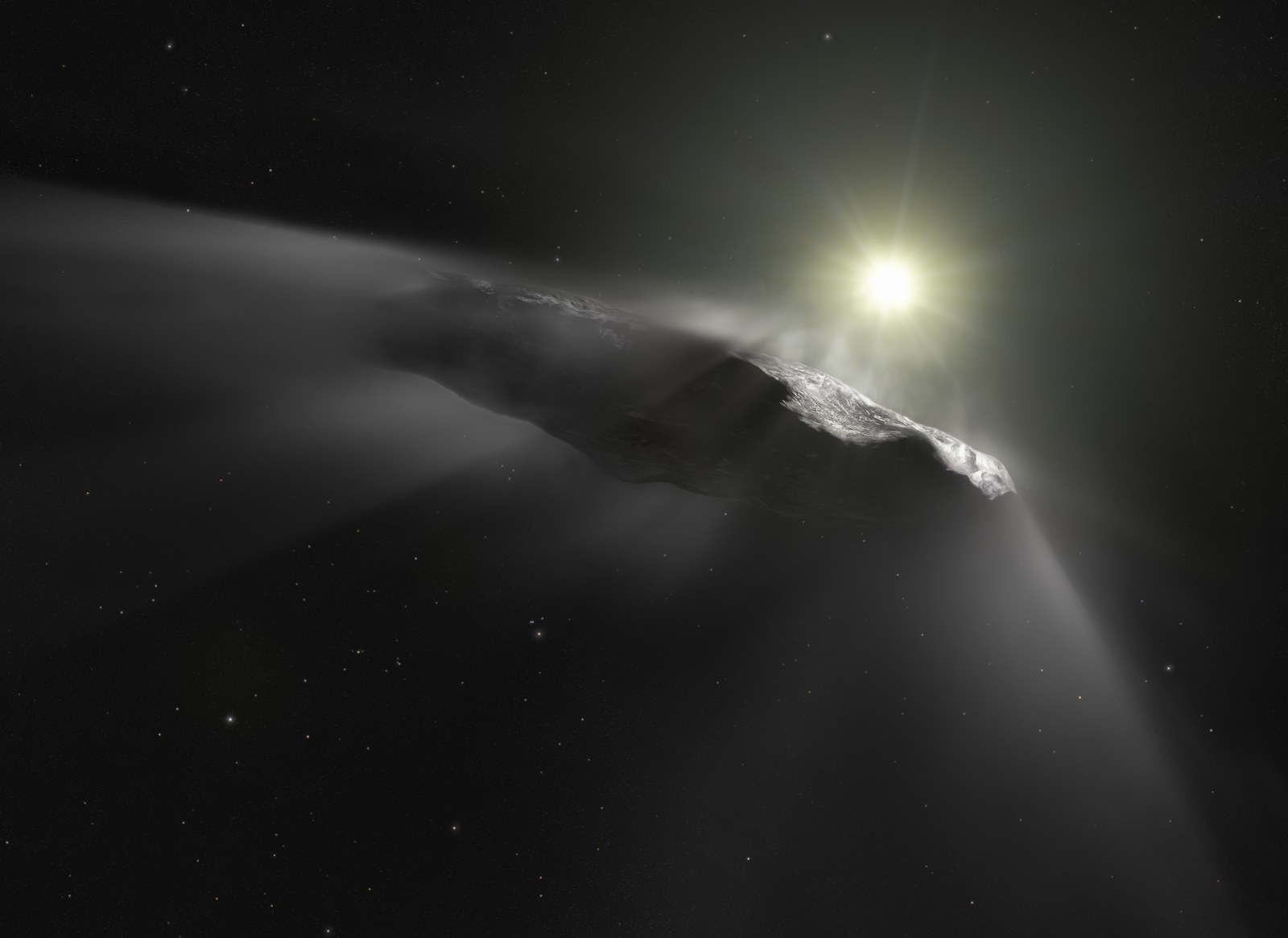
On 19 October 2017, a Canadian physicist named Robert Weryk was working with the Pan-STARRS telescope at Haleakalā Observatory in Hawaii when he spotted something moving across the sky that did not belong there. It was faint, fast, and on a trajectory that no object born in our Solar System could follow. Within days, astronomers around the world realised what they were looking at: the first confirmed interstellar object ever detected passing through our Solar System — a piece of another star system, tumbling through ours, never to return. They named it ‘Oumuamua, a Hawaiian word meaning “scout” or “messenger”, chosen to honour the culture of the place where it was found. It was, by any measure, one of the great discoveries in the history of astronomy. It was also, from the very beginning, deeply strange.
A messenger forty days late
‘Oumuamua was discovered approximately forty days after it had passed its closest point to the Sun, on 9 September 2017. That delay matters, because it meant astronomers were catching the object on its way out, already fading, with only a few weeks to study it before it became too dim to follow. It had approached from the direction of Vega, in the constellation Lyra, within roughly six degrees of the solar apex — the direction the Sun itself is travelling through the galaxy — and it was moving fast, reaching a maximum velocity of approximately 87 kilometres per second relative to the Sun.
Its orbit gave it away immediately. The trajectory was hyperbolic, with an eccentricity of around 1.2, which meant the object was not falling around our Sun at all. It was passing through, unbound, on a path that would carry it back out into interstellar space. The Minor Planet Center initially classified it as a comet, then reclassified it as an asteroid, and finally gave it a designation that had never existed before: 1I/2017 U1, the “1I” standing for the first interstellar object. It was a new category of thing, and ‘Oumuamua was its first and only member.
The shape that should not exist
What the telescopes found, in the few weeks they had, was a puzzle. ‘Oumuamua is a small object estimated to be between 100 and 1,000 metres long, with its width and thickness both estimated between 35 and 167 metres. Different models put the dimensions at roughly 230 by 35 by 35 metres, or 115 by 111 by 19 metres, depending on the assumed reflectivity. However the numbers are cut, the shape is extreme: an aspect ratio possibly near ten to one, more elongated than all but a few other natural bodies observed in the Solar System. Its light curve — the way its brightness rose and fell as it turned — showed that it was tumbling, rotating on more than one axis at once, with a reported period of around 8.1 hours. It was red, like objects in the outer Solar System, its surface resembling the dark, carbon-rich crust of a cometary nucleus.
And yet, despite its close approach to the Sun, it showed no signs of having a coma — the glowing nebula of gas and dust that forms around a comet when its ices warm and sublimate. A comet that close to the Sun should have been shedding material visibly. ‘Oumuamua shed nothing that anyone could see. It looked like an asteroid, behaved in some ways like a comet, and matched neither category properly. Astronomers compared it to Rama, the elongated alien spacecraft of Arthur C. Clarke’s novel Rendezvous with Rama, and the comparison stuck, because the real object was almost as strange as the fictional one.
The acceleration nobody could explain
The real trouble began in June 2018, when a team led by Marco Micheli reported, in Nature, the detection of a non-gravitational acceleration in ‘Oumuamua’s trajectory at 30 sigma significance — a deviation from a purely gravity-driven path so large that it could not be a statistical fluke. The object was being pushed outward, away from the Sun, with a force that grew roughly with the inverse square of its distance from the Sun. After ruling out solar radiation pressure on an ordinary body, drag, friction, interaction with the solar wind, and geometric effects, the team concluded that comet-like outgassing was a physically viable explanation — provided that ‘Oumuamua had thermal properties similar to comets. The problem was that no outgassing had been observed. A comet that pushes itself with invisible gas is a strange comet indeed.
The acceleration set off one of the most heated debates in modern astronomy. In 2018, Shmuel Bialy and Avi Loeb of Harvard proposed, in the Astrophysical Journal Letters, that solar radiation pressure acting on a thin, high area-to-mass object — something like a light sail, a sheet of material millimetres thick — could explain the acceleration. Loeb went further in public, suggesting that ‘Oumuamua might be an artefact of an alien civilisation. The claim was extraordinary, and it was treated as such: most astronomers rejected it, but the debate it started was genuine, because the natural explanations on offer were not obviously better.
Natural models followed. Some proposed that ‘Oumuamua was a fragment of a disintegrated rogue comet, or a piece of a planet torn apart near its star. Others suggested it was a chunk of nitrogen ice, or a fractal dust aggregate — a fluffy, low-density body that would respond to sunlight in unusual ways. In 2023, Jennifer Bergner and Darryl Seligman published a model in Nature showing that molecular hydrogen, produced by radiation inside water ice and trapped there over billions of years, could be released as the object warmed near the Sun, outgassing strongly enough to drive the observed acceleration. That model is now treated as the leading natural mechanism. None of the models has been conclusively confirmed, but natural explanations remain the mainstream interpretation, and by July 2019 most astronomers had concluded that ‘Oumuamua is most likely a natural object.
What we will never know
‘Oumuamua is gone. By 2020 it had faded to the 34th magnitude, far beyond the reach of any telescope, and it is now on its way out of the Solar System for good. No follow-up mission could measure its composition directly, and no spacecraft will ever catch it. Everything we know about it comes from a few weeks of observations in late 2017, and everything we do not know about it will remain unknown.
That is what makes ‘Oumuamua a mystery rather than merely a discovery. Its extrasolar origin is certain. Its shape, its colour, its tumble, and its acceleration are all measured facts. But the object itself — what it was made of, where it came from, and what pushed it — remains a matter of competing models, each of which explains part of the evidence and none of which explains all of it. The acceleration has several competing natural explanations and one unconfirmed artificial one. The truth is that ‘Oumuamua is unresolved: a signal of interest, detected once, that the available data cannot settle.
There is a consolation. ‘Oumuamua was the first interstellar object, but it was not the last. In 2019, 2I/Borisov arrived — a genuine interstellar comet, with a coma and a tail, behaving exactly as a comet should. In 2025, 3I/ATLAS followed, another interstellar comet, larger and older than the Sun. The visitors are coming more often now, or at least we are getting better at seeing them. Each one teaches us something about the others. And each one reminds us that ‘Oumuamua, the scout, was the one that arrived first — and the one that refused, politely and completely, to behave.
What is documented, and what is not
Documented facts: 1I/’Oumuamua is the first confirmed interstellar object detected passing through the Solar System. It was discovered on 19 October 2017 by Robert Weryk using the Pan-STARRS 1 telescope at Haleakalā Observatory, Hawaii, about forty days after its closest approach to the Sun on 9 September 2017. Its trajectory is hyperbolic, with an eccentricity of around 1.2, and it reached a maximum velocity of approximately 87 kilometres per second relative to the Sun. It is estimated to be 100 to 1,000 metres long, extremely elongated with an aspect ratio possibly near ten to one, red in colour, and tumbling in non-principal-axis rotation with a period of around 8.1 hours. It showed no coma despite its close approach to the Sun. In June 2018, Micheli and colleagues reported a non-gravitational acceleration at 30 sigma significance, an outward push growing roughly with inverse-square distance from the Sun. In 2018, Bialy and Loeb proposed that solar radiation pressure on a thin, light-sail-like object could explain the acceleration. In 2023, Bergner and Seligman showed that hydrogen produced by radiolysis and trapped in water ice could drive the observed acceleration. By July 2019, most astronomers concluded that ‘Oumuamua is most likely a natural object. It had faded to the 34th magnitude by 2020.
Unverified or disputed claims: No model of ‘Oumuamua’s composition or of the cause of its acceleration has been conclusively confirmed. Natural explanations — including a hydrogen-ice body, a fractal dust aggregate, and a fragment of a disintegrated rogue comet — remain the mainstream interpretation, but each explains only part of the evidence. The proposal that ‘Oumuamua is an artificial object, such as a light sail, is unconfirmed and is not supported by direct evidence; it remains a minority hypothesis. The object’s planetary system of origin and the age of its journey are unknown.
Sources
- https://en.wikipedia.org/wiki/ʻOumuamua
- https://anomalyindex.jonathanrreed.com/beyond/candidates/oumuamua-interstellar-object/
- https://cosmobc.com/1i-oumuamua-interstellar-object/
- https://www.researchgate.net/publication/326018112_Non-gravitational_acceleration_in_the_trajectory_of_1I2017_U1_’Oumuamua