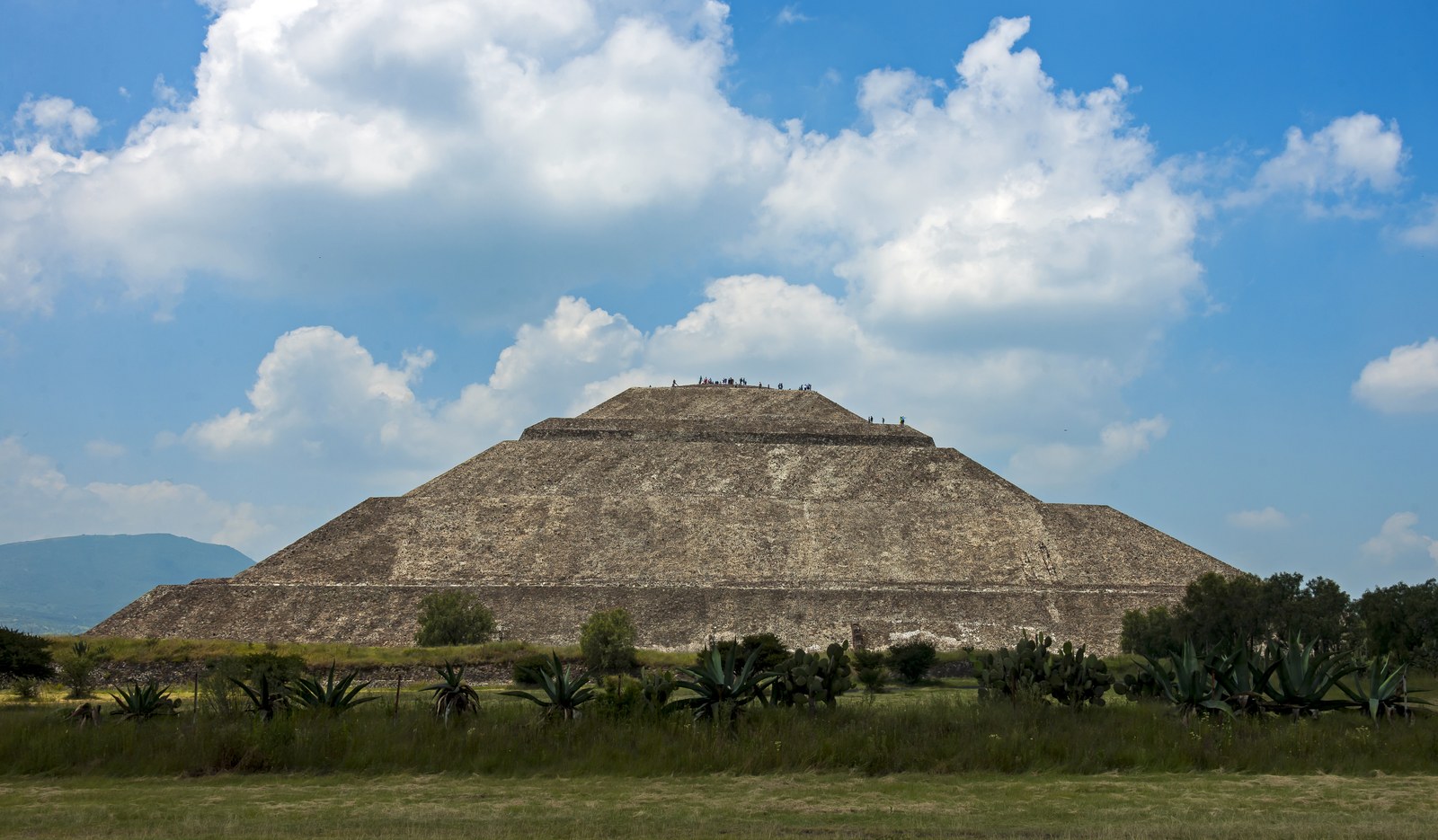
About 40 kilometres northeast of modern Mexico City, on a high, dry plateau in the Valley of Mexico, stand the ruins of a city that was already ancient when the Aztecs found it. Its great pyramids rise from the plain like mountains built by hand. The city is Teotihuacan: a metropolis that may have held more than 100,000 people, yet left no name for itself, no record of its rulers, and no account of why it burned.
A city before the Aztecs
The most common misunderstanding about Teotihuacan is also the easiest to correct. It was not an Aztec city. The Aztecs, who called themselves the Mexica, did not rise to power in central Mexico until the 14th century, roughly seven hundred years after Teotihuacan’s great monuments were sacked and burned. When Aztec pilgrims visited the ruins in the 1400s, the city had already lain abandoned for centuries.
The first small settlements in the valley date back to around 600 BCE. Archaeologists generally date the founding of the city itself to around 100 BCE, with its great monuments under continuous construction until about 250 CE. The city reached its height between about 100 and 550 CE, when it was the largest city in the pre-Columbian Americas and one of the largest cities in the world. Its population at its peak is commonly estimated at 125,000 or more, with some estimates reaching 200,000.
Teotihuacan was a planned city, laid out on a grid aligned to a central axis. The urban core covered roughly 21 square kilometres, and the wider archaeological zone covers about 83 square kilometres. Within the city stood some 2,000 single-storey apartment compounds, along with plazas, temples, palaces and workshops.
The Pyramid of the Sun
The largest structure at Teotihuacan is the Pyramid of the Sun, the third largest pyramid in the world by volume after the Great Pyramid of Cholula and the Great Pyramid of Giza. It stands about 65 metres high, with a base measuring roughly 225 by 222 metres, and its volume is estimated at around one million cubic metres. Built in stages, it was completed by about 200 CE.
The pyramid faces west and stands in the shadow of the mountain Cerro Gordo to the north. It was once topped by a temple, and its stepped tiers were originally covered in lime plaster and painted. Beneath it, excavations in 1971 revealed a cave-like tunnel running from the western face towards the centre of the pyramid. The tunnel was probably a natural lava tube adapted for ritual use, suggesting the site was sacred before the pyramid was raised over it.
The first major excavations of the Pyramid of the Sun were carried out under Leopoldo Batres in 1905. Much of the pyramid’s present appearance dates from that restoration. Even so, it remains an extraordinary monument: hundreds of thousands of tonnes of stone, adobe brick and volcanic rock, moved and set in place without metal tools, draught animals or the wheel.
The Pyramid of the Moon and the Avenue of the Dead
At the northern end of the city’s great axis stands the Pyramid of the Moon. It is the second largest structure at Teotihuacan, about 43 metres high with a base of roughly 130 by 156 metres.
The Avenue of the Dead, known in Spanish as the Calzada de los Muertos, is the spine of the city. It runs for roughly two kilometres through the ceremonial centre, flanked by platforms, temples and palace compounds. Its name, like the names of the pyramids, was given by the Aztecs, who believed the low mounds lining it were tombs. The structures along it were mostly temples and elite residences, and the avenue itself was a processional way.
The palaces and temples that line the avenue were decorated with murals of extraordinary richness, painted in reds, greens and blues on lime plaster, showing feathered serpents, jaguars, butterflies and figures in elaborate costume. Fine examples survive in the palace compounds of Tetitla, Atetelco and Tepantitla.
The Temple of the Feathered Serpent
At the southern end of the Avenue of the Dead lies the Ciudadela, a great walled enclosure that may have been the city’s administrative heart. At its centre stands the Temple of the Feathered Serpent, also known as the Pyramid of Quetzalcoatl. Built around 200 CE, it is the most richly decorated building at Teotihuacan, its facades carved with alternating heads of the feathered serpent Quetzalcoatl and the rain god Tlaloc.
The temple’s splendour conceals a darker history. In the late 1980s, archaeologists excavating the temple discovered a burial pit containing the remains of some 200 sacrificed warriors, buried with their weapons and ornaments. The building was evidently consecrated with large-scale human sacrifice.
In 2003, archaeologists found a tunnel beneath the temple, sealed for nearly 1,800 years. Explored by a team led by Sergio Gómez of Mexico’s National Institute of Anthropology and History (INAH), it contained thousands of offerings, including jade, obsidian, pottery and shells, and appears to have symbolised the underworld.
A planned metropolis of many peoples
Teotihuacan was not only a ceremonial centre. It was a working city, and one of the most cosmopolitan in the ancient Americas. Its workshops produced obsidian tools, pottery and the thin orange ware traded across Mesoamerica. Obsidian from nearby mines was an economic foundation, and Teotihuacan goods and styles reached the Maya cities of Guatemala and Yucatán.
Isotope analysis of bones from the apartment compounds shows that people from far away lived and died in Teotihuacan. Distinct neighbourhoods housed Zapotec migrants from Oaxaca and Maya from the lowlands, some maintaining their own customs for generations. Some scholars argue the city was governed by a collective government rather than a single king. That idea remains debated, but it fits a striking fact: unlike the Maya, who recorded their kings in inscriptions, Teotihuacan has yielded no names of rulers, no royal tombs, and no readable written history. Its talud-tablero architecture, a sloping wall topped by a vertical panel, was used throughout the city and copied far beyond its borders.
The burning of the city
Around 550 CE, the monumental heart of Teotihuacan was systematically sacked and burned. The great temples and elite residences along the Avenue of the Dead were set on fire and sculptures smashed. By about 750 CE it was largely abandoned.
Why the city fell is one of the central questions of Mesoamerican archaeology, and there is no settled answer. The destruction was concentrated on elite and ceremonial buildings rather than on ordinary housing, which has led many archaeologists to favour the theory of an internal uprising, in which the city’s own people turned against their rulers. Other proposed causes include drought, deforestation for lime plaster, and the extreme weather events of 535–536, possibly linked to volcanic eruptions elsewhere. Rival cities such as Cholula and Xochicalco have also been suggested as factors. Anthropologist Linda Manzanilla of the National Autonomous University of Mexico has argued for internal clashes between groups with differing economic interests. The cause was probably a combination of several pressures, and no single explanation has won general agreement.
The Aztecs and the name
Centuries after the fall, the ruins were visited by the Aztecs. They named the place Teotihuacan, from the Nahuatl words usually translated as “the place where the gods were created” or “where men became gods”. According to Aztec legend, the gods gathered here to create the sun and the moon. The Aztecs treated the site as a place of pilgrimage, adopting its gods, including Tlaloc and Quetzalcoatl, into their own religion.
The Aztec name stuck, and it is the name the site is known by today. But it is not the city’s own name. The original name of Teotihuacan, and the language its people spoke, are unknown. The Maya called it “puh”, “place of reeds”, in their texts — an outsider’s label. Candidates for the inhabitants’ ethnicity include the Nahua, Otomí and Totonac peoples, and many scholars favour a multi-ethnic view. The Toltecs, once suggested as the builders, flourished centuries later, between about 900 and 1150 CE.
Rediscovery and protection
Teotihuacan was never truly lost. People lived in and around the ruins for centuries, and the pyramids were visible landmarks long before modern archaeology. Excavation has continued under INAH since Batres, and the site is now Mexico’s most visited archaeological site.
In 1987, UNESCO inscribed the Pre-Hispanic City of Teotihuacan on the World Heritage List, under cultural criteria (i), (ii), (iii), (iv) and (vi), citing the artistic achievement of the ceremonial ensemble and the city’s influence across Mesoamerica. The site is protected under Mexican federal law and is in the custody of INAH.
Today the Pyramid of the Sun still dominates the valley as it did nearly two thousand years ago. The city that built it remains anonymous: no king list, no chronicle, no name — only a planned metropolis of stone and paint that outlasted its builders by more than a thousand years.
What is documented, and what is not
Documented facts: Teotihuacan lies about 40 kilometres northeast of modern Mexico City. It was founded around 100 BCE, with major monuments built until about 250 CE, and reached its peak between about 100 and 550 CE, with a population estimated at 125,000 or more. The Pyramid of the Sun is about 65 metres high with a base of roughly 225 by 222 metres and a volume of about one million cubic metres. The Pyramid of the Moon is about 43 metres high. The Temple of the Feathered Serpent was built around 200 CE; excavations found some 200 sacrificed warriors at its core. The city’s monumental centre was sacked and burned around 550 CE, and the city was largely abandoned by about 750 CE. The Aztecs named the ruins Teotihuacan centuries later; the city’s original name, its people’s language, and its rulers’ names are unknown. UNESCO listed the site in 1987; it is in the custody of INAH.
Unverified or disputed claims: The cause of the city’s collapse is disputed: internal revolt, drought, environmental degradation, the climate events of 535–536, and rivalry with other cities have all been proposed, and no single explanation is established. Whether it was ruled by a king or a collective government is debated, as is the ethnicity of its founders. Claims of extraterrestrial builders are fringe claims with no archaeological support. The peak population is an estimate, and figures vary between sources.