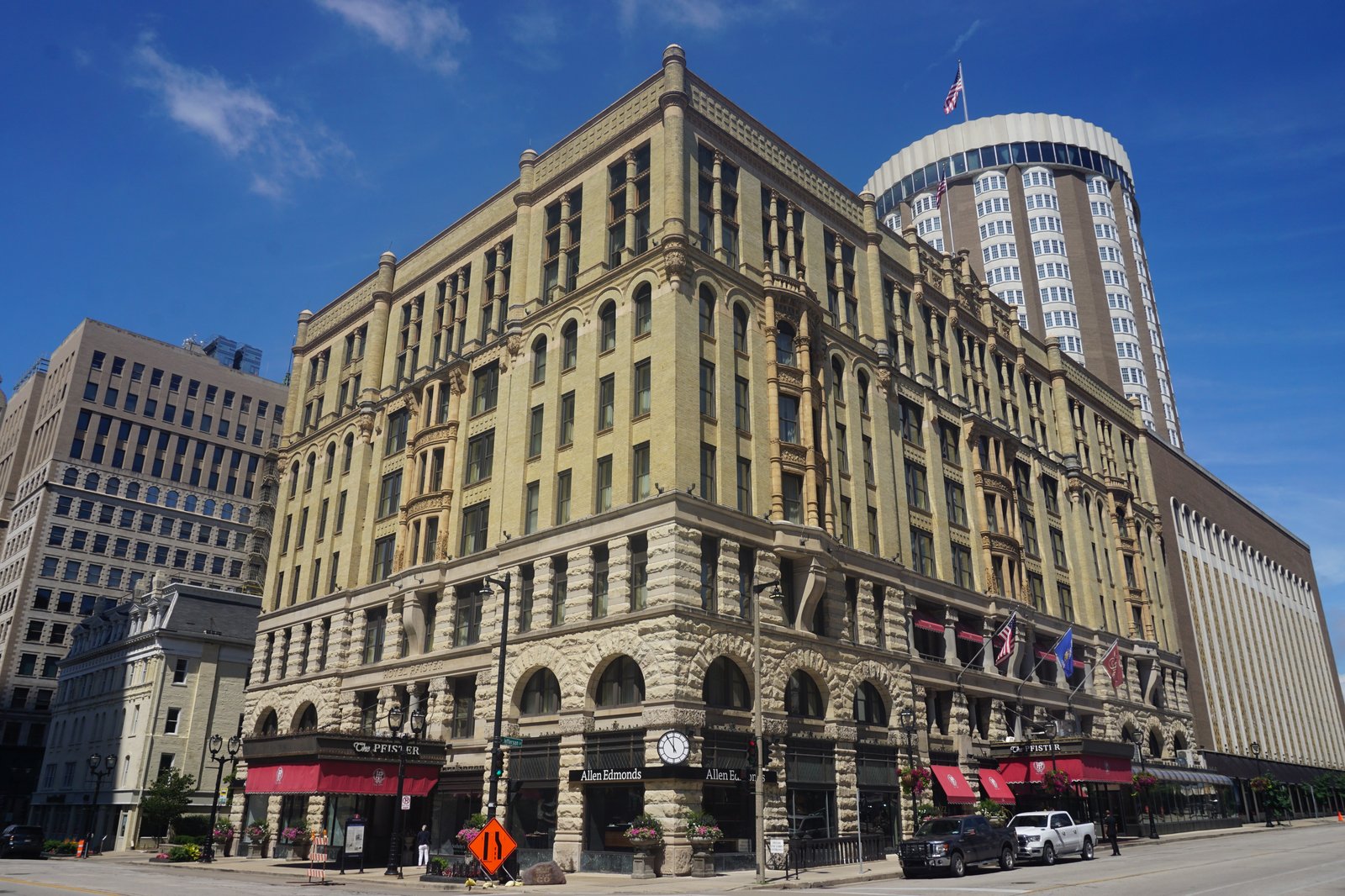
In downtown Milwaukee, on the corner of East Wisconsin Avenue and North Jefferson Street, stands a grand old hotel of stone and brick, with arched windows, a red-canopied entrance, and a clock above the door. It is the Pfister Hotel, and it has been Milwaukee’s grandest address since 1893. It is also, by a wide margin, the most haunted hotel in American professional sports. Visiting Major League Baseball teams stay at the Pfister when they play the Milwaukee Brewers, and over the years, a remarkable number of players have come away with stories. Footsteps in locked rooms. Televisions and air conditioners switching on by themselves. Clothes moved across the room overnight. Some players have asked for new rooms. Some have refused to stay at all. The ghost, most people say, is Charles Pfister himself, the man who built the hotel and ran it for more than three decades, still checking that everything runs smoothly.
The grand hotel of the west
The Pfister was the dream of Guido Pfister, a German immigrant who had made a fortune in tanning in Milwaukee. He planned a grand hotel for the city, but he died before it was built. His son Charles carried the plans forward. The hotel opened in 1893, a Romanesque Revival building designed by the architect Henry C. Koch, and it cost more than a million dollars — a staggering sum for the time. It was called the Grand Hotel of the West, and it lived up to the name.
The Pfister was, for its day, a marvel of technology. It was fireproof. It had electricity throughout. And every guest room had its own thermostat, so that guests could adjust their own temperature — a luxury that, in 1893, was practically science fiction. The hotel’s lobby was marble and gilt, with painted ceilings, and its art collection — Victorian paintings gathered by Charles Pfister — was said to be the largest of any hotel in the world. The hotel still displays it.
Charles Pfister ran the hotel from opening day until his death, doing everything from greeting guests to personally hiring employees. He suffered a paralytic stroke in April 1927 at his lake retreat, Camp Rest, on Lake Five in Washington County, Wisconsin. Seven months later, he suffered a second stroke at the same place, and died on 12 November 1927, of pneumonia. He did not die at the hotel. There are, in fact, no official records of any death in the Pfister Hotel in its entire history. That has not stopped the ghost stories.
A twenty-three-storey guest tower was added in 1965, behind the original 1893 building. The hotel is a member of Historic Hotels of America and Historic Hotels Worldwide, and it sits in a historic district on the National Register of Historic Places. It has 307 rooms. Most visiting Major League Baseball teams stay there. That is how its ghost stories went national.
The ballplayers
The best-known Pfister stories come from baseball players, and they have accumulated over more than two decades. The pattern is consistent: a player, alone in his room after a night game, hears something, sees something, or wakes to find something changed.
In 2001, Adrián Beltré, then with the Los Angeles Dodgers, described several eerie happenings during his stay: knocking in the hallway and on his door, with nobody there when he looked, and the air conditioning and the television switching on and off by themselves. In 2008, Carlos Gómez, then with the Minnesota Twins, said he heard voices and saw his iPod turn on and vibrate wildly; he hurried to the lobby before he was fully dressed. In 2009, Pablo Sandoval of the San Francisco Giants told a similar story: he left his iPod by a speaker while he showered and came out to find it playing.
In 2012, Bryce Harper, then with the Washington Nationals, told ESPN that he had left his jeans and shirt on the bench at the foot of his bed and woken to find the clothes on the floor and the bench pushed against the far wall, with the door still latched. He asked for a different room. In 2013, C.J. Wilson described flickering lights. In the same year, Michael Young, the longtime Texas Rangers infielder, told ESPN The Magazine that he had lain in bed after a night game and heard footsteps stomping around inside his locked room. His response was oddly polite: make yourself at home, he said, but please don’t wake me up.
The stories continued. In 2016, Ji-Man Choi, then with the Los Angeles Angels, felt a ghost on a Sunday night during his first trip to Milwaukee. In 2018, St. Louis Cardinals players Carlos Martínez and Marcell Ozuna both claimed to have seen a ghost. In 2023, Los Angeles Dodgers star Mookie Betts declined a room at the hotel for a regular-season series, and has done so on every road trip to Milwaukee since, renting an Airbnb instead. Betts has said he does not believe in ghosts, but just in case. Other players have made the same choice. In May 2009, the Palm Beach Post reported that whenever the Florida Marlins stayed at the Pfister, at least four players demanded to double up and share rooms for fear of the ghost.
The ghost himself
The ghost most often linked to the Pfister is Charles Pfister. Guests and staff have described an elderly gentleman walking the halls, a portly, smiling figure who is there one moment and gone the next. He is said to haunt the grand staircase up to the second floor, and to appear in the lobby and the Imperial Ballroom. The stories describe him as a protective presence, a man checking that his hotel is running properly, rather than a frightening one.
There is an alternative theory. Charles Milwaukee Sivyer, a city native born in 1836, was interviewed in the Milwaukee Daily Sentinel shortly after the Pfister opened, and some have suggested that he, rather than Charles Pfister, is the figure in the halls. The hotel’s own lore, however, favours Pfister, and it is Pfister’s name that the stories use.
The reported activity covers a lot of ground. Accounts include footsteps in hallways, knocking on doors, whispers, laughter, and sudden cold spots. The second floor is said to be completely haunted. Paranormal investigators have taken an interest, and the hotel often lands on lists of the most haunted hotels in the country. In 2018, the Travel Channel ranked the Pfister as the creepiest place in Wisconsin. In the same year, Historic Hotels of America ranked it eleventh on a list of the most haunted historic hotels.
Why baseball players?
The Pfister’s haunting is unusual in that its witnesses are, disproportionately, professional athletes. That is partly a matter of exposure: visiting teams stay at the Pfister more than any other group, and they stay in the historic 1893 building, where the reports are concentrated. It is also a matter of testimony. Baseball players talk to the press. They give interviews. They tell stories. A travelling salesman who hears footsteps in his room does not make the news. A Major League shortstop who does is on ESPN the next day.
There is also a psychological factor. Baseball players are, by the nature of their work, creatures of routine and superstition. They sleep in a different hotel every week. They are tired, they are alone, and they are in a strange room. A noise in the night, in those circumstances, is easily a ghost. And once the story is established — once a player has heard, before he arrives, that the Pfister is haunted — he is primed to hear it. Expectation is a powerful thing.
None of which means the players are lying. Beltré, Young, Harper, Betts and the others have told their stories consistently, and in detail, to reputable journalists. They have nothing to gain from the stories, and in some cases — Betts, who now books his own accommodation — they have something to lose. The stories are, at the very least, sincerely told.
The hotel’s position
The Pfister does not hide its ghost. It does not advertise it aggressively, either. The hotel’s official position is that guests report what they report, and that the hotel is proud of its history. There is no named haunted room — the advice, for those who want the experience, is to ask for a room in the historic 1893 building rather than the tower. The grand staircase, the lobby and the Imperial Ballroom are the places where the stories cluster.
The hotel’s art collection, its architecture and its history would be enough to make it a landmark. The ghost is a bonus. Milwaukee has embraced it. The Pfister is the city’s grand hotel, and it is also its haunted hotel, and the two identities reinforce each other. A hotel with a ghost is a hotel with a story, and a hotel with a story is a hotel people remember.
What is documented, and what is not
Documented facts: The Pfister Hotel opened in 1893 in Milwaukee, Wisconsin, built by Guido Pfister and his son Charles at a cost of about $1 million; the architect was Henry C. Koch. Charles Pfister ran the hotel until his death on 12 November 1927. A 23-storey tower was added in 1965. The hotel is a member of Historic Hotels of America and sits in a historic district on the National Register of Historic Places. Multiple Major League Baseball players — including Adrián Beltré (2001), Carlos Gómez (2008), Pablo Sandoval (2009), Bryce Harper (2012), C.J. Wilson (2013), Michael Young (2013), Ji-Man Choi (2016), Carlos Martínez and Marcell Ozuna (2018), and Mookie Betts (2023–24) — have publicly described unexplained events in their rooms. In 2018, the Travel Channel ranked the Pfister the creepiest place in Wisconsin.
Unverified or disputed claims: The claim that the hotel is haunted by Charles Pfister rests on anecdotal reports, none of them independently verified. The claim that there are no official records of any death in the hotel’s history is reported in secondary sources and has not been independently confirmed. The claim that the second floor is “completely haunted” is local lore. The players’ accounts — footsteps, moving clothes, electronics switching on — are sincerely reported but have natural explanations, including expectation, fatigue, unfamiliar surroundings, and the ordinary noises of a large old building, none of which has been ruled out.