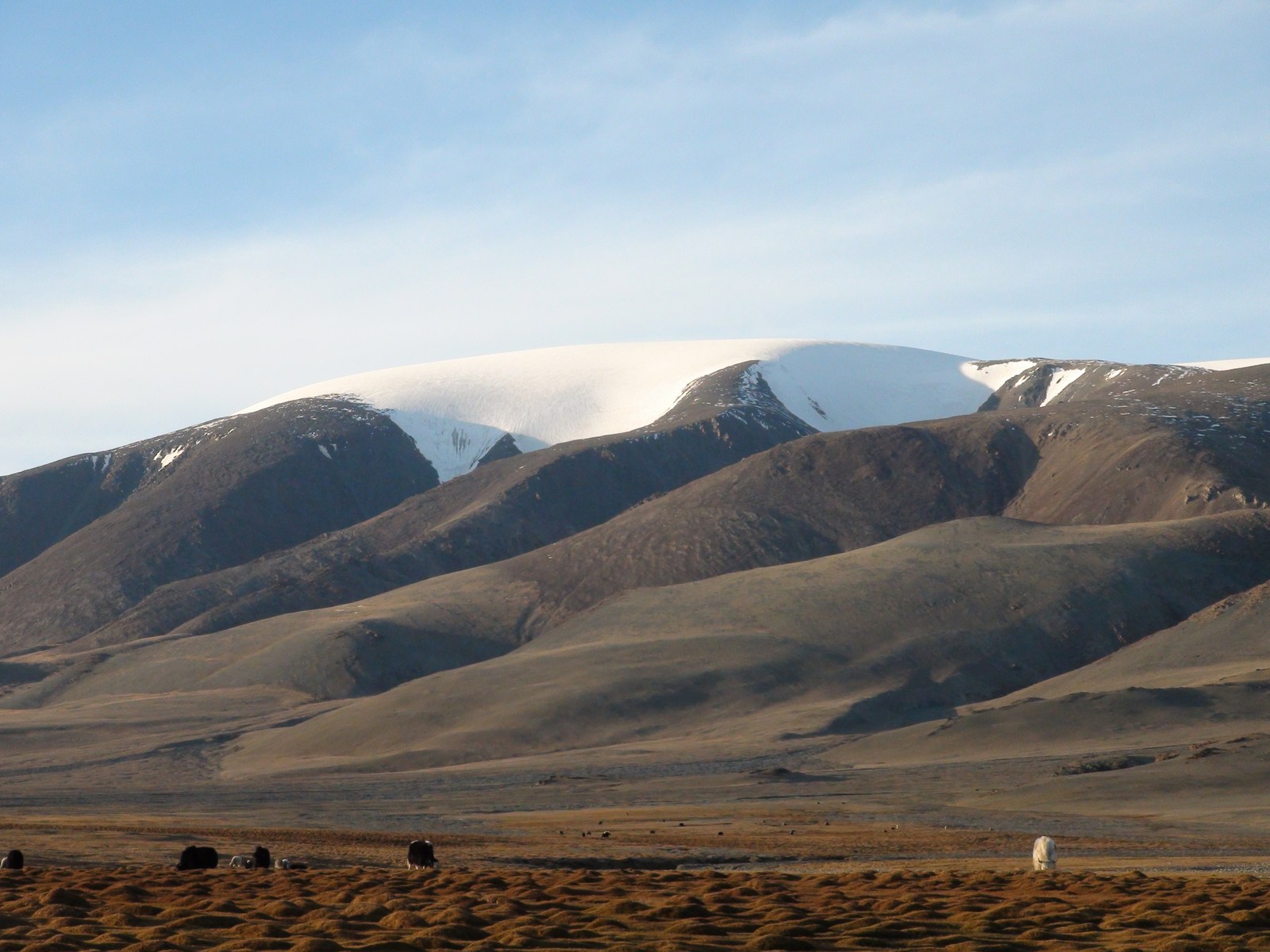
The word is Mongolian, and it means “wild man”. The creature it names has been reported for longer than any other wild man on Earth — longer than Bigfoot, longer than the yeti, longer than any of the forest giants that fill the cryptozoological literature. The almas is said to live in the mountains of Central Asia: the Caucasus, the Pamir, and the Altai of southern Mongolia. It is described as six feet tall, covered in reddish-brown fur, with a heavy brow, a flat nose and no chin, and a way of life that is more human than ape-like. It does not hide in the deep forest. It walks the high valleys, it trades with remote villages, and it has, on at least one occasion, lived among people. The almas is the wild man as a neighbour, not a monster, and that is what makes it the most interesting of its kind.
The Mongols themselves do not treat the almas as folklore. In Mongolian tradition, the creature is not a spirit or a demon. It is an animal, an ordinary creature made of flesh and blood, listed among the other animals of the country. A Mongolian manuscript of natural history from the late eighteenth century includes a wild man among its entries, alongside the other species of the region. A Tibetan medicinal book, an apothecary’s handbook full of illustrations, includes a drawing of an almas among its animals. The British anthropologist Myra Shackley, writing about the book in 1983, noted that it contained thousands of illustrations of reptiles, mammals and amphibians, “but not one single mythological animal such as are known from similar medieval European books. All the creatures are living and observable today.” If the Tibetans drew the almas, she argued, it was because they believed it was real.
Six hundred years of reports
The oldest written account of the almas comes from a Bavarian nobleman named Hans Schiltberger, who crossed the Tian Shan mountains as a prisoner of the Mongols around 1420. Schiltberger recorded seeing wild men in the mountains, and he also recorded one of the first European sightings of the Przewalski’s horse, the wild horse of the steppe. His manuscript survives in the Munich Municipal Library, and it is the first European description of the almas, written by a man who had no reason to invent it and no audience for a monster story.
The reports continued. In 1871, the Russian explorer Nikolai Przhevalsky, the man who gave his name to the wild horse, observed almas in Mongolia. Local people told stories of sightings and of encounters with the creatures that went back several hundred years. They told of almas trading goods with remote villages, leaving items at agreed places and taking others in return — a silent trade, conducted without speech, between two peoples who shared a mountain range but not a language.
The most detailed modern account came in 1963, when a Soviet paediatrician named Ivan Ivlov reported observing a whole family group of almas in Mongolia. Ivlov had been interviewing Mongolian children who were his patients, and he discovered that many of them claimed to have seen the creatures. He went to look for himself, and described a family: adults and young, moving through the high country, covered in reddish-brown hair, with anthropomorphic faces, pronounced brow ridges, flat noses and no chins. Shackley recounted Ivlov’s observation in her book Still Living?, published in 1983, and it remains the most careful eyewitness account in the almas literature.
The woman called Zana
The most famous almas case of all is also the one that, in the end, proved the least. It is the story of Zana, a wild woman said to have lived in the isolated mountain village of Tkhina, about fifty miles from Sukhumi, in Abkhazia in the Caucasus. According to the accounts collected by Russian investigators — Igor Burtsev, Dmitri Bayanov, Alexander Mashkovtsev and Boris Porshnev, who gathered more than a hundred testimonies about her — Zana was captured in the mountains in 1850. She was at first violent toward her captors, but soon became domesticated, and was able to assist with simple household chores.
Zana passed through several owners. She was, at one point, the property of a local prince, and later she was presented to a nobleman named Edgi Genaba, who took her to his estate in the village of Tkhina, on the Mokva River, about seventy-eight kilometres from Sukhumi. At first Genaba kept her in a strong enclosure, because she acted like a wild beast, and nobody ventured in to give her food. Over time, she settled. She could not speak — in decades among people, she did not learn a single Abkhaz word, only inarticulate sounds — but she learned to work, to carry water, to help in the house. She is said to have had sexual relations with Genaba, and to have given birth to several children, all of apparently normal human appearance. One son, named Khwit, died in 1954. Zana herself died in 1890.
Some cryptozoologists speculated that Zana was an almas, a wild woman captured and tamed. The evidence, when it was finally tested, said otherwise. In 2013, the Channel 4 documentary Bigfoot Files featured Professor Bryan Sykes of the University of Oxford, who analysed DNA from Zana’s descendants and showed that her DNA was 100 per cent Sub-Saharan African in origin. She could have been a slave brought to Abkhazia by the Ottoman Empire, Sykes suggested. In 2015, Sykes reported further tests — on saliva samples from six of Zana’s living relatives and on a tooth of her deceased son Khwit — and concluded that Zana was 100 per cent African but not of any known group, refuting the theory that she was a runaway Ottoman slave. What she was, exactly, remains unclear. What she was not, the DNA says, was a wild man. She was a human being, and her story is a human tragedy, not a cryptozoological triumph.
What the witnesses describe
The descriptions of the almas are consistent across six centuries, and they are more detailed than most wild-man reports, because the almas is said to live close to people. The creature stands about six feet tall, walks upright, and is covered in reddish-brown fur. Its face is human-like, with pronounced brow ridges, a flat nose, and no chin. Its behaviour is considered far more human than ape-like: it walks, it gestures, it trades, it watches. It does not, in most accounts, attack people. It avoids them, or it deals with them on its own terms.
The theories
The almas has attracted more serious scientific speculation than almost any other cryptid, and the speculation has run in two directions. Myra Shackley and Bernard Heuvelmans both suggested that the almas might be a relict population of Neanderthals, surviving in the mountains of Central Asia long after the species was thought to have died out. Shackley wrote that the almas’s straightforward way of life and appearance “strongly suggests that the almas may represent remnants of a prehistoric way of life and perhaps even an early form of a human, of which the best representative is the Neanderthal.” Loren Coleman, the American cryptozoologist, suggested surviving specimens of Homo erectus instead.
The mainstream view is simpler, and less romantic. Most scientists consider the almas to be a purely legendary creature, and they reject the possibility of such a cryptid on ecological grounds: a breeding population of large hominids would need improbably large numbers to survive, and would leave bones, droppings and hair. The Altai and the Pamir are remote, but they are not unvisited. They have been hunted, herded, mined and surveyed for centuries. A population of six-foot wild men would have been found by now, or at least would have left a body.
There is a middle possibility, and it is the one Shackley’s work points toward. The almas may be a memory — a cultural memory of the Denisovans, or of Neanderthals, or of other archaic humans who really did live in Central Asia, preserved in Mongolian tradition long after the people themselves were gone. The Altai is, after all, the place where Denisovan fossils were found, in a cave not far from where the almas is said to live. A tradition that remembers a wild man in the mountains may be remembering something real, even if the thing it remembers is no longer there.
Why the story endures
The almas endures because it has the longest paper trail of any wild man, and because the paper trail was written by people who knew what they were looking at. Schiltberger was a prisoner, not a storyteller. Przhevalsky was a professional explorer. Ivlov was a doctor. Shackley was an anthropologist. None of them set out to find a monster, and all of them wrote down what they saw with a care that is unusual in this field.
What is documented, and what is not
Documented facts: Written accounts of wild men in Central Asia go back to Hans Schiltberger’s journal of about 1420. Nikolai Przhevalsky observed almas in Mongolia in 1871. A Mongolian manuscript of natural history from the late eighteenth century and a Tibetan medicinal book both include drawings of a wild man. Ivan Ivlov reported observing a family group of almas in Mongolia in 1963, as recounted by Myra Shackley in Still Living? (1983). Zana, a wild woman, was captured in the Caucasus in 1850, lived in the village of Tkhina, had children with Edgi Genaba, and died in 1890; her son Khwit died in 1954. DNA analysis by Professor Bryan Sykes, reported in 2013 and 2015, showed Zana was 100 per cent Sub-Saharan African in origin. No body, skeleton or DNA sample of an almas exists.
Unverified or disputed claims: That a population of unknown hominids lives in the Altai, Pamir or Caucasus rests entirely on eyewitness testimony and footprints, none of it independently verified. That Zana was an almas is contradicted by the DNA evidence, which shows she was human. The suggestions that the almas is a relict Neanderthal population or a surviving Homo erectus are speculation, not findings. The claim that the almas trades goods with remote Mongolian villages is part of the local tradition, not a documented observation. The significance of Khwit’s skull, described as different from normal Abkhazian males, has never been established.
Sources
- https://alchetron.com/Almas-(cryptozoology)
- https://Monstropedia.org/index.php?title=Almas
- https://ancient-theory.com/mysterious-almas-bigfoot-of-central-asia/
- http://esoterx.com/2013/01/26/the-almas-of-the-atlai-our-cousins-the-mongolian-monstrosities/comment-page-1/