In the winter of 1850, a great storm battered the Orkney Islands, off the northern coast of Scotland. Wind and high tides tore the turf from a large mound on the Bay of Skaill, on the west coast of Mainland Orkney, and exposed stone walls beneath. The landowner, William Watt, the seventh Laird of Skaill, whose house stood only two hundred metres away, noticed what the storm had revealed and began to dig. Under the sand lay a village, five thousand years old, its houses still standing, its furniture still in place. It is called Skara Brae, and it is the best-preserved Neolithic village in Europe.
The village was built around 3100 BCE — older than Stonehenge, and older than the Great Pyramid of Giza. It was occupied for about six hundred years, until around 2500 BCE. When it was inhabited, the shore was further away than it is today; the sea has eaten into the land since, and the village now sits at the edge of the bay, protected by a modern sea wall. The name “Skara Brae” is a corruption of the old name for the mound that buried the village, “Skerrabra” or “Styerrabrae”. The name its own people used is unknown.
Houses of Stone
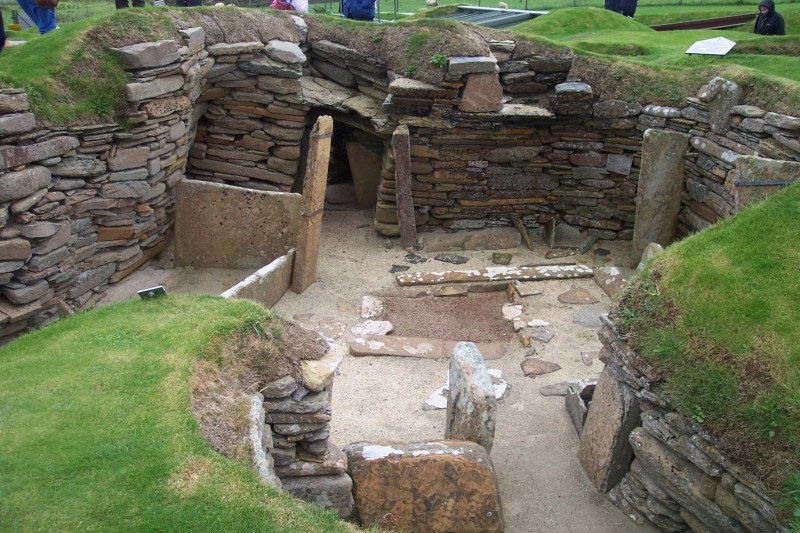
Skara Brae is a cluster of stone-built houses, linked by covered stone passages. Ten houses have been uncovered; eight of them form the main linked cluster, with two more — including a building identified as a workshop — standing nearby. The houses were built partly sunk into the ground, inside a huge mound of midden material: decomposed vegetable matter, dung, animal bones, and shells. The thick stone walls, insulated with earth, and the low, covered passages kept out the wind that sweeps across Orkney.
Step inside one of the houses — or rather, look down into it from the path, since visitors cannot enter the houses themselves — and you see a home that is recognisably a home. Each house has a central hearth for cooking and heat, a stone dresser opposite the door, where precious objects were probably displayed, and box-beds built into the walls on either side. There are stone shelves, stone water tanks set into the floor, and small stone boxes that may have been used to store fishing bait, kept wet with seaweed. The doors were made of stone too, pivoting on stone sockets, and could be barred from the inside.
There are no windows. Light came through the doorway and, probably, through a hole in the roof above the hearth, which also let out the smoke. The roofs themselves have not survived; they were probably made of wood, turf, or whalebone, and they collapsed or rotted away long ago. What survived is the stone — and that is what makes Skara Brae extraordinary. In most Neolithic settlements, only the foundations remain. Here, the furniture is still there.
A Farming Community
The people of Skara Brae were farmers, at a time when farming was still new to northern Europe. They grew barley and wheat, and they kept cattle, sheep, and pigs. They fished, hunted seals and seabirds, and gathered shellfish. The bones found in the village show a diet that mixed farming with the resources of the shore, and the tools — stone knives, bone pins, pottery — show a community that made almost everything it needed.
The houses changed little over six centuries. Walls were rebuilt, furniture was rearranged, and passages were re-routed, but the basic plan stayed the same. There is no sign of a great house, a temple, or a chief’s residence — Skara Brae looks like a village of equals, a community of families living in similar houses, side by side. That is itself a remarkable fact: six hundred years of stability, in a place that most of the world would have called the edge of nowhere.
The village is part of a much larger Neolithic landscape. Two kilometres away stand the Stones of Stenness and the Ring of Brodgar, great stone circles; nearby is Maeshowe, a chambered tomb aligned to the setting sun at the winter solstice. Together with Skara Brae, these form the Heart of Neolithic Orkney, inscribed on UNESCO’s World Heritage List in 1999. Orkney in the Neolithic was not a backwater. It was one of the most important centres of early farming culture in Britain.
The Storm, the Excavation, and the Legend
The traditional story of Skara Brae’s discovery is a good one: a storm in 1850, a laird with a taste for archaeology, and a buried village revealed in a single night. The Orcadian historian Ernest Marwick later argued that the story was, in his words, “a complete fiction”, and that the existence of an ancient site at the location had long been known locally. The truth probably lies between the two versions: the mound was known, but the storm of 1850 did expose the walls, and it was William Watt who first excavated the site, uncovering four houses before work stopped.
After Watt, the site was left largely alone for decades. Then, in 1925, another storm damaged the previously excavated structures, and the site came under the care of the state. Between 1928 and 1931, the archaeologist Gordon Childe — the first professor of archaeology at the University of Edinburgh — excavated and stabilised the village, building the sea wall that still protects it. Later excavations, notably by David Clarke in the 1970s, used radiocarbon dating to establish the age of the site and to study its abandonment.
For decades, a popular theory held that the village was buried in sand by a great storm, and that its people fled in panic, leaving their homes behind. Excavation in the 1970s disproved that idea. The evidence gathered by Graham and Anna Ritchie showed that the village was abandoned gradually, for reasons that are not known, and that it was then slowly buried by sand and soil over centuries. The storm-burial story, like the discovery story, was too dramatic to be true — and the real story, a village quietly emptied and slowly covered by the earth, is stranger in its own way.
Why Did They Leave?
The abandonment of Skara Brae, around 2500 BCE, remains a mystery. No evidence of violence or disaster has been found. Some researchers have suggested environmental change — a shift in climate, the encroachment of the sea, or the exhaustion of the land. Others point to social change: the Neolithic world of Orkney was changing, new ideas and new peoples were arriving, and a small village may simply have been left behind. The honest answer is that we do not know, and the village does not tell us.
What it does tell us is a great deal about how ordinary people lived five thousand years ago. Skara Brae is often called the “Scottish Pompeii”, and the nickname captures something real: a moment in daily life, preserved. But unlike Pompeii, there was no catastrophe here. The houses were not frozen in a moment of terror. They were left, and the sand came in, and the sea kept its distance for a while, and the village waited — under a dune, beside a laird’s house — for a storm to give it back.
Today the site is cared for by Historic Environment Scotland. Visitors look down into the houses from a path around the perimeter, and a visitor centre tells the story of the village from its founding to its abandonment. The sea is still close, and the sea wall is still needed. Skara Brae survived five thousand years under the sand. Keeping it safe now that it is exposed is a different kind of work.
What Is Known — and What Is Not
Documented facts: Skara Brae is a Neolithic village on the Bay of Skaill, Mainland Orkney, occupied from about 3100 to 2500 BCE. Ten stone houses have been uncovered, eight of them forming the main linked cluster, connected by covered passages. The houses contain stone furniture — beds, dressers, hearths, shelves, and storage boxes — preserved in place. The inhabitants farmed barley and wheat and kept cattle, sheep, and pigs. The village was exposed by a great storm in the winter of 1850 and first excavated by William Watt, the Laird of Skaill. Gordon Childe excavated and stabilised the site between 1928 and 1931 after a further storm in 1925. It was inscribed on UNESCO’s World Heritage List in 1999 as part of the Heart of Neolithic Orkney.
Unverified or open to interpretation: The traditional story that the village was discovered by the 1850 storm alone is disputed; the historian Ernest Marwick argued that an ancient site at the location was already known locally. The theory that a great storm buried the village and drove its people out in panic was disproved by excavations in the 1970s; the abandonment was gradual, and its cause is unknown. The identification of one outlying building as a workshop is an interpretation based on the objects found in it. The nickname “Scottish Pompeii” is a modern comparison, not a historical fact, and it is misleading in one respect: unlike Pompeii, Skara Brae was not destroyed by a catastrophe. The original name of the village is unknown.
Five thousand years ago, a family in Orkney came home in the evening, barred a stone door, and cooked over a fire in the middle of a room that still stands. That is the mystery of Skara Brae — not that it is strange, but that it is so familiar, across a distance of time that is almost impossible to imagine.
Sources
- https://www.thecollector.com/skara-brae-scotland-neolithic-village/
- https://www.worldhistory.org/audioplayer/en/1-11449/
- https://www.northlinkferries.co.uk/orkney-blog/skara-brae/
- https://www.historyextra.com/period/prehistoric/skara-brae/
- https://museumsuk.com/museums/stromness/skara-brae-visitor-centre.html
- https://commons.wikimedia.org/wiki/File:Orkney_Skara_Brae.jpg