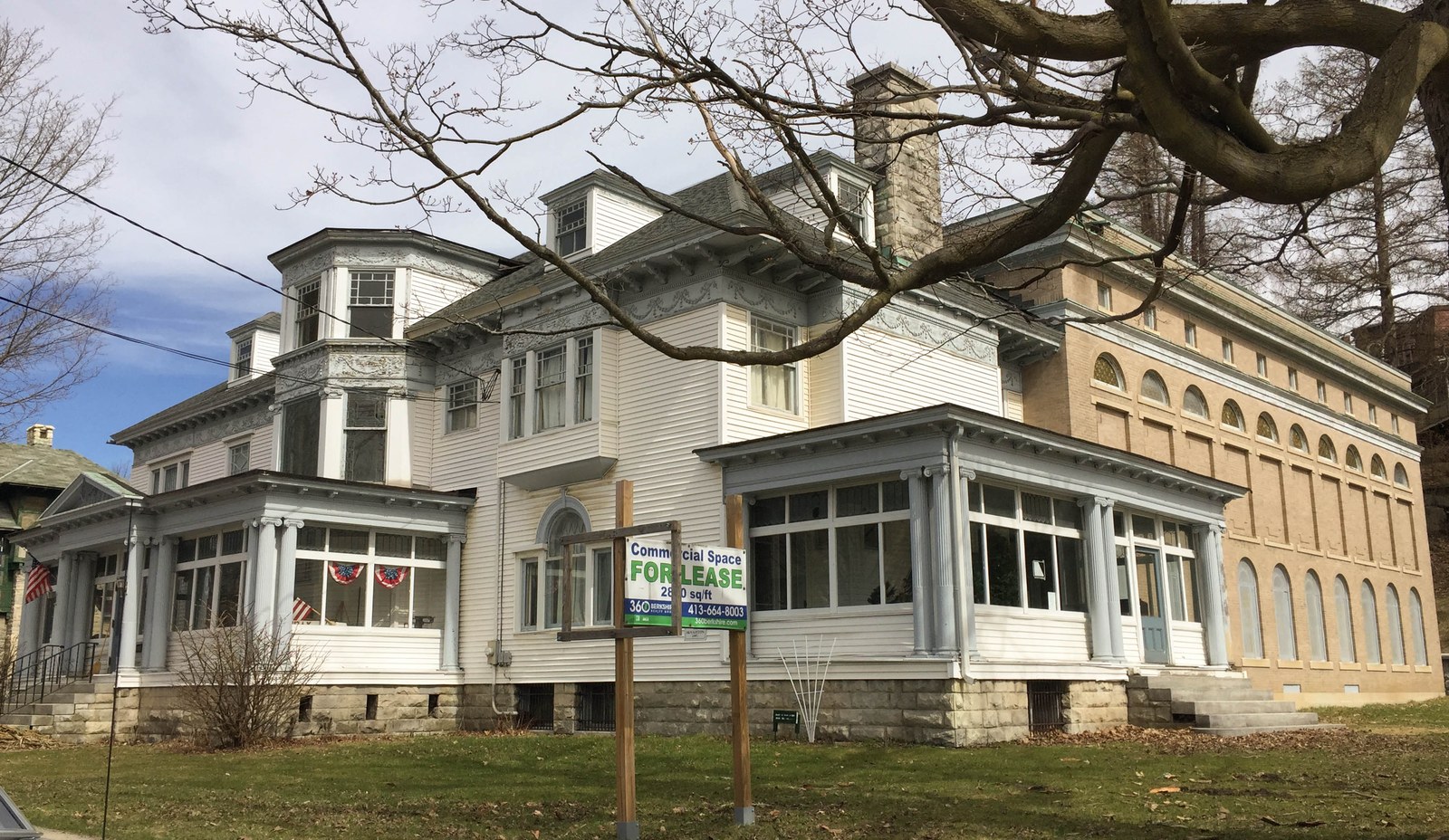
Walk up Church Street in North Adams, Massachusetts, and the house stops you. It is a grand Neoclassical Revival mansion, white clapboard with Greek details, a deep porch and a tall stone chimney, standing above a mill city in the northern Berkshires. The house is quiet now, and closed. But its story is one of the darkest in New England: in twelve days in August 1914, a single family lost a daughter, a friend, a chauffeur and its patriarch, and the house has been called haunted ever since.
It is a listed historic house at 172 Church Street, added to the National Register of Historic Places on 25 October 1985, and its ghost stories grew out of a real, documented tragedy.
The mayor’s house
Albert Charles Houghton was born in Vermont in 1844 and rose to become one of the most powerful men in North Adams. He ran the Arnold Print Works, one of the largest textile printing companies in the country. He was also the first mayor of North Adams, and the mansion was his statement of arrival: his third home in the city, and by far the most extravagant, built in the 1890s shortly before his term as mayor expired, to a design by architect Henry Neill Wilson.
The house was built in the Neoclassical Revival style, with strong Greek features and an eclectic mix of influences. Its roof was originally Spanish tile, and a formal garden at the rear hosted parties raising money for the North Adams Hospital.
The Houghtons moved in around 1900. The household then consisted of Albert, his wife Cordelia, and their youngest surviving daughter Mary, then twenty-three years old. Another daughter, Laura, had died as an infant, while three other daughters had grown up, married and had children of their own. By 1905, when Albert was sixty-one, his health had begun to fail, and Mary resolved that she would never marry but would devote her life to taking care of her father. Albert never truly retired, leaving major decisions to his son-in-law, William A. Gallup.
A new car, and a summer drive
In the spring of 1914, the Houghtons bought their first car, a seven-passenger Pierce-Arrow touring car, and sent their long-time chauffeur, John Widders — his name is also spelled Winters in some accounts — to learn to drive it. On the morning of Saturday, 1 August 1914, Albert and Mary decided to take a pleasure drive to Bennington, Vermont. Cordelia chose to stay at home. They were accompanied by Dr. and Mrs. Robert Hutton of New York; Mrs. Hutton, Sybil Cady Hutton, was a childhood friend of Mary’s and the daughter of North Adams shoe manufacturer W. G. Cady.
With Widders at the wheel, the car left the mansion at 9:00 a.m. By 9:30 it was in Pownal, Vermont, heading up what is now Oak Hill Road. The road was under repair, and a team of horses was parked on the right-hand side. Widders went around them on the left at about twelve miles per hour. On the left shoulder, the car tilted, went down a steep embankment and rolled over three times before coming to rest upright in a farmer’s field. Everyone except Mary was thrown from the car.
The men escaped with minor injuries. The women did not. Sybil Hutton was killed almost instantly when the car rolled over her. Mary was just as badly hurt and died of her injuries at 3:00 p.m. that afternoon at North Adams Hospital. Albert was taken home, expected to survive. He never recovered from the crash or the shock, and died at home ten days later, on 11 August 1914, at the age of seventy. It was said that he died of a broken heart.
The chauffeur’s guilt
The Vermont state investigator exonerated Widders of all wrongdoing, blaming the accident on the soft shoulder of the road rather than on the driver. But Widders blamed himself. He took his own life in the Houghton barn shortly afterwards, shooting himself with a horse pistol. Accounts differ on the exact morning — some say the day after the crash, others give 12 August, the day after Albert’s death — and on the precise hour, so the date is best left as it is recorded in the most careful histories: within days of the crash, in the barn on the Houghton property.
The crash became one of the most talked-about tragedies in the Berkshires.
After the crash, one of the surviving Houghton daughters, Florence, moved into the house with her husband, William A. Gallup, and they made it their home, looking after Cordelia until her death in 1916. They lived there until Gallup retired in 1926. That year Florence Gallup and her sister, Susan Houghton McKeon, sold the mansion to the Freemasons.
The Masons’ century
The Masons did away with the formal garden and built their lodge building in its place — the long brick hall with arched windows that still stands behind the house. Later the Spanish tile roof was replaced with asphalt, and siding covered the clapboards.
It was under the Masons that the ghost stories began. The lodge members who met in the house, and the ghost hunters they invited in, told of footsteps on the third floor, voices, a girl’s giggle, and lights moving up the main staircase. The house appeared on television, most notably on Ghost Adventures, whose first-season episode on the mansion helped fix its reputation as one of the most haunted houses in New England.
Mary Houghton is the figure most often named. The story goes that she kept her promise to care for her father, and still does. Visitors on overnight investigations have reported a girlish giggle, a tug on the hair, and a light like a lantern moving up the main staircase, followed by footsteps overhead with no one there. Her apparition is said to be seen most often in her old room, and visitors often describe feeling an immense sadness around her presence.
Albert Houghton himself is also said to be seen, and the chauffeur, John Widders, is reported as a shadowy figure on the servant staircase or in his old room. One of the most repeated stories concerns the piano: Masons are said to have played the first five notes of “Shave and a Haircut” and heard an unseen player answer with the two-note reply. Some accounts also mention a little girl in the basement, said to have no connection to the family.
A Williams College student reporter who toured the mansion in 2019 noted that a flashlight answering questions could be explained by a loose bulb, and that a table that moved may have been nudged by a guest.
A private house again
In 2017, unable to afford keeping the building up to code, the Lafayette-Greylock Freemasons sold the house to hotel developer Benjamin Svenon at a reported price of $160,000. The building has been closed to the public ever since, and its future use has not been made public. Older guides still describe it as a Masonic temple; that is no longer true, and there are no tours and no ghost hunts.
That matters for anyone who wants to see it. The mansion can be viewed from Church Street, but it is privately owned, and visitors should not trespass. The Houghton Mansion endures because its tragedy is real and its dates are exact. A car left the house at nine in the morning on 1 August 1914, and within days the family at its centre was gone. Whether anything lingers in the rooms is unproven. That a family was broken there, in a single fortnight, is not.
What is documented — and what is not
Documented: Albert Charles Houghton, president of the Arnold Print Works and first mayor of North Adams, built the mansion in the 1890s (sources give 1897; the family moved in around 1900) at 172 Church Street; it is a Neoclassical Revival house by architect Henry Neill Wilson, listed on the National Register of Historic Places on 25 October 1985. The car crash of 1 August 1914 in Pownal, Vermont, killed Sybil Hutton and Mary Houghton, who died at 3:00 p.m. at North Adams Hospital; Albert Houghton died on 11 August 1914; the Vermont investigator blamed the soft road shoulder and cleared the chauffeur, John Widders, who then took his own life in the Houghton barn. Florence Gallup and Susan Houghton McKeon sold the house to the Masons in 1926, and the Lafayette-Greylock Masons sold it to a private developer in 2017 for a reported $160,000. It has been closed to the public since.
Not verified or presented only as reported: The hauntings — footsteps, voices, the girl’s giggle, the lantern light on the stairs, the piano answering “Shave and a Haircut”, apparitions of Mary, Albert and Widders, and the little girl said to appear in the basement — are reports from Masons, investigators and visitors, not established fact. The claim that an earlier house stood on the site and that its basement survives under the mansion is local lore, not documented history. Sources disagree on the exact date and hour of Widders’ death (the morning after the crash, or 12 August; 4:00 a.m. or 5:00 a.m.), and some popular retellings wrongly call him the family’s butler — he was the chauffeur — or wrongly say Albert shot himself. The statement that Albert died “of a broken heart” is how the loss was described at the time, not a medical cause of death.
Sources
- Wikipedia, “Houghton Mansion” — https://en.wikipedia.org/wiki/Houghton_Mansion
- Haunted Rooms, “Haunted Houghton Mansion, North Adams: History and Ghosts” — https://www.hauntedrooms.com/massachusetts/haunted-places/houghton-mansion-north-adams
- Salem Ghosts, “The Spirits of Houghton Mansion” — https://salemghosts.com/the-spirits-of-houghton-mansion/
- Paul W. Marino, “The History of the Houghton Mansion” (quoted in The Nabokovian, “The Florence Houghton Room, a ghost story”) — https://www.thenabokovian.org/topic/florence-houghton-room-ghost-story
- The Williams Record, “Exploring North Adams’ Most Haunted Mansion” — https://williamsrecord.com/188010/features/exploring-north-adams-most-haunted-mansion/