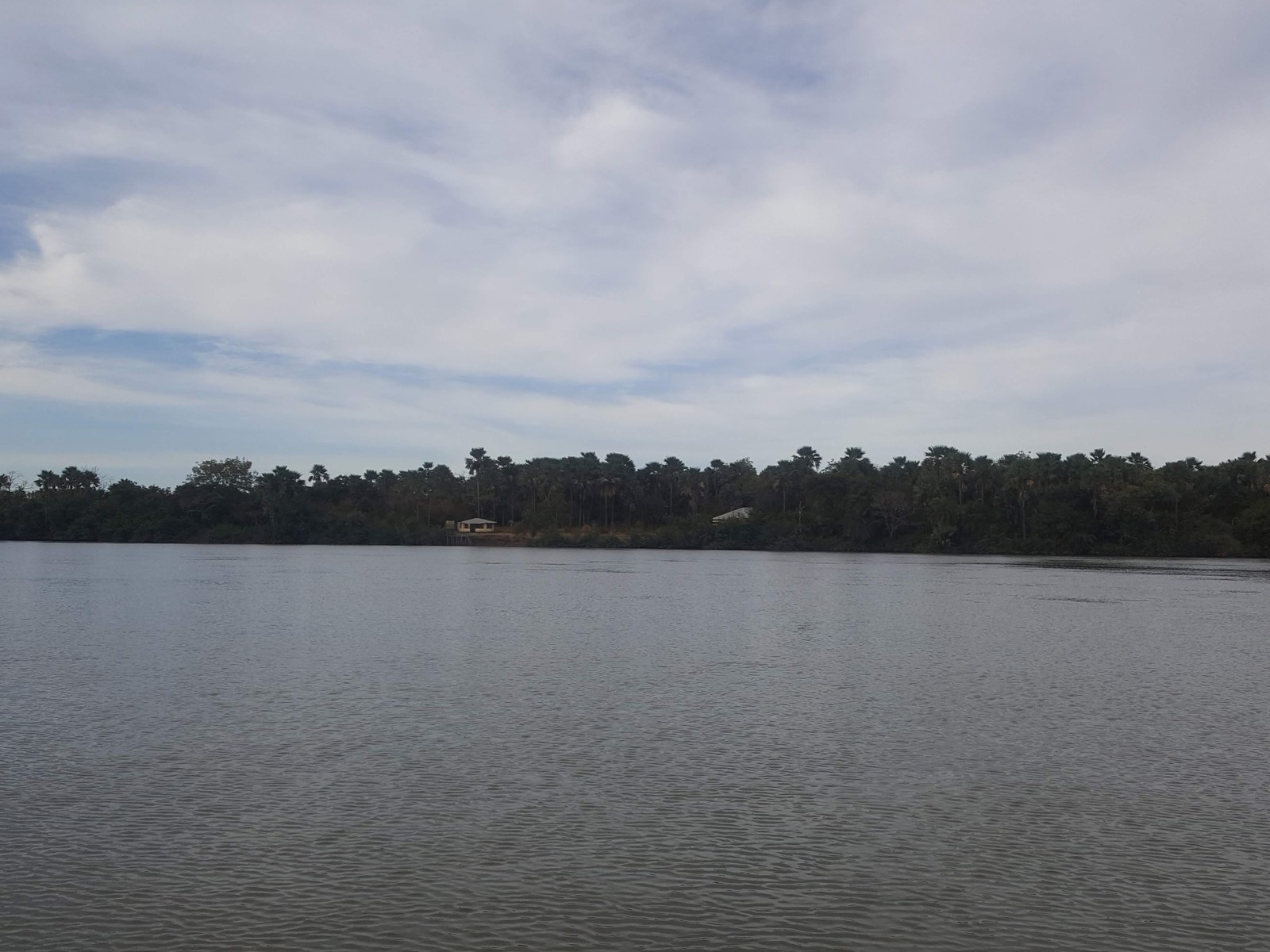
The Gambia River runs through the smallest country in mainland Africa, a long, slow river that winds from the highlands of Guinea through Senegal and The Gambia to the Atlantic. Its lower reaches are a maze of swamp and mangrove, creeks and slow water, and its banks are lined with palm trees and rice fields. It is a river that keeps secrets. The people who live on it — the Mandinka, the Fula, the Wolof — have, for as long as anyone can remember, told of a creature that owns the swamp margins, the creeks and the slow rivers of the lower Gambia. They call it the ninki nanka. It is a dragon, and it is the most frightening spirit on the river.
The ninki nanka has been described as a colossal, dragon-like reptile, a serpent of the swamps, a devil-dragon. It is said to be thirty to fifty feet long, with the body of a crocodile, the head of a horse — sometimes with horns — and a long neck like a giraffe. It has mirror-like scales, and in some accounts a feather-like crest, and a gaze that is fatal: to see the ninki nanka, the tradition says, is to die soon after. It lives deep in the River Gambia and the surrounding swamps, and it is a guardian of the places no one dares to farm, enforcing the taboos that keep people away from dangerous or sacred ground. It is, in the folklore of West Africa, both a monster and a warning.
The dragon of the river
The ninki nanka belongs to the oral traditions of the Mandinka, Fula and Wolof peoples of The Gambia, Senegal, Guinea and Sierra Leone, and its shape has never been fixed. Accounts of its form have never fully agreed, and nobody in the tradition treats the disagreement as a problem. In some tellings it is a great serpent, long and scaled, like the Chinese lung, elegant and terrible. In others it is a chimera: a crocodile’s body, a horse’s head, a giraffe’s neck, a hippopotamus’s bulk. In others still it is a sea spirit, a dragon with the attributes of a serpent and a horse. The name itself is uncertain: “nanka” may mean “snake” or “dragon”, and “ninki” suggests something supernatural or monstrous.
What the accounts agree on is the creature’s nature. It is a guardian of the swamp margins, and it is dangerous. It is said to feed on children who disobey their parents by venturing into its swamp. It is said to kill people who see it, or to bring death to those who encounter it. It is said to live in the deep water, in the places where the river is slow and the reeds are thick, and to come out only when it is disturbed. It is the creature that owns the fertile margins no one dares to farm, and its presence is the reason those margins stay wild.
The 2006 expedition
In the summer of 2006, the ninki nanka acquired a new chapter, and its most famous one in the West. A group of “dragon hunters” from the Centre for Fortean Zoology, a British cryptozoological organisation based in Dorset, went to The Gambia to investigate the creature and to take testimony from those who claimed to have seen it. The expedition was known as the “J. T. Downes Memorial Gambia Expedition 2006”, and it was led by the cryptozoologist Richard Freeman. It received a fair amount of media attention, including coverage in a BBC Online article, and it drew international attention to a legend that had previously been known only to folklorists.
The team spent two weeks in The Gambia, interviewing locals across the country and searching the swamps of Kiang West and along the Gambia River. They collected one first-hand account, from a villager who described a creature a hundred and sixty feet long, with mirror-like scales and a feather-like crest, seen in a swamp in Kiang West. Other testimonies included second-hand stories of a kangaroo-faced, fork-tongued beast, and of an animal that looked like a Chinese dragon. The team explored the swamps, looked for tracks and droppings, and found nothing.
They did come home with one object: a supposed ninki nanka scale, described as a large, two-pound fragment with a shiny, metallic appearance, presented to them by locals. Analysis revealed that it was not biological at all — most likely a piece of degraded celluloid film, or plastic. It was, in the end, the only physical evidence the expedition produced, and it proved nothing except that someone, somewhere, had mistaken a piece of rubbish for a dragon’s scale.
Freeman concluded that the creature’s existence was unlikely, citing the prevalence of second-hand stories and cultural embellishment. The expedition made the BBC, and it went nowhere. The river kept its secrets. Mandinka grandmothers, asked about the conclusion, were not surprised.
The other expedition
The CFZ expedition’s failure is, in its way, the most informative thing about the ninki nanka. A six-person team, with two weeks, local guides, and the attention of the world’s press, found one first-hand witness, a sheaf of second-hand stories, and a piece of plastic. The creature, if it exists, is either very good at hiding or very good at not existing. Freeman’s conclusion — that the legend is sustained by second-hand stories and cultural embellishment — is the sober reading of the evidence. It is also, notably, the reading the local people would have given, if anyone had asked them whether a foreigner could find the dragon. The ninki nanka is not an animal to be found. It is a spirit to be avoided.
The theories
The theories about the ninki nanka fall into two groups, and they say more about the theorists than about the creature. The first group treats it as a possible real animal, and suggests candidates. The most popular is a very large extinct snake, a giant constrictor that once lived in West Africa and survives in the folklore, if not in the river. The CFZ team itself put forward this theory, suggesting that some very large extinct snake might once have lived in the region. Others have suggested a giant monitor lizard, or a surviving dinosaur, or a crocodile of unusual size. All of these are guesses, and none of them is supported by any physical evidence.
The second group treats the ninki nanka as a cultural artefact, and this is the reading the folklore supports. The creature is a guardian of the swamp margins, a spirit that enforces taboos against trespass on dangerous or sacred ground. The swamps of the lower Gambia are dangerous places: they are full of crocodiles, they are malarial, they flood without warning, and they are easy to get lost in. A story about a dragon with a fatal gaze is a practical way to keep children away from the water, and to keep farmers from clearing land that would flood. The ninki nanka, on this reading, is not a failed zoological specimen. It is a successful piece of public safety advice, dressed as a monster.
Why the story endures
The ninki nanka endures because it is still told, and still believed, on the banks of the Gambia River. The legend continues to thrive in contemporary West African culture, and today the Ninki Nanka Trails invite travellers to explore the creature’s myth through eco-tours, oral storytelling and cultural performances. The dragon has become a tourist attraction, and a source of local pride, and a way for the communities of the lower Gambia to tell their own story to the world.
It also endures because the 2006 expedition, for all its failure, gave the legend a new life. The BBC coverage, the “dragon hunters”, the scale that turned out to be plastic — all of it made the ninki nanka famous in a way it had never been before. The creature that was once a local spirit is now a global cryptid, listed in books and websites alongside Nessie and Bigfoot, and the irony is that the expedition that made it famous also concluded it probably does not exist.
And it endures because the river endures. The Gambia is still slow, still dark, still lined with palms and reeds, and still full of places where a person could imagine something large moving under the surface. The ninki nanka may be a spirit, or a story, or a snake that died out long ago. But the river is real, and the swamp is real, and the fear is real, and that is enough.
What is documented, and what is not
Documented facts: The ninki nanka is a legendary creature in West African folklore, told among the Mandinka, Fula and Wolof peoples of The Gambia, Senegal, Guinea and Sierra Leone. It is described as a dragon-like, serpentine creature, thirty to fifty feet long in most accounts, with a crocodile-like body, a horse-like head, a long neck, mirror-like scales and, in some accounts, a feather-like crest. Local tradition holds that its gaze is fatal and that seeing it is an omen of death. In the summer of 2006, the Centre for Fortean Zoology’s “J. T. Downes Memorial Gambia Expedition”, led by Richard Freeman, spent two weeks in The Gambia investigating the creature. The team collected one first-hand account, from a villager in Kiang West who described a 160-foot-long creature with mirror-like scales and a feather crest, and several second-hand accounts. A supposed scale presented to the team was analysed and found to be non-biological, most likely degraded celluloid film or plastic. No tracks, droppings, bones, photographs or DNA evidence were found. Freeman concluded the creature’s existence was unlikely.
Unverified or disputed claims: That a dragon-like animal lives in the Gambia River rests entirely on oral tradition and on a single first-hand account from 2006, none of it independently verified. The claim that the creature is 160 feet long comes from one witness and contradicts the more common thirty-to-fifty-foot description. That the creature’s gaze is fatal is a folkloric belief, not an observed fact. That it is a surviving giant snake, a giant monitor lizard, or any other known or unknown animal is speculation, with no physical evidence to support it. The claim that the creature killed people as recently as the 1990s is reported, not documented.
Sources
- https://thehorrorcollection.com/does-the-ninki-nanka-really-exist/
- https://en.wikipedia.org/wiki/Ninki_Nanka
- https://mythlok.com/ninki-nanka/
- https://www.mentalfloss.com/culture/folklore-mythology/11-legendary-monsters-africa