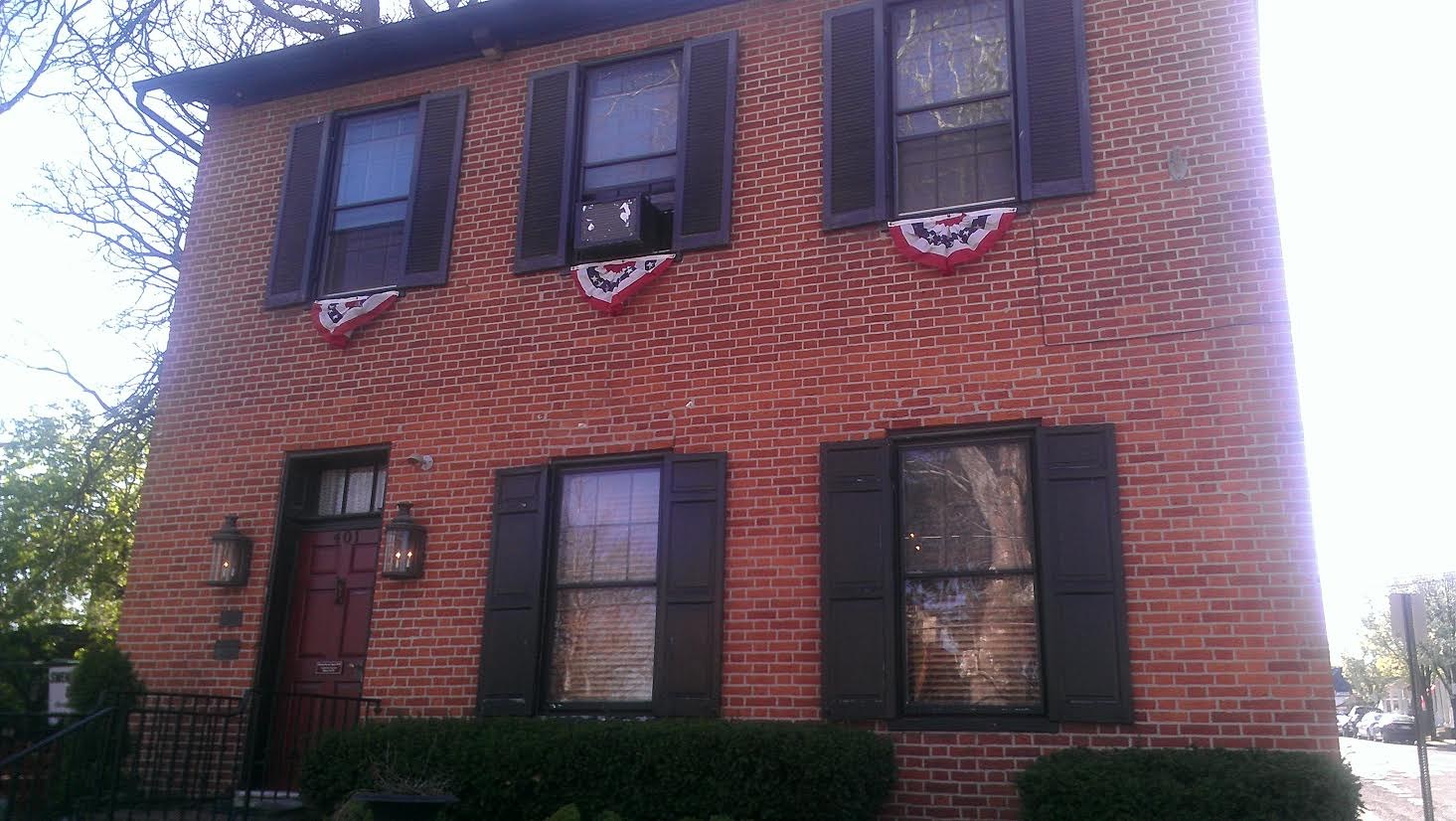
Stand on the pavement of Baltimore Street in Gettysburg on a quiet evening, and the Farnsworth House Inn looks like any other handsome brick house in a small American town. The shutters are black, the door is painted red, and bunting hangs beneath the upper windows. Then you look closer at the brickwork on the south side of the building, and the street seems to go still. The wall is pocked with small, dark pits — more than a hundred of them — where bullets struck in July 1863. They were never filled in. They were never meant to be. This is a house that wears its worst three days on its face, and inside, according to the family that has run it for more than fifty years, the past has never entirely left.
A House on Baltimore Street
The oldest part of the house was built in 1810 by John McFarlane, a stone structure standing on what was then a growing road through the young town of Gettysburg, Pennsylvania. In 1833 a three-storey brick section was added facing Baltimore Street, giving the house the shape visitors see today. By the time of the American Civil War it was owned by the Sweney family, local residents whose home stood in one of the most exposed positions in town: between the Confederate forces holding Gettysburg itself and the Union guns dug in on Cemetery Hill, a short distance to the south.
The house has carried several names across two centuries. One later owner, the Black family, called it the Sleepy Hollow Inn and advertised its bullet-scarred wall as a curiosity. It was not until 1972 that the building became the Farnsworth House Inn, when Loring and Jean Shultz bought it, restored it, and opened it as an inn and restaurant.
July 1863: The Sharpshooters’ Attic
The Battle of Gettysburg was fought from 1 to 3 July 1863, and it became the bloodiest battle of the Civil War, with tens of thousands of casualties on both sides. Gettysburg itself was occupied by Confederate troops for much of the fighting, and Baltimore Street ran directly through the contested ground. The Farnsworth House, standing between the town and Cemetery Hill, was in the middle of it.
According to the inn’s own history and local tradition, Confederate sharpshooters took up position in the house during the battle and fired from the attic — the room the inn now calls the Garret — toward Union positions on Cemetery Hill. From that high window they had a clear line of sight down Baltimore Street. Union troops returned fire, and the south wall of the house took the punishment. More than a hundred bullet holes are still visible there today, a cluster of them near the attic window, and visitors can walk up and look at them from the pavement.
One of the most repeated stories about the house concerns Mary Virginia “Jennie” Wade, a twenty-year-old woman who was killed on 3 July 1863 while baking bread in her sister’s house further down Baltimore Street. She was the only civilian killed during the battle. Local tradition holds that the fatal shot was fired by a Confederate sharpshooter from the Farnsworth House attic. That link is widely told in Gettysburg, and the inn itself repeats it as a belief rather than a proven fact. Historians still debate where the shot came from, and no record settles the question. What is certain is that Wade died that day, that sharpshooters were firing from houses along Baltimore Street, and that the Farnsworth House was among them.
After the battle, the house served as a field hospital for wounded soldiers of both armies, as did much of the town. The cellar, according to the inn’s accounts, was used to hold the bodies of Confederate dead. On 19 November 1863, when President Abraham Lincoln travelled to Gettysburg to dedicate the Soldiers’ National Cemetery, his procession passed directly by the house on its way up Baltimore Street. Four months after the fighting, the bullet holes were already part of the town’s landscape, and they have been ever since.
A Hospital, Then an Inn
They named it for Brigadier General Elon John Farnsworth, a Union cavalry officer killed in a charge on 3 July 1863, the final day of the battle. The Shultz family still runs the inn today, and it is listed on the National Register of Historic Places.
For more than a century after the war, the house remained a private home and then a small inn, while the battlefield around it became a national park. The Shultz family’s purchase in 1972 changed its character for good. Loring and Jean Shultz restored the building, opened the restaurant and guest rooms, and began offering tours of the Garret and the cellar — the two spaces most associated with the battle and with the reports that followed.
Today the inn has twelve named guest rooms, dining rooms named for the opposing generals Meade and Lee, a tavern called Sweney’s, and a beer garden. It also runs a nightly programme of ghost tours and paranormal evenings, and it has been featured in television programmes about haunted places. The business is open about the arrangement: the haunting is part of the attraction, and the family says it began with experiences of their own shortly after they moved in. Whether a visitor believes the reports or not, the history underneath them is real, and the inn does not hide the difference between the two.
The Reported Hauntings
The Shultz family says that as many as sixteen spirits have been identified in the house at one time or another, each with its own name and character. The reports, gathered over five decades from guests, staff and investigators, cluster around a small number of figures.
The best known is Jeremy, described as a boy of about eight who is said to haunt the cellar and the room named after him. Guests and staff report the sound of a child giggling, marbles rolling across the floor, and tugs at sleeves and clothing, especially when children are staying in the house. The story told on the inn’s tours is a sad one: Jeremy was, according to the tale, a boy who was struck and killed by a stagecoach outside the house and carried inside to die. No documentary record of such a death has been produced, and at least one careful visitor has noted that the name Jeremy appears to have been given to the spirit by mediums rather than recovered from any record. The reports of a child’s presence are consistent; the biography attached to them is not verified.
Then there is Mary, believed to have been a midwife, who is most often reported in the Sara Black Room, the inn’s most active bedroom. Guests say they have felt a hand tucking the covers around them at night, a touch on their hair, or the weight of someone sitting on the edge of the bed. The room is named for Sara Black, a member of the family that owned the house before the Shultzes. Photographs said to show a figure at the Sara Black Room window have been taken from the street, and the room is the one most often requested by visitors who want to experience the stories for themselves.
The Garret, the old sharpshooters’ attic, carries its own reports: footsteps in an empty room, the feeling of being watched, and the figure of a soldier at the window. In the cellar, where the dead were once laid out, guests report heavy breathing, cold spots, and the smell of cigar smoke — cheroot, in the older accounts — in rooms where nobody is smoking. A woman in nineteenth-century dress has been reported on the cellar stairs, and shadow figures in the dining rooms. None of these reports has been independently verified, and the inn presents them as reported experiences rather than proven events. What can be said is that the reports have been steady for decades, that they come from many different people, and that they concentrate in the rooms with the strongest links to the battle.
Visiting the House Today
The Farnsworth House Inn still works as an inn first and a haunted attraction second. Guests sleep in rooms named for figures from the town’s past, eat in dining rooms named for the generals who fought over it, and can walk out of the front door and look at the bullet holes in the wall before breakfast. The evening tours take visitors into the Garret and the cellar, the two spaces that are not part of an ordinary stay, and tell the history of the house alongside the stories attached to it.
The battlefield outside town is vast and carefully preserved, but the Farnsworth House is small and close at hand. Its damage is not on a distant ridge; it is on a wall beside a pavement, at eye level, where anyone can touch it.
What is documented — and what is not
Documented: the house’s construction in 1810 by John McFarlane, with the brick section added in 1833; its position on Baltimore Street between the town and Cemetery Hill; the Battle of Gettysburg on 1–3 July 1863; the use of the house by Confederate sharpshooters and the more than one hundred bullet holes still visible in its south wall; its service as a field hospital after the battle; Jennie Wade’s death on 3 July 1863 as the battle’s only civilian casualty; the Black family’s ownership and the name Sleepy Hollow Inn; the purchase by Loring and Jean Shultz in 1972 and the renaming for General Elon John Farnsworth; and the building’s listing on the National Register of Historic Places.
Not established: that the shot that killed Jennie Wade was fired from this house — that is a strong local tradition, but historians still debate the shot’s origin. The identities and life stories of the reported spirits, including Jeremy and Mary the midwife, rest on mediums’ accounts and guests’ reports, not on historical records; Jeremy’s stagecoach story has no known documentary source, and the name itself appears to have been assigned rather than discovered. Individual reports of footsteps, touches, smells and apparitions are anecdotal and have not been independently verified. One older claim sometimes repeated about the house — that Confederate General Lewis Armistead was treated here after being wounded — is incorrect; he was taken to the George Spangler farm.
Sources
- https://en.wikipedia.org/wiki/The_Farnsworth_House_Inn
- https://farnsworthhouseinn.com/about/
- https://www.hauntedrooms.com/pennsylvania/gettysburg/haunted-places/haunted-hotels/farnsworth-house-inn
- https://ghostcitytours.com/gettysburg/haunted-gettysburg/ghosts-farnsworth-house/
- https://gettysburgghosts.com/the-top-10-most-haunted-places-in-gettysburg/
- https://midatlanticdaytrips.com/2017/01/a-spirited-stay-at-gettysburgs-most-haunted-address/