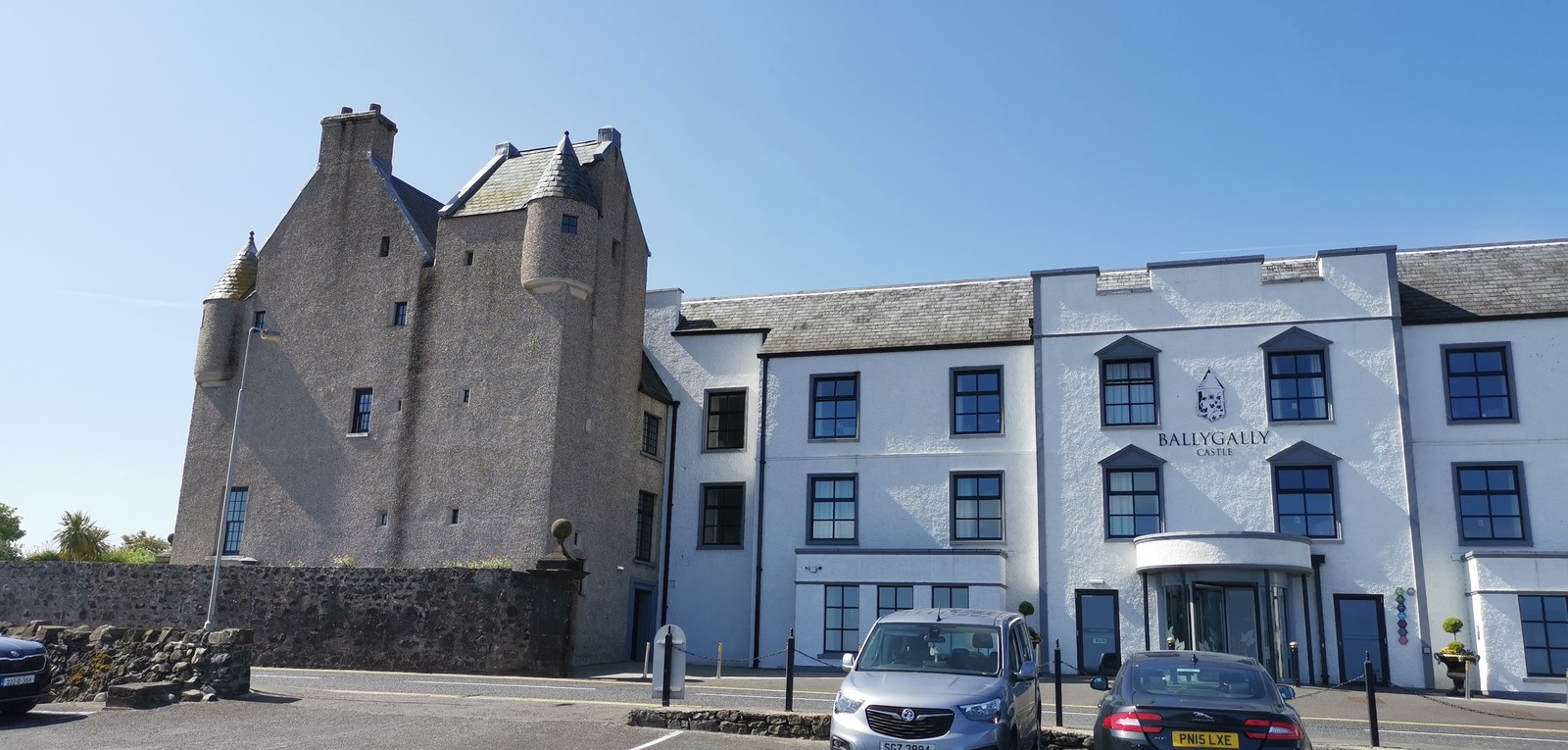
The rain comes in off the Irish Sea at Ballygally, and it comes in sideways. It rattles the windows of the white hotel wing and drives across the bay toward the dark headland, and then, quite suddenly, it stops, and the whole coast is bright and cold and clear. On the edge of the village, where the Coast Road bends around the bay, stands a grey stone tower that has watched that weather for four hundred years. Its walls are thick, its windows are small, and one of its corner turrets holds a room that the hotel does not rent out to guests. It is called the Ghost Room, and it is the reason many people come to Ballygally Castle at all.
A Castle Built to Survive
Ballygally Castle stands in the village of Ballygally, about three miles north of Larne in County Antrim, Northern Ireland, overlooking the sea at the head of Ballygally Bay. It was built in 1625 by James Shaw, a Scot from Greenock who had come to Ireland in 1606, in the early years of the Plantation of Ulster, and rented the land from Randal MacDonnell, Earl of Antrim, for £24 a year. It took him almost twenty years to build the castle, and he built it to survive rather than to impress.
The building is a Scottish baronial tower house, solid and plain, with thick stone walls, small windows and corner turrets. Above the original entrance, a carved stone is dated 1625 and carries the Scots motto “Godis Providens is my Inheritans” — God’s providence is my inheritance — along with the initials of Shaw and his wife, Isabella Brisbane. The castle’s bawn, the walled courtyard that once protected it, and its walled garden are registered as Scheduled Historic Monuments. The castle is widely described as the only seventeenth-century building still used as a residence in Northern Ireland, and it marked the 400th anniversary of its construction in 2025.
Life in the castle was not quiet. During the rebellion of 1641, the castle came under attack from the Irish garrison at Glenarm, and each assault was unsuccessful — the thick walls did the work they were built to do. The castle remained in the Shaw family for generations, until it passed to William Shaw in 1799, who sold the estate. What followed was a long period of private ownership, and then, in the 1950s, a new chapter: the carpet tycoon Cyril Lord bought the castle, extended and renovated it, and turned it into a hotel. In 1966 the Hastings Hotels Group bought the property, and it has run it as the Ballygally Castle Hotel ever since. The old tower still stands at the heart of the building, joined now to a modern wing of some fifty rooms, and guests still sleep beneath the same roof that sheltered the Shaws.
The Lady of the Tower
The ghost story that defines Ballygally Castle is the story of Lady Isabella Shaw — spelled Isobel in some accounts — the wife of James Shaw. It is a bleak tale, and it should be understood from the start as legend rather than as a securely documented account of a real woman’s death. No contemporary record of the circumstances survives, and the details vary from telling to telling. What follows is the story as it is told at the castle.
According to the legend, James Shaw badly wanted a son and heir. When Isabella gave birth to a daughter, he is said to have locked her in the turret room, taken the baby away, and left her there. Desperate to reach her child, she is said to have tried to escape through the small tower window and fallen to her death on the rocks below. Other versions say she was starved in the room, or pushed. The differences between the versions are themselves a warning: this is folklore that has been retold for generations, not a record.
What is consistent is the haunting attached to it. Lady Isabella is said to be the castle’s most active spirit, and her habit, in the reports, is a strangely domestic one: she knocks on the doors of the guest rooms and then disappears. Guests have reported opening their doors to an empty corridor, and hearing the sound of children in the corridors at night. The small room in the corner turret, reached by a narrow spiral staircase, is kept as the Ghost Room. The hotel does not let it out to guests, but visitors can usually see it on a tour, and staff will show it to those who ask. Standing in it, under the low ceiling with the sea visible through the small window, it is easy to understand why the story attached itself to this room rather than any other.
Madame Nixon and the Silk Dress
Lady Isabella is not the only spirit said to remain at Ballygally. Another long-standing story concerns a woman known as Madame Nixon, who lived at the castle during the nineteenth century. According to the hotel’s folklore, she was one of the widowed sisters-in-law of a later owner, John Shaw, and came to stay at the castle after her husband’s death.
Madame Nixon is rarely described as a visible apparition. Instead, guests and staff report hearing her: the distinctive rustling of a silk dress moving through the corridors after dark, and the sound of footsteps in rooms and passages that turn out to be empty. Some accounts say she can be heard walking around the hotel in her silk dress late at night. Like the stories about Lady Isabella, the supernatural element cannot be established historically. What can be said is that the story has been told at the castle for a long time, that it is tied to a real period in the building’s history, and that the sound of a dress in a corridor is the kind of report that is easy to imagine in a house full of stone passages and sea wind — and hard to prove either way.
Paranormal investigators have visited the castle over the years, including teams from overseas, drawn by its reputation as one of the most haunted places in Northern Ireland. The hotel is open about the interest: it keeps the Ghost Room, runs ghost-themed tours and events, and treats the stories as part of the castle’s character rather than as a secret. A journalist who spent a night in the turret room in 2025 described the temperature dropping sharply in the small chamber, a detail that will surprise nobody who has stood in a stone tower on the Antrim coast — and that, like every other report from the castle, sits exactly on the border between atmosphere and evidence.
Four Centuries on the Coast Road
Today Ballygally Castle is a working four-star hotel on the Causeway Coastal Route, the long scenic drive along the Antrim coast. Guests come for the sea views, the gardens, the afternoon tea and the bar lunch, and many of them come without knowing about the ghosts at all. The castle’s old tower stands beside the modern wing, and the contrast is part of the place: seventeenth-century stone on one side, white-painted hotel on the other, with the bay in front and the road running past the door.
The castle has also gathered a newer piece of folklore. It holds one of the ten carved Game of Thrones doors installed at venues across Northern Ireland, a reminder that the Antrim coast has become a filming landscape as well as a historic one. But the older story is the one that lasts. Four hundred years after James and Isabella Shaw first lived in the tower, people are still sleeping beneath its roof, still asking at reception about the Ghost Room, and still listening, in the small hours, for a knock on the door.
There is something fitting about that. Ballygally Castle was built by a man who crossed the sea from Scotland to make a new life in Ireland, and it has been a home, a fortress, a hotel and a haunted house in turn. The stone has outlasted every family that lived in it, every owner that rebuilt it, and every story told about it. The Ghost Room is empty, the door is kept shut, and the knocking — reported, repeated, never explained — goes on.
What is documented — and what is not
Documented: the castle’s construction in 1625 by James Shaw, a Scot from Greenock who had come to Ireland in 1606 and rented the land from the Earl of Antrim for £24 a year; the carved entrance stone dated 1625 with the motto “Godis Providens is my Inheritans” and the initials of James Shaw and Isabella Brisbane; the attacks on the castle during the 1641 rebellion, which were unsuccessful; the Shaw family’s ownership until William Shaw sold the estate in 1799; the purchase and renovation by Cyril Lord in the 1950s and the purchase by Hastings Hotels in 1966; the bawn and walled garden’s status as Scheduled Historic Monuments; the existence of the small corner-turret room known as the Ghost Room, which the hotel does not let to guests; and the castle’s 400th anniversary in 2025.
Not established: the story of Lady Isabella Shaw’s imprisonment, fall and death — it is a legend with no known contemporary record, and its details differ between versions, including whether she fell, leapt, was pushed or was starved, and whether her name was Isabella or Isobel. The reports of knocking on doors, children heard in corridors, and the rustling of Madame Nixon’s silk dress are anecdotal guest and staff reports, not verified evidence. The claim that the castle is the only seventeenth-century building still used as a residence in Northern Ireland is widely repeated but is a description rather than a formally certified fact. Nothing about the reported hauntings has been independently verified.
Sources
- https://en.wikipedia.org/wiki/Ballygally_Castle
- https://www.connollycove.com/360-degree-video-of-ballygally-beach-and-ballygally-hotel/
- https://www.connollycove.com/beautiful-ballygally-and-ballintoy-county-antrim/
- https://irisharoundtheworld.com/10-haunted-places-around-ireland/
- https://www.outlooktraveller.com/stay/halloween-special-6-haunted-irish-castles-you-can-actually-spend-the-night-in
- https://popandthistle.com/ghosts-legends-and-dark-secrets-ballygally-castle-irelands-most-haunted/
- https://eoceanic.com/sailing/harbours/392/ballygalley_bay?pictureView=1