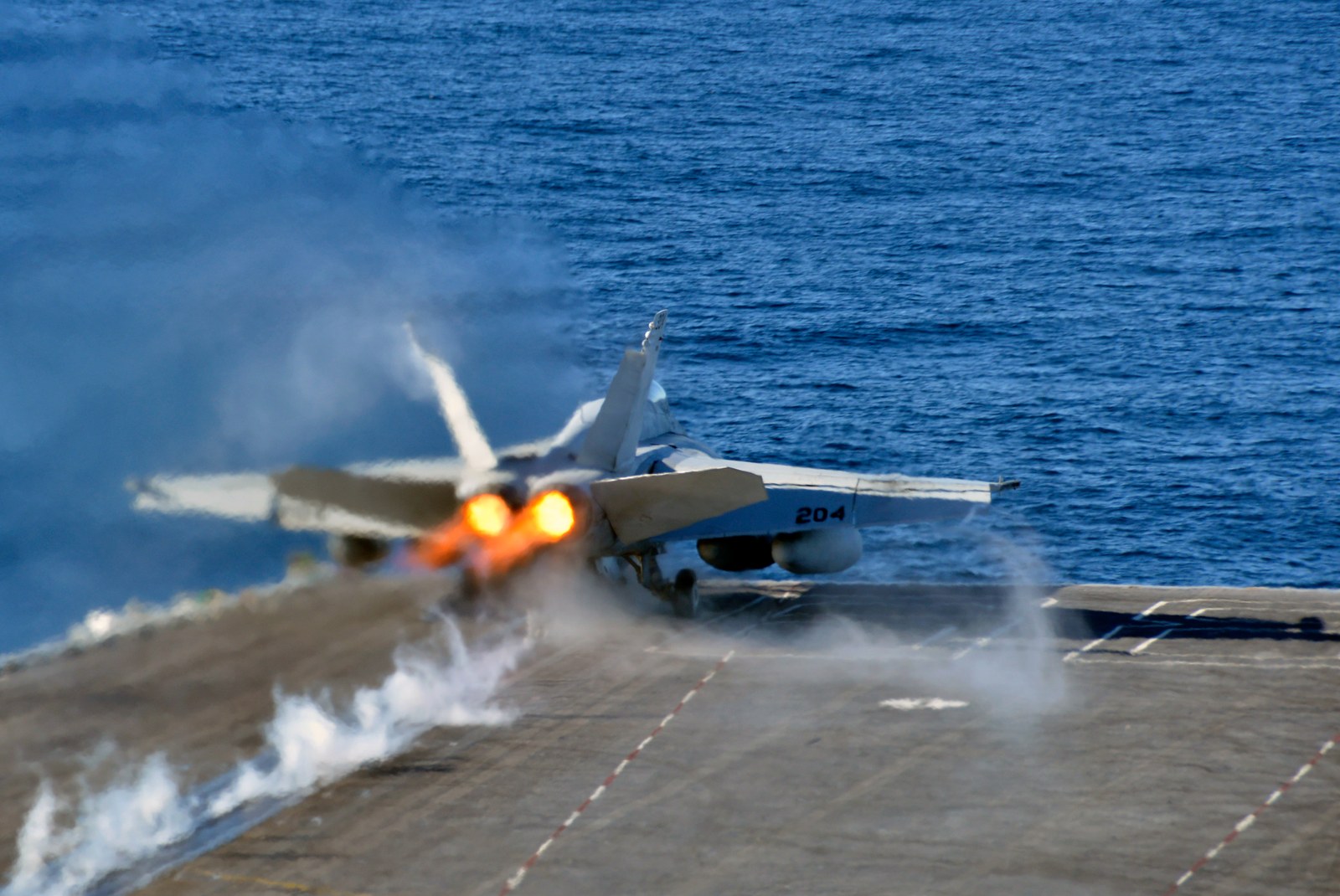
In January 2015, off the coast of Jacksonville, Florida, a U.S. Navy F/A-18F Super Hornet was flying a training mission as part of a carrier strike group exercise when its forward-looking infrared targeting pod locked onto something it could not identify. The video that resulted is 34 seconds long, grainy, black and white, and almost comically unremarkable to look at: a dark, oblong shape against a pale sky, seen through the narrow field of view of an AN/ASQ-228 ATFLIR pod, the Navy’s most advanced targeting sensor. The object appears to slow, to stop, and to rotate, turning on its axis as if it were pivoting in mid-air, while the aircrew’s voices register surprise. The footage is known as the Gimbal video, named for the rotating motion the object appears to make, and it is the single most famous piece of UAP evidence in the world. It is also, officially, still unresolved.
The encounter took place during a COMPTUEX exercise, a composite training unit exercise, conducted by the USS Theodore Roosevelt Carrier Strike Group off the U.S. East Coast. The Roosevelt’s aircrew had been reporting strange encounters for months. Lieutenant Ryan Graves, a Navy pilot assigned to the strike group, later described near-daily encounters with unidentified objects during 2014 and 2015, objects that appeared on radar, that flew in ways no known aircraft could, and that the squadron’s pilots discussed openly among themselves. The Gimbal video was one of three pieces of footage that came out of that period. The other two, known as FLIR1 and GoFast, were filmed in different encounters. All three were classified, and all three stayed classified for more than two years.
The leak and the release
The videos reached the public through an unusual route. On 16 December 2017, The New York Times published a front-page investigation by Leslie Kean, Ralph Blumenthal, and Helene Cooper revealing the existence of a secret Pentagon programme called the Advanced Aerospace Threat Identification Program, or AATIP, which had studied unidentified aerial phenomena. The article was accompanied by the FLIR1 and Gimbal videos, released the same day by To The Stars Academy of Arts and Science, the organisation founded by former Blink-182 musician Tom DeLonge, which had obtained the footage. Christopher Mellon, a former Deputy Assistant Secretary of Defense for Intelligence, later said he had provided the videos to the press. Luis Elizondo, a former director of AATIP, became the programme’s most prominent public advocate. The GoFast video followed on 9 March 2018, released by To The Stars Academy.
The public reaction was immediate and enormous. For the first time, the U.S. government had, in effect, acknowledged that its own pilots had filmed objects it could not identify, and that it had spent money studying them. The videos were discussed in Congress, in the press, and in the Pentagon, and they became the foundation of a new era of official engagement with the subject. In September 2019, the Navy formally acknowledged that the videos depicted unidentified aerial phenomena, using the term UAP rather than UFO. On 27 April 2020, the Department of Defense formally released all three videos, stating that it was doing so to clear up misconceptions about whether the circulating footage was real. It was real. It had been filmed by Navy aircraft. What it showed was, in the Pentagon’s own words, still unidentified.
What the video shows — and what it does not
The Gimbal video is 34 seconds of infrared footage, and its interpretation depends on understanding what an ATFLIR pod does. The pod is a stabilised, gimballed sensor that tracks a target and keeps it centred in the frame while the aircraft moves. When the pod rotates to maintain its lock, the image rotates too, and a stationary object can appear to rotate. That is the central dispute in the case. The object in the video appears to turn on its axis, but that apparent rotation may be an artefact of the pod’s own gimbal movement, not of the object itself. The sceptical analyst Mick West has argued in detail that the video shows a distant aircraft, probably a conventional jet, seen through an infrared sensor, and that the apparent rotation is a product of the pod’s optics, not of the object.
The counterargument is that the pod’s behaviour does not explain everything in the video. The object appears to slow and to stop relative to the clouds behind it, and the aircrew’s reaction suggests they were seeing something they did not understand. The pilots of the Roosevelt strike group, including Graves, have described the encounters of 2014 and 2015 as involving objects that performed in ways no known aircraft could, and they have maintained that position in public testimony, in interviews, and before Congress. The video alone, however, does not show that. It shows a dark shape against clouds, and the argument over what it is has been conducted largely in the technical literature and on the internet, between analysts who understand infrared optics and pilots who were in the cockpit.
The official position
The Pentagon’s own assessment of the three videos has evolved. The All-domain Anomaly Resolution Office, AARO, the Pentagon’s current UAP investigation body, has published assessments of the footage. Its 2024 and 2025 reports resolved the GoFast video, concluding that the object’s apparent high speed was a parallax effect, an illusion created by the motion of the aircraft and the pod. The Gimbal video, by contrast, remains officially unresolved. AARO has not identified the object, and it has not confirmed the sceptical explanation either. The video sits in an official limbo: authenticated, unexplained, and still argued over.
The pilots themselves carried the story into Congress. Ryan Graves, who had flown with the Roosevelt strike group, became one of the most prominent military witnesses on the subject, describing the near-daily encounters of 2014 and 2015 in interviews and, in July 2023, in sworn testimony before a House Oversight subcommittee, alongside former intelligence officer David Grusch and retired Navy Commander David Fravor, the pilot who had encountered the “Tic Tac” object off California in 2004. Graves testified that the objects his squadron encountered posed a flight-safety concern, that they were detected by radar and by multiple sensors, and that the Navy’s reporting system at the time had discouraged pilots from filing reports. His testimony, and the hearing itself, would have been unthinkable before December 2017, when the Gimbal video was still classified and the subject was still officially a matter for tabloids. The video did not just change the Pentagon’s paperwork. It changed who was willing to speak, and where.
The Gimbal video’s importance is not really about what it shows. It is about what it started. Before December 2017, the U.S. government had not publicly acknowledged a UFO investigation programme in decades, and the subject was treated in official circles as a matter for tabloids. After the Gimbal video, the Navy changed its reporting procedures for UAP encounters, Congress held hearings, the Pentagon created a permanent investigation office, and the term UAP replaced UFO in official usage. The video is 34 seconds of grainy infrared footage, and it changed the way the most powerful military in the world talks about unidentified objects in the sky. Whatever the object was, that change is real, and it is permanent — and it began with a targeting pod, a dark shape against the clouds, and a crew that could not explain what it had filmed.
What is documented — and what is not
Documented: In January 2015, during a COMPTUEX exercise off the U.S. East Coast, a U.S. Navy F/A-18F Super Hornet’s ATFLIR pod recorded 34 seconds of infrared video, known as the Gimbal video, showing an object that appears to slow, stop, and rotate against a cloud background. Pilots of the USS Theodore Roosevelt Carrier Strike Group, including Lieutenant Ryan Graves, reported near-daily encounters with unidentified objects in 2014 and 2015. On 16 December 2017, The New York Times published an investigation by Leslie Kean, Ralph Blumenthal, and Helene Cooper revealing the Pentagon’s Advanced Aerospace Threat Identification Program, and the Gimbal and FLIR1 videos were released the same day by To The Stars Academy; Christopher Mellon said he provided the videos to the press. The GoFast video was released on 9 March 2018. In September 2019, the Navy acknowledged the videos showed unidentified aerial phenomena. On 27 April 2020, the Department of Defense formally released all three videos. AARO’s 2024–2025 assessments resolved the GoFast video as a parallax effect; the Gimbal video remains officially unresolved.
Unverified or unproven: That the object in the Gimbal video is a craft of unknown origin, since the footage shows a dark shape whose apparent rotation may be an artefact of the ATFLIR pod’s gimbal movement; that the object performed manoeuvres beyond known aircraft capability, which rests on the aircrew’s interpretation rather than on the video alone; that the object was a conventional aircraft, as the sceptical explanation holds, since AARO has not confirmed that explanation; the identity, origin, size, and speed of the object.
Sources
- https://zfilesuap.com/en/cases/gimbal-gofast-2015
- https://overclassified.org/case-files/uss-roosevelt-gimbal-gofast-2015.html
- https://knowyourmeme.com/memes/gimbal-first-recorded-uap-footage
- https://www.ufo-timeline.com/uss-roosevelt-uap-incidents-gimbal-ufo-and-other-strange-objects/
- https://newspaceeconomy.ca/2025/11/11/the-new-era-of-unidentified-anomalous-phenomena-government-disclosure-credible-reports-and-the-search-for-answers/