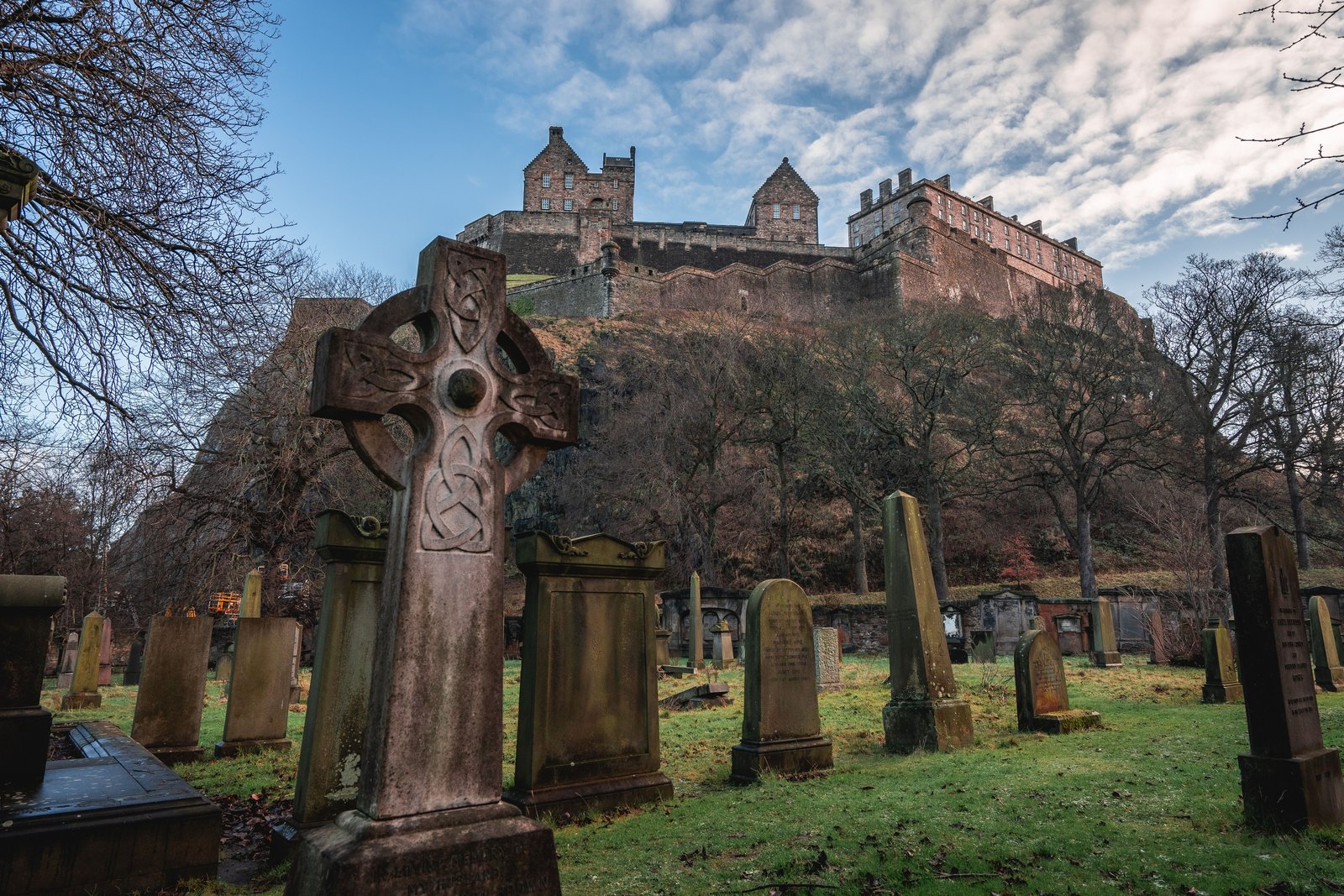
Greyfriars Kirkyard, on Candlemaker Row in Edinburgh’s Old Town, is one of the most visited graveyards in the world — and, by reputation, one of the most haunted. The kirkyard dates to 1562, and its ground holds centuries of Edinburgh’s history: plague pits, body-snatchers’ mortsafes, the signing of the National Covenant in 1638, and the grave of a small dog who refused to leave his master.
But the story that draws the crowds is darker. It begins with a judge, a prison, and a break-in in December 1998 — and it has not stopped since.
Bloody Mackenzie
Sir George Mackenzie of Rosehaugh (1636–1691) was Lord Advocate — Scotland’s chief law officer — under King Charles II and James VII. His name is tied to one of the bloodiest chapters in Scottish history: the persecution of the Covenanters, Presbyterians who resisted the crown’s control of the church.
After the Battle of Bothwell Bridge on 22 June 1679, Mackenzie took about 1,200 Covenanter prisoners. There was no prison large enough to hold them, so he penned them in a walled field beside Greyfriars Kirkyard — an open-air jail with no shelter, little food, and bitter Scottish weather. Many died there, of hunger, cold, and disease; others were executed. The field became known as the Covenanters’ Prison, and Mackenzie earned the nickname “Bluidy Mackenzie” — Bloody Mackenzie.
Mackenzie himself is buried in the kirkyard, in a domed tomb designed by the architect James Smith — the tomb tour guides call the Black Mausoleum. For three centuries, his grave lay undisturbed.
The break-in
In December 1998, a homeless man seeking shelter from a storm broke into the mausoleum. He fell through rotted floorboards into a hidden lower vault, among the remains of Mackenzie family members, and fled into the night.
What followed is the Mackenzie Poltergeist. From 1999 onwards, visitors to the area around the mausoleum — particularly in the Covenanters’ Prison section — began reporting physical attacks: deep scratches appearing on their skin, bruises, burns, sudden cold, and people fainting or being knocked unconscious. Tour operators claim hundreds of such incidents since 1999, with more than 500 reports of physical attack and some 170 visitors fainting. The numbers vary by source, and they come from the tour companies themselves — but the volume of reports is, by any measure, extraordinary for a single graveyard.
The City of Edinburgh Council locked the Covenanters’ Prison. It can now be entered only on guided tours, which carry warnings about the risk of physical distress.
The sceptical view
No scientist has confirmed a supernatural cause for the Greyfriars reports, and several ordinary explanations have been offered. The power of suggestion is strong in a dark, locked graveyard, on a tour that has just told you that people get scratched here. Scratches, bruises, and fainting can all have mundane causes — thorns, uneven ground, anxiety, heat, and the simple fact that hundreds of people walk the same paths every night.
Critics also note that the poltergeist story is, in large part, the story of one tour company — City of the Dead Tours — which dates the first reports to 1999 and has built its business around them. The company has an interest in the legend, and its incident counts have not been independently verified.
That said, the history underneath the legend is real. The Covenanters’ Prison was a real place of suffering. Mackenzie was a real persecutor. The ground of Greyfriars Kirkyard is, in places, several feet higher than the street outside — raised by centuries of burials, including plague victims. The kirkyard does not need a ghost to be a sombre place.
Greyfriars Bobby
The kirkyard’s gentlest legend belongs to a dog. Greyfriars Bobby was a Skye terrier owned by John Gray, a night watchman with the Edinburgh City Police. When Gray died of tuberculosis on 15 February 1858 and was buried in the kirkyard, Bobby is said to have stayed at or near the grave for fourteen years, until his own death on 14 January 1872.
Bobby was buried just inside the kirkyard gate, and a bronze statue of him, sculpted by William Brodie and commissioned by Baroness Burdett-Coutts, stands on the corner outside. The story has been challenged by historians — Forbes Macgregor and Jan Bondeson have both examined its inconsistencies — but Bobby was a real dog, and his grave is real. Visitors still leave sticks at his statue.
The kirkyard holds both stories at once: the dog who would not leave, and the judge who, some say, will not let visitors leave in peace.
What the evidence says
- Documented: Greyfriars Kirkyard, Edinburgh, dates to 1562. The National Covenant was signed there in 1638. Sir George Mackenzie of Rosehaugh (1636–1691), Lord Advocate under Charles II and James VII, persecuted the Covenanters; after the Battle of Bothwell Bridge on 22 June 1679, about 1,200 prisoners were held in a walled field beside the kirkyard, the Covenanters’ Prison, where many died.
- Documented: In December 1998, a homeless man broke into Mackenzie’s mausoleum and fell through floorboards into a lower vault. Reports of physical attacks — scratches, bruises, burns, fainting — around the mausoleum and the Covenanters’ Prison date from 1999 onwards. The Covenanters’ Prison is now locked and accessible only on guided tours.
- Claimed: Tour operators report hundreds of physical incidents since 1999, including more than 500 reports of attack and about 170 faintings. These figures come from the tour companies and have not been independently verified.
- Documented: Greyfriars Bobby, a Skye terrier owned by night watchman John Gray, is said to have guarded Gray’s grave for fourteen years after Gray’s death on 15 February 1858, until Bobby’s own death on 14 January 1872. His statue, by William Brodie, stands outside the kirkyard. Historians have challenged details of the story.
- Proposed explanations: Suggestion and expectation on guided tours, mundane injuries, anxiety and fainting; the poltergeist narrative is closely tied to one tour company’s business.
What remains unknown
No independent investigation has confirmed a supernatural cause for the Greyfriars reports, and no mechanism has been proposed that science can test. What is certain is the history: a prison, a persecutor, and a graveyard that has held Edinburgh’s dead for more than four centuries. Whether something in that ground still acts — or whether the living do it to themselves — remains an open question.
Sources
- https://everythingedinburgh.com/edinburgh-legends-spooky-locations/
- https://eatdrinktravel.com/most-haunted-graveyard/
- https://thehorrorcollection.com/mackenzie-poltergeist-violent-haunting/
- https://www.contexttravel.com/stories/articles/greyfriars-kirkyard-the-history-behind-edinburghs-most-haunted-graveyard?display_currency=USD