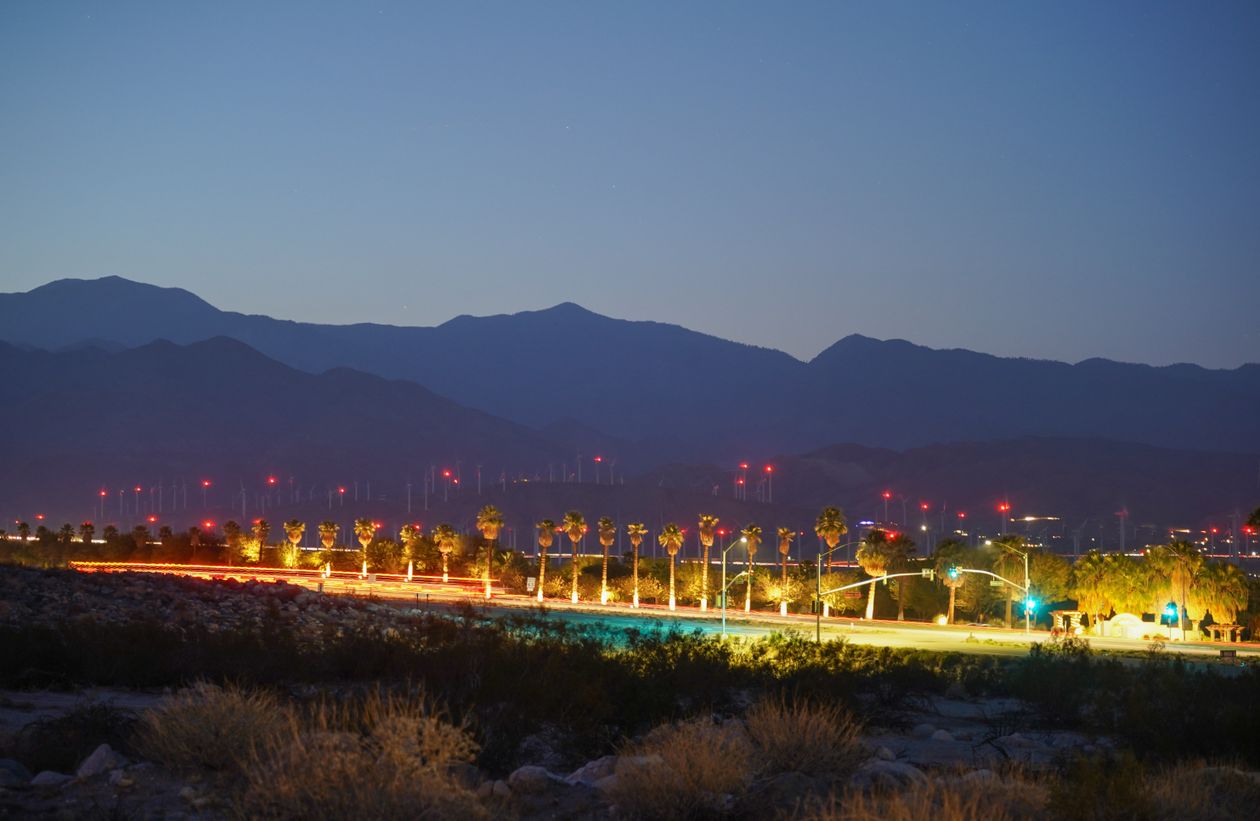
On a clear Thursday evening in mid-March, the desert air over Arizona was mild, and the sky above the Phoenix valley was dark enough for stars. People were out in their yards, driving home from work, and walking dogs along quiet streets. Nothing about the evening suggested that it would become one of the most talked-about nights in the modern history of unexplained sightings.
Then the telephone lines began to fill. From the high country in the north to the suburbs of the capital, callers described lights moving across the sky in a formation they could not place. Within a few hours, thousands of people had seen something unusual. Within a few days, the whole country had a name for it: the Phoenix Lights.
The name, as it turned out, was misleading in one important way. What happened that night was not one event but two, separated by more than an hour and by a wide stretch of sky. One of them now has a documented explanation. The other does not. Much of the argument that has followed, for nearly three decades, comes from treating the two as if they were the same thing.
A Night in Two Parts
The first episode began in the early evening. At about 8:15, reports came from the Prescott area, in the pine country north of Phoenix, of a group of lights moving slowly southward. Witnesses described them as reddish-orange or amber, arranged in a V or a wedge, and moving together across the sky without sound. Over the next half hour, similar reports followed the same southward path: over the Phoenix metropolitan area, then on toward Tucson in the south of the state. By about 8:45, the formation had passed beyond the most populated part of Arizona.
The second episode began at about 10 o’clock that same night, and it looked very different. Southwest of Phoenix, above the dark outline of the Estrella Mountains, a row of bright amber lights appeared in the sky. They did not move across the state. They hung, more or less in place, glowing steadily, and then went out one by one over several minutes. These are the lights that most of the famous video footage shows, and they are the lights that most television viewers remember.
Keeping these two episodes apart is the key to the whole case. The second set of lights was eventually traced to a military training exercise, and that explanation is now supported by the military’s own account and by later tests. The first set of lights has no such settled account. Witnesses disagreed about what they had seen, investigators disagreed about what the evidence showed, and no official record released to the public has identified the earlier formation with certainty. The Phoenix Lights, then, are best understood as two stories that share one night.
The First Passage: A V Over Arizona
The early-evening reports share a broad outline. A group of lights, usually counted as five, moved across the sky in a V-shaped or triangular arrangement, travelling from north to south. Many witnesses said the lights were amber or reddish-orange. Many said the passage was silent. Some said the lights appeared to be separate objects flying in formation. Others were convinced that the lights were fixed to a single enormous structure, a dark shape blotting out the stars between the lights as it passed overhead.
That disagreement matters, because it is the difference between an unusual flight of aircraft and something far stranger. In the Prescott Valley area, where the formation passed nearly overhead, several witnesses described a vast triangular outline, and some estimated its size as very large indeed, with figures of up to a mile across repeated in later retellings. Other witnesses in the same part of the state described only the lights themselves, with no solid shape between them. Some placed the formation high in the sky; others thought it passed low, close enough to seem almost within reach. The same night produced very different descriptions, and that variation is itself part of the evidence: it shows how hard it is for observers, even careful ones, to judge the size, height, and distance of lights seen against a dark sky.
What is not in dispute is the scale of the response. Thousands of people across Arizona reported seeing the lights, and the reports came in a clear southward sequence, from the northern part of the state through Phoenix and toward Tucson. The National UFO Reporting Center, a civilian organization that collects sighting reports, began receiving calls from northern Arizona that evening. Local television stations and newspapers picked up the story. By the next day, the lights were a statewide conversation, and within weeks they were a national one.
One detail from the early evening deserves special attention because it cuts against the idea of a single solid craft. A witness in the Prescott area watched the formation through a telescope and later reported that what he saw was not one object but separate aircraft, each carrying its own lights. That observation has been cited ever since by those who argue for a conventional explanation of the first episode. It has also been questioned by those who note that a single telescopic observation, made under difficult conditions, cannot settle the accounts of thousands of other witnesses. Both points are fair, and neither, on its own, closes the question.
Radar, which might have been expected to resolve the matter, did not. Luke Air Force Base, the large military airfield west of Phoenix, said its operators had seen nothing unusual that night, and noted that a high-altitude formation outside its restricted airspace would not necessarily have drawn attention. No radar record of an unknown object over Arizona that night has been released to the public. The absence of such a record is sometimes treated as evidence that nothing extraordinary was there, and sometimes treated as evidence that the right records were never examined or never kept. The record itself is silent, and silence can be read in more than one way.
The Second Act: Lights Over the Estrellas
The later lights were a different kind of sighting, and they were captured far better on camera. At about 10 p.m., residents of the Phoenix area looked southwest and saw a row of brilliant amber lights hanging above the horizon. They appeared one after another, glowed for several minutes, and then faded out in sequence, as if each light were being switched off in turn. Amateur video of these lights, shot from backyards and balconies across the valley, became the defining image of the Phoenix Lights, and it is still the footage most often shown whenever the case is discussed.
Unlike the earlier formation, these lights did not travel. They stayed in roughly the same part of the sky, low over the mountains, and their behaviour, steady glow followed by sequential disappearance, matched no ordinary aircraft in level flight. It did, however, match something else: illumination flares, dropped from aircraft and descending slowly beneath small parachutes, burning brightly for a few minutes before going out. Flares of this kind are used in night training to light up the ground below, and they hang in the air far longer than a firework or a falling object.
For months, however, no one in authority said so. The military did not immediately explain the lights, and in the gap, speculation flourished. It was only later, after public pressure and press inquiries, that the explanation arrived, and when it did, it arrived with unusual precision, as the next part of this story shows.
The Governor’s Joke
The official response to the sightings began badly, and the misstep became part of the legend. On May 6, 1997, Phoenix city councilwoman Frances Emma Barwood raised the sightings at a council meeting and became the only elected official in the state pressing publicly for an inquiry. She was told, in effect, that the Air Force had left the business of investigating unidentified flying objects years earlier, and her request went nowhere.
Then, on June 19, 1997, Governor Fife Symington held a news conference that made the situation worse. Facing reporters and cameras, he announced that the culprit behind the lights had been captured, and then brought out his chief of staff, Jay Heiler, dressed in an alien costume. Symington told the room that the reporters were taking themselves entirely too seriously. The room laughed. The joke was widely reported, and widely resented by people who had seen the lights and wanted a serious answer. Whatever Symington intended, whether to calm public anxiety or simply to make light of a strange story, the effect was to close down official discussion of the case for years.
It is worth pausing on this moment, because it shaped everything that followed. A governor’s joke does not change what was in the sky, but it changes what happens on the ground. Witnesses who might have come forward stayed quiet. Reporters moved on. The file, such as it was, was never properly opened. The Phoenix Lights became a story people told rather than a question anyone in authority tried to answer, and that is one reason the case has lasted so long in public memory.
The Flares, Confirmed
The explanation for the later lights arrived in the summer of 1997, and it arrived from the military itself. On July 25, 1997, Captain Drew Sullins, a spokesman for the Maryland Air National Guard, told the Associated Press that its A-10 ground-attack jets had been flying training missions that night over the Barry M. Goldwater Air Force Range, a vast military training area southwest of Phoenix. The aircraft had dropped high-intensity parachute flares from about 15,000 feet, and had released their remaining flares at high altitude before returning to Davis-Monthan Air Force Base near Tucson.
The details fit the 10 p.m. sighting closely. The flares in question were LUU-2B/B illumination flares, designed to burn brightly and descend slowly, which accounts for the lights’ steady glow and their disappearance one by one. The range lies in the direction in which the lights were seen from Phoenix. The Maryland Guard’s aircraft were in Arizona for winter training under a program known as Operation Snowbird, which brought Air National Guard units to Davis-Monthan for the colder months. A separate confirmation came from the air: a lieutenant colonel of the Maryland Guard later identified himself publicly as one of the pilots who had released flares that night, describing the exercise from the cockpit rather than from a press office.
Independent checks pointed the same way. In June 1997, a television reporter in Phoenix filmed military flares dropped over the gunnery ranges southwest of the city, and the footage looked strikingly like the 10 p.m. lights of March 13. Video analysts who studied the original footage concluded that the later lights behaved as flares behave: appearing in a line, holding position as they descended on parachutes, and winking out in sequence. For the second episode, the case is as close to settled as such cases usually get, and most serious students of the subject, including writers sympathetic to the unexplained, accept the flare explanation for the 10 p.m. lights.
It is important to be precise about what this explanation covers. The Maryland Guard’s statement concerned the hovering lights seen southwest of Phoenix at about 10 p.m. Its spokesman said explicitly that its aircraft had not gone north of Phoenix that night, and therefore could not have been the earlier formation. The flare explanation, in other words, accounts for the second episode and leaves the first untouched. Anyone who cites the flares as the answer to the whole night is claiming more than the evidence supports.
The First Formation, Still Open
The earlier formation has attracted several conventional explanations, and each of them deserves a fair hearing. The most prominent is that the first lights were also military aircraft: a formation of A-10 jets, flying under visual flight rules along an assigned corridor, returning to Davis-Monthan after an evening mission. On this view, the V of lights was simply five aircraft in formation, and the impression of a single giant craft was a trick of the dark, in which the eye joins separate points of light into one shape. The telescopic observation from the Prescott area is often cited in support of this view, and so is the fact that A-10s were operating in the region that night.
There are difficulties with this account, and they should not be hidden. The Maryland Guard, which owned the flare explanation, said its aircraft were not north of Phoenix at the relevant time. The formation’s reported path, from the Prescott area southward through the state, does not match, in the public record, any documented flight plan released for that evening. Witnesses who described a solid triangular shape passing overhead, blotting out stars, were describing something that a loose formation of jets does not obviously produce. And the sheer number of witnesses, reporting from towns spread across hundreds of miles, makes it hard to dismiss the first episode as a handful of mistaken observers.
Other explanations have been offered and set aside. No commercial aircraft, no astronomical event, and no weather phenomenon has been shown to match the reports. The idea that the lights were a secret military aircraft of some new design has been suggested, but no evidence for such a craft operating over Arizona that night has been produced, and the suggestion remains speculation. The idea that the formation was something not made by human hands at all is held by many witnesses and by some investigators, but it rests on eyewitness testimony rather than on physical evidence, and testimony, however sincere, cannot by itself establish what an object was.
The honest position on the first episode is therefore a narrow one. Something moved across Arizona on the evening of March 13, 1997, in a V-shaped arrangement of lights, and thousands of people saw it. What that something was has not been established in any public record. That is not the same as saying it cannot be explained, and it is not the same as saying it was extraordinary. It is a statement about the state of the evidence, which is incomplete, and about the limits of what can be claimed from it.
Ten Years Later: The Governor Changes His Story
The case took an unexpected turn on its tenth anniversary. In March 2007, former Governor Fife Symington said publicly that he had seen the lights himself on the night of March 13, 1997, and that what he had seen was not flares. He described a large triangular craft of unknown origin passing over the valley, so symmetrical in its arrangement of lights that it could not, in his view, have been a flare exercise. He said the object was bigger than anything he had ever seen, and he described the experience as otherworldly.
Symington also explained, for the first time, why he had kept quiet. He said he had telephoned the commander at Luke Air Force Base, the general in charge of the National Guard, and the head of the state’s Department of Public Safety on the night of the sighting, and that none of them had answers for him. He said he had staged the alien-costume joke in 1997 partly to defuse public anxiety, and partly because he was facing fraud charges at the time and did not want to add a public controversy about flying objects to his troubles. He had told no one but his wife, he said, until a decade had passed.
Symington’s reversal changed the tone of the case without changing its evidence. He was a former pilot and a former Air Force officer, and his account carried weight for that reason. It was also, by his own admission, a memory recalled ten years after the event, unaided by any document or recording, and it contradicted the public position he had taken as governor. Some investigators welcomed his statement as confirmation from a credible witness. Others noted that a decade-old recollection, however honest, is still only one witness’s account, and that it does not, on its own, identify what flew over Arizona. Both reactions are understandable. A governor’s testimony is more interesting than an anonymous report, but it is not a different kind of evidence.
The tenth anniversary also brought renewed media attention, including documentaries and a fresh round of interviews with witnesses. The case, which had never quite left public conversation in Arizona, returned to national attention. And with that attention came a familiar pattern: new lights over Phoenix in 2007 and 2008 were quickly reported as a return of the phenomenon, and then quickly attributed, in one case to military flares and in another to flares attached to balloons released by a civilian. Those later episodes are a useful reminder of how easily bright lights over a desert city can be mistaken, and of how important it is to check each sighting on its own facts rather than folding it into an existing legend.
Why the Case Endures
Nearly three decades on, the Phoenix Lights remain one of the most discussed sighting cases in the United States, and the reasons are not hard to see. The number of witnesses was very large. The sightings stretched across an entire state rather than a single town. The governor of that state first mocked the event and then, ten years later, said he had seen it himself. And the case contains, within a single night, both a solved puzzle and an unsolved one, which gives everyone something to point to: the sceptic can point to the flares, and the believer can point to the formation.
There is also a simpler reason, which is that the night itself was genuinely strange to the people who lived through it. A silent V of amber lights crossing the sky is not an everyday sight, even in a state accustomed to military aircraft. The desert sky is wide and dark, and things in it are seen clearly. When thousands of people, in different towns, at different times in the same evening, report the same southward passage, it is reasonable for them to want an answer, and reasonable for them to be dissatisfied when the answer they receive covers only half the night.
The case also illustrates something larger about how unexplained sightings are remembered. The Phoenix Lights became famous through video of the second episode, the flares, while the first episode, the formation, is the part that remains unexplained. The images that fixed the case in public memory are therefore images of the solved part, and the unsolved part survives mainly in words, in witness accounts that are harder to replay on television. This mismatch between what was filmed and what remains unknown has shaped the debate ever since, and it is a good reason to be careful, in any retelling, about which lights are being discussed.
For the archive, the Phoenix Lights belong in a particular category: not a case with no explanation at all, and not a case fully explained, but a case split down the middle. One half has been accounted for by a documented military exercise, confirmed by the unit that flew it and consistent with the behaviour of the lights on video. The other half has not been accounted for in any public record, despite the efforts of journalists, investigators, and witnesses over many years. That split is the fact that matters most, and it is the fact that any honest account must preserve.
The Investigation That Never Was
One of the stranger features of the Phoenix Lights is how little formal investigation followed an event witnessed by thousands of people. There was no official inquiry of the kind that a comparable event on the ground would certainly have produced. No government body published a report. No file of radar data, flight logs, or interview transcripts was released to the public. The case was investigated, instead, by journalists, by civilian research groups, and by individual witnesses who kept their own records.
The civilian effort was considerable. The National UFO Reporting Center collected calls on the night itself and in the days that followed. The Mutual UFO Network, a civilian organization that investigates sighting reports, examined witness accounts and video. A Phoenix newspaper published a detailed investigation in 1998 that reconstructed the southward path of the early-evening reports and tested the various explanations against the timeline. Local television stations, notably KPNX, filmed flare exercises over the southwestern ranges and showed, visually, how closely flares resembled the later lights. These efforts produced much of what is now known about the night, and they deserve credit for it.
What they could not produce was access. Civilian investigators could not compel the release of military flight records, and the military, when it did speak, spoke only about the flare exercise. Requests routed through elected officials produced the flare explanation for the 10 p.m. lights and nothing about the earlier formation. Councilwoman Barwood’s request for an inquiry went unanswered in any substantive sense. The governor’s office, having made a joke of the matter, did not pursue it. The result is a public record that is rich in witness testimony and poor in documents, and that imbalance has defined the case ever since.
It is worth noting that the case has not entirely disappeared from official attention. In November 2024, the director of the Pentagon’s office for unidentified anomalous phenomena, Jon Kosloski, said that a second volume of its historical report would revisit notable cases including the Phoenix Lights. No Phoenix-specific resolution has appeared in that office’s public releases. The statement is a reminder that the case remains, in official terms, neither closed nor resolved, and that the absence of a final answer is not the same as the absence of interest.
What Witnesses Agree On, and What They Do Not
When witness accounts are laid side by side, a pattern emerges that is more useful than any single account. On several points, the witnesses agree. The lights were amber or reddish-orange. They were arranged in a V or wedge. They moved from north to south. They made no sound that anyone reported. They were seen over a period of roughly half an hour in the early evening, in a sequence that followed the geography of the state. These points of agreement are the strongest part of the case, because they come from people who did not know one another, in towns many miles apart, describing the same passage in the same terms.
On other points, the witnesses disagree, and the disagreements are instructive. Some describe a solid triangular craft, dark against the sky, with lights along its leading edge. Others describe only lights, with no structure between them. Some place the formation very high; others place it low, near the rooftops. Some describe it as moving slowly, almost hovering; others describe a steady, purposeful transit. Estimates of size range from modest to enormous. These differences do not mean the witnesses were dishonest. They mean that judging the size, height, and distance of lights in a dark sky is genuinely difficult, even for careful observers, and that the human eye, presented with a row of lights and no other reference, will sometimes join them into a shape.
This is why the case resists a simple verdict. The points of agreement establish that something real crossed the state that evening, in formation, and was widely seen. The points of disagreement prevent that something from being identified with confidence from testimony alone. A solid craft and a formation of aircraft can produce similar reports from the ground, especially at night, and the reports themselves cannot always distinguish between them. Any account of the Phoenix Lights that quotes only the most dramatic descriptions, or only the most mundane ones, is selecting its evidence. The full picture is messier, and more interesting, than either selection.
Evidence Ladder
Verified
- On the evening of March 13, 1997, thousands of people across Arizona reported lights in the sky, in two distinct episodes: a moving V-shaped formation in the early evening and a row of stationary amber lights southwest of Phoenix at about 10 p.m.
- On July 25, 1997, the Maryland Air National Guard confirmed that its A-10 aircraft had dropped high-intensity parachute flares over the Barry M. Goldwater Range that night, an account consistent with the behaviour and location of the 10 p.m. lights.
- Governor Fife Symington staged a news conference on June 19, 1997, at which his chief of staff appeared in an alien costume, and in March 2007 Symington said publicly that he had seen the formation himself that night.
Leads
- A formation of A-10 aircraft returning to Davis-Monthan Air Force Base has been proposed as the explanation for the early-evening lights, supported by a telescopic observation from the Prescott area that reported separate aircraft rather than a single object.
- The southward sequence of reports, from the Prescott area through Phoenix toward Tucson, suggests a single moving phenomenon rather than unrelated local sightings, though the reports disagree on its height, size, and solidity.
- The absence of any released radar record of an unknown object that night leaves open whether the formation was ever tracked, and whether relevant records were examined or retained.
Rumour
- Claims that the early-evening formation was certainly a solid craft up to a mile across go beyond what witness testimony can establish, since estimates of size, height, and distance for lights in a dark sky vary widely between observers.
- Claims that the military deliberately covered up knowledge of an unknown craft over Arizona that night rest on no released document, and the flare explanation for the later lights was volunteered by the unit involved.
- Claims that the 10 p.m. lights and the early-evening formation were the same object ignore the time gap, the different behaviour of the two sets of lights, and the Maryland Guard’s own statement that its aircraft were not north of Phoenix that night.
Mystery File
- What happened: Thousands of people across Arizona reported lights in the sky on one evening, in two distinct episodes: a V-shaped formation moving south across the state, and a row of stationary amber lights southwest of Phoenix that was later traced to military flares.
- When: March 13, 1997.
- Status: Partially explained.
Closing question: When one night holds both a solved puzzle and an unsolved one, which half should we remember first?
Keep exploring: Area 51: The Base That Turned Secrecy Into Legend; Rendlesham Forest: Britain’s Best-Documented UFO Encounter; The Belgian Triangle Wave: Radar, Jets, and a Photograph; Kecksburg, 1965: The Object That Fell Into the Woods