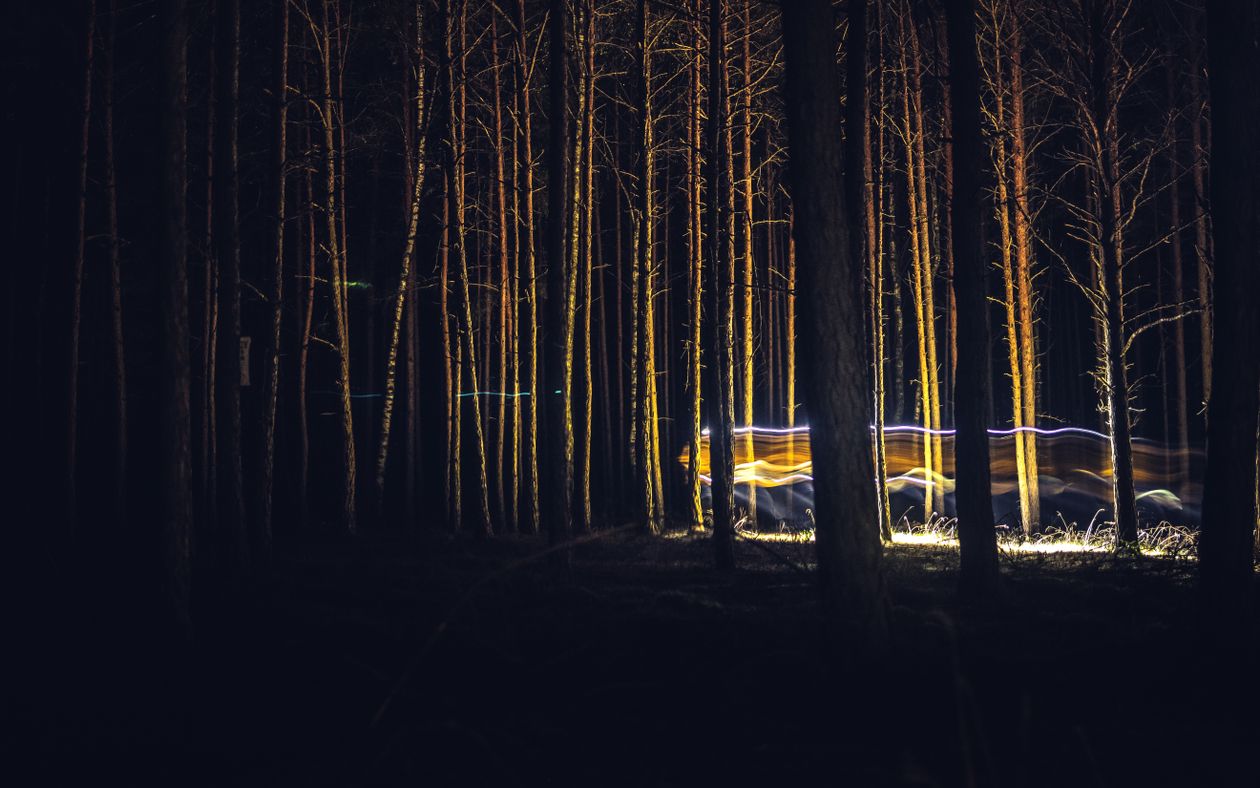
The forest was quiet after midnight, the way pine forests are quiet in winter, when the ground is soft and the air carries sound a long way. Two security policemen at the east gate of an air base in Suffolk had the night watch, and the land beyond the fence was dark except for the trees. Then, among the trees, there were lights that did not belong to the forest. They were coloured, red and blue and white, and they seemed to move, and they seemed to come down toward the ground. The men on duty thought at first that an aircraft might have come down in the trees, and that someone might need help.
That single decision, to go outside the gate and look, is where the story begins. It was the day after Christmas, 1980. The men who went into the forest were American airmen, stationed far from home at two Royal Air Force bases that the United States Air Force operated in eastern England. What they found, and what their commander found two nights later, would be written down, recorded on tape, filed with the British government, and argued about for more than forty years. The case is often called Britain’s Roswell. The comparison is imperfect, but the reason for it is real: few episodes of this kind left behind so much paper.
A Forest Between Two Bases
Rendlesham Forest is a working forest of pine plantation and heath in Suffolk, on the east coast of England. In 1980 it lay between two air stations, RAF Bentwaters and RAF Woodbridge, separated by only a few miles of trees and farmland. Both stations were operated by the United States Air Force as part of NATO’s forces in Britain, and both were guarded by American security police. The forest itself was not a secret place. It was crossed by tracks and rides, bordered by farms and small villages, and used by local people. But at night it was dark, and from the bases it looked like a wall of trees.
The winter of 1980 was an ordinary Cold War winter at the twin bases. The airmen on duty were young, most of them far from home, and the days after Christmas were quiet ones. The bases were on a reduced routine, and the men of the 81st Security Police Squadron kept the gates and the perimeters. Nothing in the routine of that week suggested that anything unusual was about to happen. That ordinariness matters, because it is part of why the case has lasted. The witnesses were not people looking for something strange. They were people on a shift, doing a job, who saw lights where they did not expect lights to be.
It is also worth understanding what the bases were. Bentwaters and Woodbridge were front-line stations, and their security was taken seriously. An unexplained light outside the fence was not a curiosity to be ignored. It was something to be checked, because a fire, a crash, or an intruder near a military base all demanded a response. When the men at the east gate of Woodbridge saw lights descending into the forest, their first thought was practical: something might have come down, and someone might be hurt. That practical instinct shaped everything that followed.
The First Night
Early in the morning of December 26, 1980, at around three o’clock, two security policemen at the east gate of RAF Woodbridge noticed unusual lights beyond the fence, in the direction of Rendlesham Forest. The lights were coloured, and they appeared to be descending, or at least moving downward through the trees. The patrolmen reported what they saw and asked permission to go outside the gate to investigate. Permission was given, and three men went into the forest on foot: Staff Sergeant Jim Penniston, Airman First Class John Burroughs, and Airman Edward Cabansag.
The men moved through the trees toward the lights, keeping in radio contact with their base. What happened next is described in the written statements they gave in the days that followed, which are the closest record to the events themselves. According to those statements, the men saw a glowing object in a clearing, metallic in appearance and triangular in shape, roughly two to three metres across its base and about two metres high. It gave off a white light bright enough to light the forest around it, with a pulsing red light on top and blue lights underneath. As the patrolmen approached, the object moved away through the trees and disappeared.
The details of the first night have been argued over ever since, and it is important to separate what the early statements say from what was added later. In his statement written soon after the events, Penniston described the object as definitely mechanical, and placed himself no closer than about fifty metres from it. He did not mention touching it, and he did not mention markings or symbols. Those details entered his account decades later, and they are not part of the original record. Burroughs and Cabansag gave accounts that are broadly consistent with Penniston’s early statement, though they differ in some details, as honest accounts of a confusing night often do.
The patrol’s walk through the forest ended in a way that would later become central to the skeptical reading of the case. After following lights for some distance, past a farmhouse and toward the coast, Burroughs and Cabansag concluded that the light they were following was a lighthouse. Penniston, according to the account of their flight chief, did not agree that this was the same light he had originally seen. The three men returned to base. At around four in the morning, the Suffolk police were called, and officers visited the area. The police later recorded that the only lights visible to them were those of the Orford Ness lighthouse, several miles away on the coast. That police observation, written down at the time, has carried great weight in every investigation since.
The Marks in the Ground
The next day, in daylight, the clearing where the object was reported was examined, and three depressions were found in the ground, arranged in a triangle. The official memo written later described them as about an inch and a half deep and seven inches across. The depressions were in the place where the object was said to have been seen, and their triangular arrangement matched the triangular shape described by the witnesses. They were photographed and noted, and they became one of the few physical traces attached to the case.
On the following night, the area was checked for radiation. A Geiger counter recorded readings of 0.1 milliroentgens of beta and gamma radiation, with the highest readings in the three depressions and near the centre of the triangle they formed. A nearby tree showed moderate readings on the side facing the depressions. These figures come from the official memo, and they have been quoted ever since. But their significance is disputed. Radiation experts have pointed out that the readings were low, close to background levels, and that the memo’s account of them does not match exactly what can be heard on the tape recording made that night. The readings are real in the sense that they were recorded and written down. What they mean is a different question, and it has never been settled.
The ground marks and the radiation readings are the reason the case cannot be dismissed with a single sentence. A light in the sky can be many things, and a light seen at night through trees can be misjudged in distance and size. But three marks in the ground, in a triangle, in the place where an object was reported, are harder to explain away. They might have been made by animals, by forestry work, or by something else entirely, and no one has ever proven what made them. But they were there, they were measured, and they were written into an official document. That is more than most episodes of this kind can offer.
The Second Night
Two nights after the first sighting, on the night of December 27 to 28, lights were reported in the forest again. This time the man who went to look was not a patrolman but the deputy base commander himself, Lieutenant Colonel Charles Halt. Halt was alerted while a Christmas party was still going on at the base, and he gathered a small party and went into the forest, carrying a hand-held tape recorder so that he could record what happened as it happened.
Halt’s party inspected the clearing with the depressions, and the Geiger counter was used again. Then, as the night went on, the party saw lights in the sky. Halt described them on the tape as they appeared: a red, sun-like light seen through the trees, moving and pulsing, which seemed to throw off glowing particles before breaking into five separate white objects and disappearing. Later, three star-like objects were seen in the sky, two to the north and one to the south, low above the horizon, moving rapidly in sharp, angular movements and showing red, green, and blue lights. The tape runs for about eighteen minutes, and Halt’s voice on it is calm and methodical, the voice of an officer narrating what he sees for the record.
The tape is one of the most important documents in the case, and also one of the most debated. Supporters of the case point out that it was recorded at the time, by a senior officer, in the presence of other men, and that it captures genuine puzzlement. Skeptics point out that the tape also contains moments that support ordinary explanations, including a moment when Halt himself notes that a light appears to be clear off to the coast, on the horizon, which is consistent with a lighthouse. Both readings are drawn from the same recording. That is part of what makes the tape so valuable and so frustrating. It is not a story told long afterwards. It is a record of a night as it unfolded, with all the confusion of the night still in it.
Halt’s party eventually returned to base, and the second night ended without any object being recovered, photographed clearly, or brought back. No wreckage was found. No material was kept. Whatever had been in the forest, if anything had been there at all, left nothing behind except the marks in the ground, the radiation readings, and the tape.
The Memo
On January 13, 1981, about two weeks after the events, Halt wrote a one-page memorandum to the British Ministry of Defence, headed with the subject of unexplained lights. The memo was written on United States Air Force letterhead, signed by Halt as deputy base commander, and passed through the Royal Air Force commander at the base to the Ministry. It described the first night, the depressions and the radiation readings, and the second night, in plain, official language. It did not claim that the lights were spacecraft, and it did not offer a theory. It reported what had been seen and measured, and it left the explanation open.
The memo is the reason the Rendlesham case is different from most others. It is an official document, written by a senior officer, about events on a military base, sent to a government ministry. It was not classified, and it was later released under the American Freedom of Information Act in 1983, after which it became public. The original is kept at The National Archives in Kew, in London. Its existence means that the case cannot be treated as a rumour or a story invented afterwards. Something happened that a deputy base commander thought worth reporting to the Ministry of Defence, and he put his name to it.
But the memo also has weaknesses, and honesty about them matters. Halt wrote it from memory, and he got the dates wrong by one day in each case, placing the first night on December 27 instead of December 26, and the radiation check on December 29 instead of December 28. The memo’s account of the radiation readings also differs in some details from what is heard on the tape. These are the kinds of errors that memory makes, and they do not by themselves prove that the events did not happen. But they are a reminder that even official documents are written by people, and that the memo is a summary made two weeks later, not a record made on the night.
The Ministry of Defence, on receiving the memo, did not launch a large investigation. Its files show that the case was looked at briefly and judged to be of no defence significance, meaning that it did not appear to pose a threat to the country. The witnesses were not formally interviewed by the Ministry. That response has been read in two opposite ways. Some read it as evidence that the authorities knew more than they said and chose not to pursue it. Others read it as evidence that the authorities, looking at the same facts, saw nothing that required further action. The files themselves do not resolve that argument. They show a brief inquiry and a decision to move on.
The Lighthouse
The most durable ordinary explanation for the Rendlesham lights is the Orford Ness lighthouse, a tall lighthouse on the Suffolk coast, roughly five miles east of the forest. The lighthouse beam sweeps the horizon at regular intervals, and from certain places in the forest, where the ground rises above the level of the coast, the beam can appear to hover just above the ground, bright and close, shining between the trees. A person walking toward it through dark woods, with no clear sense of distance, could reasonably think it was something nearer and stranger than it was.
The lighthouse explanation was developed in detail by the astronomy writer Ian Ridpath, who visited the forest in the early 1980s with a local forester. The forester, who knew the ground well, told Ridpath plainly that the lights were the lighthouse. Ridpath plotted the directions the airmen had described and found that they pointed toward the coast. Standing at the edge of the forest after dark, he saw for himself how the lighthouse beam could look like a light floating just above the ground. A television crew filmed the effect, and Ridpath published his explanation in a national newspaper in 1985. The explanation also fits the Suffolk police observation on the first night, that the only lights visible were those of the lighthouse.
Halt rejected the lighthouse explanation, arguing that the men involved knew where the lighthouse was and would not have mistaken it for something else. That objection carries weight, because the airmen were not strangers to the area, and the lighthouse was a familiar feature of the coast. But familiarity does not always prevent misjudgment at night, in woods, under stress, and when lights are seen from an unfamiliar angle. The forest floor rises and falls, and the beam appears and disappears between trees, which can make a steady, distant light seem to move, approach, and retreat. The lighthouse explanation is strongest for the second night, and for the lights followed toward the coast. It is weaker for the first night’s report of an object on the ground in a clearing, which is a different kind of sighting from a distant beam.
Other ordinary explanations have been offered for parts of the case. Bright stars and planets, low in the winter sky, can appear to move and change colour when seen through thin cloud or turbulence, and some of the star-like objects described on the second night may have been stars. A lightship off the coast has also been suggested as a contributor. None of these explanations covers every part of the case on its own, and that is why the argument has continued. The lighthouse explains the lights toward the coast. It does not, by itself, explain the triangular object described on the first night, or the marks in the ground, or the radiation readings. The case is not one puzzle but several, and different pieces may have different answers.
The Later Years
For several years after 1980, the Rendlesham case was known only to a small circle of researchers and officials. That changed when the Halt memo was released in 1983 and the story reached the newspapers. From then on, the case grew. Books were written, television programmes were made, and the forest became a place of pilgrimage for people interested in unexplained phenomena. A trail was eventually marked through the woods, and visitors still walk it today, looking for the clearing where the object was said to have stood.
As the case grew, so did the accounts of it. Witnesses who had given short, plain statements in 1980 and 1981 began, in later years, to give longer and more detailed accounts, in interviews, books, and conferences. Penniston, in particular, later described touching the object, feeling its surface, and seeing symbols on it, and later still spoke of receiving a long sequence of binary code in his mind, which he wrote down and which others later tried to decode. These later claims are part of the public record of the case, and they are widely repeated. But they are not part of the original record, and they were not mentioned in the statements written at the time. A careful reading of the case must keep the two layers apart: what was written down in the days after the events, and what was added in the decades that followed.
The later years also brought new documents. The British Ministry of Defence released its file on the case in stages, and researchers examined the base’s records, the police correspondence, and the statements of the men involved. In 2010, the researcher David Clarke revealed the background to the Halt memo and the Ministry’s reaction to it, showing that the inquiry had been brief and that the witnesses had not been interviewed. These releases did not settle the case, but they did something valuable: they replaced speculation about what the authorities had done with actual paper, and paper is harder to argue with than rumour.
The case also acquired a cultural life of its own. It has been called Britain’s Roswell so often that the name has stuck, and it is now part of the folklore of Suffolk, alongside the older stories of the coast. That folklore is not a bad thing in itself. Places keep their stories, and stories bring visitors. But folklore has a way of smoothing over uncertainty, and the Rendlesham story, as it is often told today, is smoother and more certain than the record supports. The record is messier, more interesting, and less conclusive than the legend.
What Remains
More than forty years after those December nights, the Rendlesham Forest incident remains open in the sense that matters most: no single explanation has been accepted by everyone who has studied it, and no piece of physical evidence has settled it. The lighthouse explains much of what was seen, and it is the explanation that best fits the police observation and the geography of the coast. But it does not explain everything, and the men who were there have consistently said that what they saw was not the lighthouse, at least not all of it. The stars explain some of the lights in the sky. They do not explain the object on the ground. The marks in the ground and the radiation readings remain unexplained in any firm sense, because they were never investigated thoroughly at the time, and the ground itself has long since changed.
Part of the reason the case endures is that it sits at a boundary. It is not a story told by one person, long afterwards, with nothing to support it. It is a story told by several servicemen, recorded on tape, written into an official memo, and filed with a government ministry. At the same time, it is not a story supported by a photograph, a piece of wreckage, or a scientific measurement that has survived scrutiny. It is documented, but it is not proven, and that middle ground is where arguments live longest.
There is also a human reason the case endures. The men involved were young, on duty, far from home, at Christmas, in a dark forest, and they saw something they could not explain. That experience, whatever its cause, was real to them, and it stayed with them. Some of them have spent the rest of their lives talking about it. Others have said little. The difference between their early statements and their later accounts is itself part of the story, a reminder of how memory works over decades, and how a strange night can grow in the telling without anyone intending to deceive.
Rendlesham Forest itself has not changed much. The pines are still there, the tracks are still there, and the lighthouse still sweeps the horizon from the coast. Visitors who walk the forest at dusk can see for themselves how a distant beam can look close among the trees, and how a dark wood can make ordinary things look strange. That is, in the end, the most useful way to think about the case. It is not a puzzle with a missing piece that will one day be found. It is a set of facts, some ordinary and some not yet explained, held together by a few nights in December 1980, and by the paper that those nights left behind.
Evidence Ladder
Verified
- In late December 1980, United States Air Force security personnel at RAF Woodbridge and RAF Bentwaters in Suffolk reported unusual lights in Rendlesham Forest, and three men went into the forest to investigate on the first night.
- Lieutenant Colonel Charles Halt, the deputy base commander, led a second investigation into the forest on the night of December 27 to 28, recorded his observations on a tape recorder, and later wrote a one-page memorandum headed with the subject of unexplained lights to the British Ministry of Defence, dated January 13, 1981.
- The memorandum records three depressions in the ground, arranged in a triangle, and radiation readings of 0.1 milliroentgens, and the original document is kept at The National Archives in Kew; the Ministry of Defence judged the case to be of no defence significance.
Leads
- The Orford Ness lighthouse, roughly five miles east of the forest on the Suffolk coast, can appear from parts of the forest as a bright light hovering just above the ground, and the Suffolk police recorded on the first night that the only lights visible to them were those of the lighthouse.
- The three depressions in the ground, in a triangular arrangement where an object was reported, were measured and recorded, but their cause was never firmly established, and the low radiation readings have been disputed in their significance.
- The witnesses’ early written statements describe a glowing, triangular, metallic object on the first night, while later accounts from the same witnesses added details not present in those statements, which raises questions about how memory of the events changed over time.
Rumour
- Claims that the object was a craft from another world, supported by later accounts of touching it, reading symbols on it, or receiving a coded message, rest on details added decades after the events and are not part of the original statements or the official memo.
- Claims that the authorities secretly recovered wreckage, hid physical evidence, or conducted a major cover-up are not supported by the released Ministry of Defence file, which shows a brief inquiry rather than a large investigation.
- Claims that the incident involved nuclear weapons, a secret military test, or an encounter staged for unknown purposes have no supporting evidence in the contemporaneous record and belong to speculation rather than to what was documented at the time.
Mystery File
- What happened: United States Air Force personnel at two Suffolk air bases reported strange lights and a glowing triangular object in Rendlesham Forest, and their deputy base commander later investigated, recorded a tape, and reported the events to the British Ministry of Defence.
- When: December 26 to 28, 1980.
- Status: Partially explained.
Closing question: If a lighthouse can explain the lights in the sky but not the object reported on the ground, how do you decide which parts of a story belong to the ordinary world and which parts are still waiting for an answer?
Keep exploring: Area 51: The Base That Turned Secrecy Into Legend; The Phoenix Lights: Thousands of Witnesses, One Night Sky; The Belgian Triangle Wave: Radar, Jets, and a Photograph; Kecksburg, 1965: The Object That Fell Into the Woods