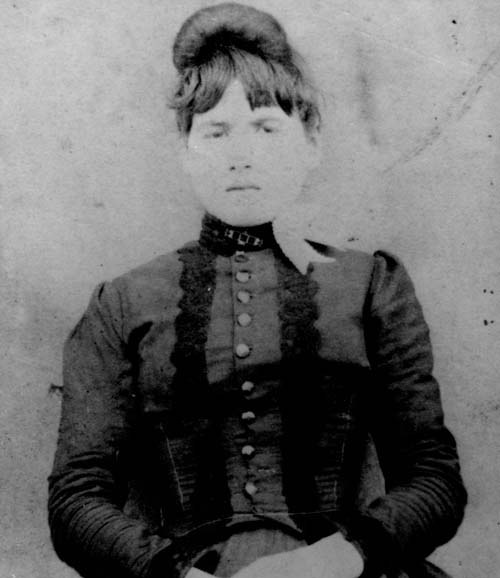
It is one of the strangest stories in American legal history. In January 1897, a young woman named Elva Zona Heaster Shue was found dead in her home in Greenbrier County, West Virginia, and the coroner’s jury ruled she had died of heart disease. She was buried the next day. And then, according to her mother, Zona came back — and told her exactly who had killed her, and how.
The case is remembered as the only known instance in which testimony from a ghost helped convict a murderer — that is what the historical marker near her grave says, and how the story is told across West Virginia to this day. The truth, as the trial record shows, is more complicated than the legend.
A Short Marriage
Elva Zona Heaster, who went by her middle name, Zona, met blacksmith Edward Stribbling Trout Shue — also known as Erastus or Erasmus — in October 1896. They married soon afterwards. She was in her early twenties; they had been married only about three months when she died.
On January 23, 1897, Zona Shue was found dead in her home. (Some accounts say January 22.) A coroner’s jury rendered a verdict of “death by heart disease.” She was buried on January 24, 1897, in the local cemetery now known as Soule Chapel Methodist Cemetery.
Neighbours already whispered about Shue’s odd behaviour — he dressed the body himself, placing a high collar and a veil around her neck — but without evidence of foul play, the case was closed.
Four Nights of Visits
Zona’s mother, Mary Jane Heaster, did not accept the verdict. According to her later account, her daughter’s spirit came to her over four consecutive nights. On the first night, Zona appeared in her burial dress and turned her head completely around to look at her mother — “like she wanted me to know all about it,” Mary Jane later testified. On the second night, the spirit told her that her husband had killed her by breaking her neck, squeezing it off “at the first joint,” after flying into a rage because she had not cooked meat for supper.
Mary Jane later said she was wide awake during these visits, not dreaming, and could touch her daughter’s ghost; the spirit also reportedly directed her to a house she had never visited, where she said she found blood connected to her daughter’s death — a detail never independently verified.
Armed with the ghost’s account, Mary Jane went to the local prosecutor, John Alfred Preston, and spent several hours in his office arguing for a re-examination. Whether Preston believed the ghost story is unknown, but local pressure and his own doubts moved him to act. He sent deputies to re-interview those involved, including Dr. Knapp, the physician who had attended Zona; Knapp admitted he had not made a complete examination of the body. That, rather than the ghost, was the formal justification for an exhumation and autopsy.
The Exhumation
On February 22, 1897, Zona’s body was exhumed and examined in the local one-room schoolhouse. The three-hour autopsy matched, almost exactly, what the ghost had reportedly said. The official report, published March 9, 1897, stated that “the neck was broken and the windpipe mashed. On the throat were the marks of fingers indicating that she had been choked. The neck was dislocated between the first and second vertebrae.”
Shue was arrested and charged with his wife’s murder. While he waited in the Lewisburg jail, more about his past came to light: he had been married twice before — his first marriage ended in divorce, his wife accusing him of great cruelty, and his second wife died under mysterious circumstances less than a year after they married. Zona was his third wife.
The Trial
The trial began on June 22, 1897. Prosecutor Preston called Mary Jane Heaster as his star witness but confined his questioning to the known facts, carefully skirting the ghostly visits. It was Shue’s own lawyer who raised the ghost, hoping to discredit her on cross-examination. The tactic backfired: she would not waver, and her answers stayed measured and consistent.
Because the defence had introduced the ghost story, it was before the jury. On July 11, 1897, the jury found Shue guilty of first-degree murder and sentenced him to life in prison, after recommending mercy.
Shue died on March 13, 1900, in the West Virginia State Penitentiary at Moundsville, a victim of an unknown epidemic, and was buried in an unmarked grave.
The Legend — and the Correction
A state historical marker near the cemetery reads:
“Interred in nearby cemetery is Zona Heaster Shue. Her death in 1897 was presumed natural until her spirit appeared to her mother to describe how she was killed by her husband Edward. Autopsy on the exhumed body verified the apparition’s account. Edward, found guilty of murder, was sentenced to the state prison. Only known case in which testimony from a ghost helped convict a murderer.”
The marker states the famous version. But the trial record tells a more careful story: the Greenbrier ghost “was never mentioned by the prosecution and played no part in the case against Shue.” Preston built his case on the physical evidence — the broken neck, the crushed windpipe, the finger marks — and on Shue’s suspicious behaviour. The ghost entered the trial only because the defence raised it, and the strategy failed.
Historian Katie Letcher Lyle, who wrote the fullest account of the case, concluded in 1999 that Mary Jane had probably invented the ghost story deliberately: Mary knew Shue to be “clever, unprincipled, and persuasive,” and feared he would go free and might kill again. By claiming the news came directly from Zona, she could appeal to her neighbours’ beliefs and force the authorities to act. “As it turned out,” Lyle wrote, “she didn’t need the ghost story, for Shue was convicted, according to every account, strictly on earthly considerations, without any unearthly ghosts.”
What Is Known, and What Is Not
Documented facts: Zona Heaster Shue was found dead on January 23, 1897 (some accounts say January 22); the coroner’s jury ruled death by heart disease; her mother claimed her daughter’s spirit visited her over four nights and said her husband had broken her neck; prosecutor John Alfred Preston ordered an exhumation; the February 22, 1897 autopsy found the neck dislocated between the first and second vertebrae and the windpipe crushed, with finger marks on the throat; Shue was convicted of first-degree murder on July 11, 1897, and sentenced to life; he died in prison on March 13, 1900.
Unverified claims: That Zona’s spirit actually appeared to her mother — this rests entirely on Mary Jane’s testimony, and Lyle’s research suggests she may have invented the story to force an investigation; the claim that the ghost directed Mary Jane to a house where she found blood, never independently verified; and the popular statement that ghost testimony convicted the murderer, which the trial record contradicts — the prosecution never mentioned the ghost. Zona’s exact age at death is also uncertain: sources variously imply 23 or 24.
The Greenbrier Ghost endures because it sits at the crossing of two kinds of truth: a young woman was murdered, and justice was done. Whether the voice that set justice in motion came from beyond the grave or from a grieving mother’s determination, the result was the same.
Sources
- https://en.wikipedia.org/wiki/Elva_Zona_Heaster
- https://blueridgetruecrime.substack.com/p/the-greenbrier-ghost-did-an-australian
- https://thethreepennyguignol.com/2025/10/13/like-she-wanted-me-to-know-all-about-it-the-greenbrier-ghost-and-true-crimes-uneasy-relationship-with-the-supernatural/
- https://www.lawweekly.org/front-page/2025/10/29/b4nz0yz4betrskt1myor79tdf9jhdv