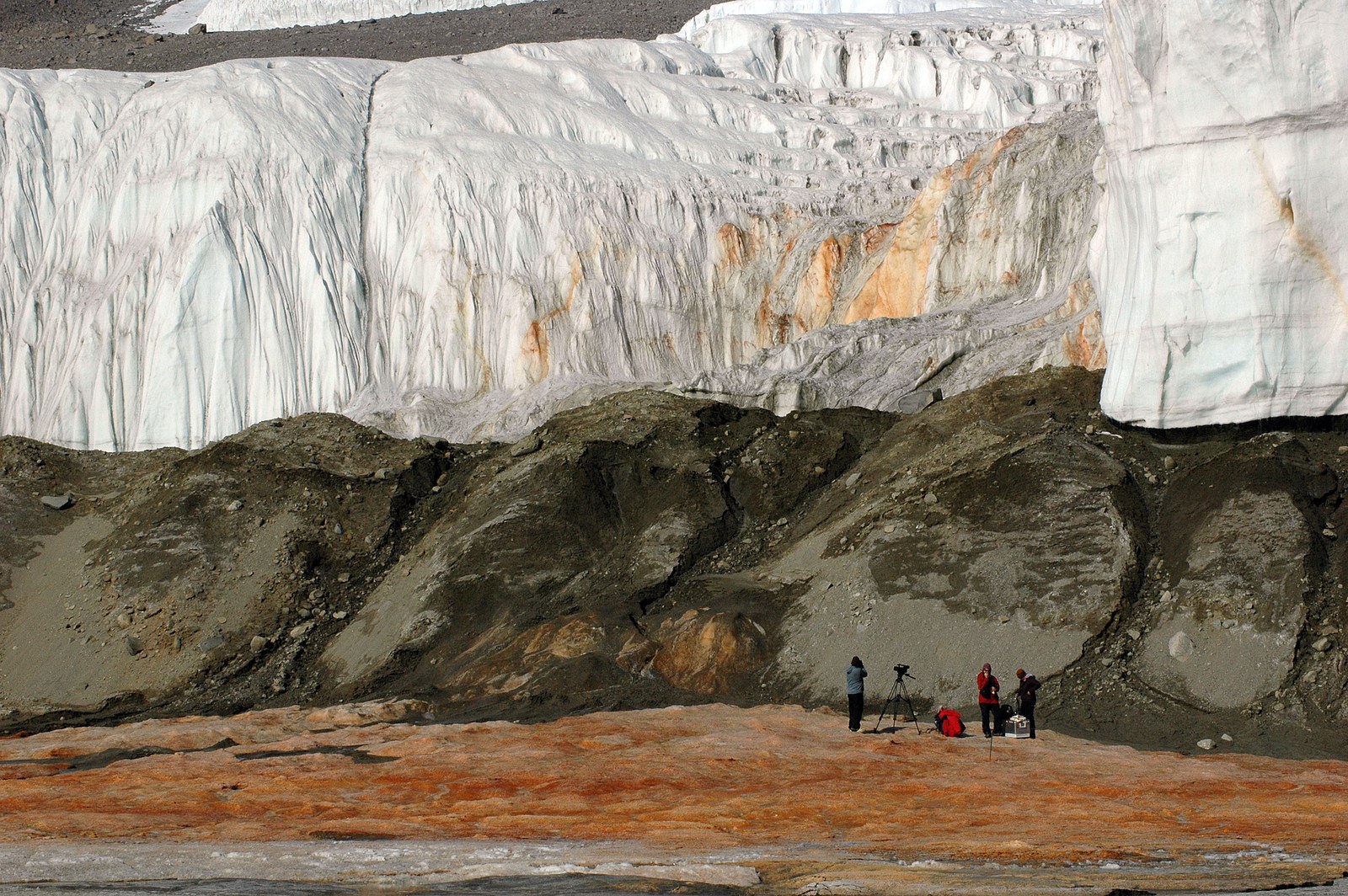
In one of the driest, coldest places on Earth, a glacier bleeds. From the tongue of Taylor Glacier in Antarctica, a plume of deep red water seeps out of cracks in the ice and stains the frozen surface of West Lake Bonney below. Against the white and grey of the McMurdo Dry Valleys, the colour is startling — the red of fresh blood on snow.
It is not blood. It is not algae, either, although that was one of the first guesses. The red is rust, formed when water that has been sealed away from air for up to two million years finally reaches the surface. And the water itself is stranger than the colour: it is several times saltier than the sea, it stays liquid at minus seven degrees Celsius, and it is home to microbes that live in darkness, without oxygen, by breathing iron.
A Red Stain Found in 1911
Blood Falls was first recorded in 1911 by the Australian geologist Thomas Griffith Taylor, during Robert Falcon Scott’s Terra Nova Expedition. Taylor was the senior geologist on the expedition, and the valley he explored — Taylor Valley — still bears his name. He found the red deposit at the end of Taylor Glacier, where it meets the ice-covered surface of West Lake Bonney in Victoria Land, East Antarctica.
The early explorers had no way of knowing where the water came from. The red colour suggested blood, or a red alga. Neither explanation survived the science that followed, but the name stuck. What Taylor could see was only the outlet: a small, sporadic outflow from fissures in the ice cascades at the glacier’s snout. The source lay hidden, several kilometres back from the glacier’s edge, under about 400 metres — roughly 1,300 feet — of ice. It would take nearly a century before researchers could sample it directly.
The Hidden Reservoir
The source of Blood Falls is a pool of hypersaline water — brine — trapped beneath Taylor Glacier. Chemical and geological evidence indicates that it began as seawater, left behind when sea level fell and the advancing glacier sealed it off. Research published by Jill Mikucki and colleagues in 2009 put that sealing at about 1.5 to 2 million years ago.
Once trapped, the water changed. As pure ice crystallised out of the seawater, the dissolved salts were concentrated into a brine two to three times as salty as the ocean. Direct sampling later found the brine to contain about 8 percent sodium chloride, compared with about 3.5 percent for ordinary seawater. That extreme salinity is why the water does not freeze: the brine sampled from beneath the glacier was about minus seven degrees Celsius — 19 degrees Fahrenheit — and still liquid.
The brine is also rich in dissolved iron, picked up from the bedrock beneath the glacier, and in sulfate. Crucially, it contains almost no dissolved oxygen. Sealed under hundreds of metres of ice, cut off from the air and from light, it has been anoxic — oxygen-free — for the whole of its isolation. That absence of oxygen is the key to everything that follows.
Why the Water Turns Red
Under the ice, the iron in the brine stays dissolved in its reduced form, ferrous iron — Fe²⁺ — because there is no oxygen to react with it. In that state it is colourless in solution. The water that emerges at Blood Falls is, by the accounts of the scientists who sampled it, cold and clear. Then it meets the air.
Oxygen attacks the dissolved ferrous iron and oxidises it to ferric iron — Fe³⁺ — which is essentially insoluble. It precipitates out as hydrous ferric oxides: rust. The same chemistry turns an old nail orange, but here it happens fast, in the open, on a glacier, and in enough volume to stain a whole ice face red.
A 2023 study from Johns Hopkins University, led by research scientist Ken Livi, refined this picture. Using high-resolution transmission electron microscopy, Livi’s team found that much of the iron is carried as tiny amorphous iron-rich nanospheres — particles roughly a hundred times smaller than a human red blood cell — which oxidise and redden on exposure to air. That helps explain the vivid, opaque quality of the colour. The waterfall is not red water. It is clear water turning red as it falls — a chemical reaction happening in front of the observer, every time the brine escapes.
Life That Breathes Iron
Blood Falls is more than a chemistry demonstration. It is one of the few places on Earth where scientists can sample a subglacial ecosystem at the surface, and what lives in the brine has changed how researchers think about life in extreme environments.
In 2009, geomicrobiologist Jill Mikucki and an international team published a landmark paper in the journal Science, “A Contemporary Microbially Maintained Subglacial Ferrous ‘Ocean'”. Working from samples of brine captured as it flowed out of a crack in the glacier wall, they showed that the water contained at least 17 different types of microbes, and almost no oxygen.
These organisms do not photosynthesise — there is no light under the glacier. Instead, chemical and microbial analyses indicate that they make a living by metabolising sulfate and ferric ions: in effect, breathing iron leached from the bedrock, with the help of a sulfur catalyst, and feeding on organic matter trapped with them when the glacier sealed their habitat. Among the microbes identified was a close relative of Thiomicrospira arctica, a bacterium from cold seas that gains energy from sulfur compounds.
In December 2014, Mikucki’s team returned to Taylor Glacier with a probe called IceMole, built by a German collaboration, which melted its way into the glacier to sample the brine directly. The samples confirmed the picture: a cold, iron-rich brine — about 3.4 millimoles of iron per litre — from which the team isolated a salt-loving, cold-loving bacterium of the genus Marinobacter.
That is why Blood Falls matters beyond Antarctica. If microbes can survive for millions of years in cold, dark, salty, oxygen-free water under a glacier, then similar life might survive in the ice-covered oceans of Europa or Enceladus, or in the subsurface of Mars. Blood Falls is a test case for astrobiology — and the only known example of subglacial material in Antarctica available for study at the surface.
What Is Still Not Known
The broad explanation is settled: ancient seawater, concentrated into brine, rich in dissolved iron, oxidising on contact with air. But the details are not all filled in. The exact size of the subglacial pool is still unknown. Researchers know it lies under about 400 metres of ice, several kilometres from its outlet, but its full extent has not been mapped. The flow itself is sporadic — the brine emerges unpredictably, through cracks that open and close — so catching it in the act has taken years of fieldwork. And while the microbial community has been characterised in broad terms, the full census of what lives down there, and exactly how the different organisms interact, is still being worked out.
None of that reopens the original mystery. The red colour has an explanation, and it has been tested: the brine has been sampled, its chemistry measured, and the oxidation observed. Blood Falls looks like a wound in the ice. It is, in fact, a window into a sealed world — a pocket of ancient sea, kept liquid by salt, kept alive by microbes, and turned red by the air itself.
What Is Documented, and What Is Not
Documented: Blood Falls was first recorded by Griffith Taylor in 1911 during the Terra Nova Expedition; its source is a subglacial brine pool under about 400 metres of ice, sealed off 1.5 to 2 million years ago; the brine is hypersaline (about 8 percent sodium chloride in directly sampled material), about minus seven degrees Celsius, and rich in dissolved ferrous iron (about 3.4 mM); the red colour is iron(III) oxide formed by oxidation on contact with air, with iron-rich nanospheres identified in a 2023 study; at least 17 types of microbes live in the brine, as reported by Mikucki and colleagues in Science in 2009.
Unverified or not yet established: The exact size and full extent of the subglacial pool; the complete inventory of its microbial community. The early idea that the colour came from algae is disproven and should not be repeated as a live possibility.