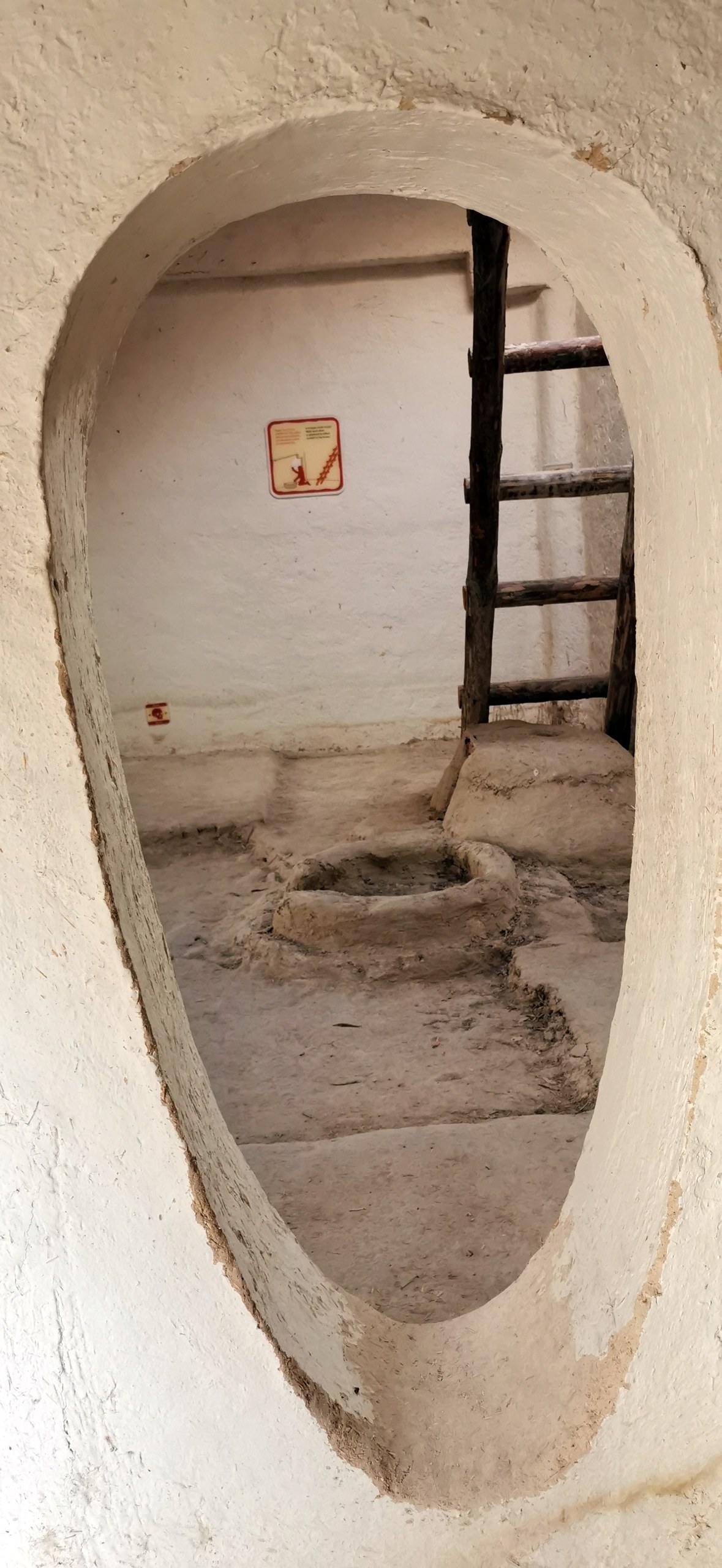
Imagine a town with no streets. No doors at ground level, no squares, no marketplaces, no palace. To visit your neighbour, you climb a ladder onto your roof, walk across the rooftops, and climb down through a hole in their ceiling. Under your feet, beneath the floor you sleep on, lie the bones of your ancestors. On your walls, painted in red and black, are scenes of wild bulls, vultures and hunting parties, and from the plaster protrude the horned skulls of aurochs. This was daily life at Çatalhöyük, on the Konya Plain in what is now south-central Turkey, some nine thousand years ago. It was one of the largest settlements of its time, and it had none of the things we assume a town must have.
Çatalhöyük, pronounced “cha-tal-HOO-yook”, means “fork mound” in Turkish. It is a pair of settlement mounds on the Konya Plain, about fifty kilometres south-east of the modern city of Konya, near the town of Çumra. The larger East Mound holds the Neolithic settlement, occupied from roughly 7100 to 6000 BCE, and the smaller West Mound holds a later, Chalcolithic settlement, occupied from roughly 6000 to 5700 BCE. Taken together, the site was occupied for nearly two thousand years, from around 7500 to 5700 BCE. The deposits reach twenty-one metres deep in places, built up layer by layer as houses were demolished and rebuilt on the same spot, generation after generation. The site covers about thirteen hectares, and at its peak, between roughly 7000 and 6500 BCE, it housed an estimated three thousand to eight thousand people — some estimates run higher, towards ten thousand — making it one of the largest known settlements of its era, older than the first Mesopotamian cities by thousands of years.
A Town Without Streets
The most famous feature of Çatalhöyük is its architecture. The houses were built of mudbrick, packed tightly against one another, wall to wall, sharing walls on all four sides. There were no streets, no alleys and no ground-level doors. People entered their houses through openings in the flat timber-and-reed roofs, climbing down wooden ladders into the main room. The rooftops served as the town’s circulation space: people walked across them, worked on them, and used them for social life, in a way that turned the whole settlement into a single three-dimensional surface. Inside, the houses were carefully organised. The walls and floors were coated in white lime plaster and replastered many times — in some houses dozens or even hundreds of times over a lifespan of fifty to a hundred years.
Paintings, Bulls and the Dead
The interior walls of the houses at Çatalhöyük were painted with scenes of hunting, in which human figures surround and bait wild bulls and deer, with vultures associated with human figures, with leopards, with geometric patterns and handprints, and with what the first excavator interpreted as a landscape painting of the settlement itself, with a volcano erupting behind it. The largest category of wall sculpture consists of high-relief plaster bulls’ heads, often moulded directly over the actual skull of a wild aurochs, the massive and now extinct ancestor of domestic cattle. These bucrania — plastered bull skulls with real horns — protruded from walls and platforms, and bull horns were mounted on freestanding pillars and along the edges of mud benches. Other animal parts were also built into houses: fox and weasel teeth, bear claws, wild boar tusks, and the skulls of vultures and cattle.
The dead were part of the house too. People buried their dead beneath the floors and raised platforms of houses that were still actively occupied, sometimes more than sixty individuals in a single house across its lifespan. The bodies were usually placed in a flexed position, and the skulls were sometimes removed later, plastered, painted and kept in the house. There was no separate cemetery, and no sign that the dead were segregated from the living.
The people of Çatalhöyük farmed wheat and barley and pulses, and herded domesticated sheep and goats, which supplied most of the meat they ate. They also hunted wild aurochs, deer and wild boar, and the aurochs in particular loomed large in feasts and in art, far out of proportion to its share of the diet. The houses contained tools, ornaments, baskets and textiles, and the settlement produced a remarkable corpus of small clay figurines — some two thousand of them, mostly animals, with fewer than five per cent depicting women.
The Goddess That Wasn’t
For decades, the most famous idea about Çatalhöyük was the Mother Goddess. The site’s first excavator, James Mellaart, identified the mound in 1958 and dug there in four seasons between 1961 and 1965, exposing nearly two hundred buildings. Among the finds were female figurines, including a famous seated woman flanked by felines, found in a grain bin. Mellaart concluded that the settlement worshipped a mother goddess, a fertility deity ancestral to later Anatolian and Aegean goddess figures, and that the town was the centre of a goddess religion. The idea was taken up eagerly by writers in the 1970s and 1980s, and the Seated Woman of Çatalhöyük became one of the most reproduced images of prehistory. Mellaart’s career in Turkey later ended with the Dorak affair, a scandal involving drawings of supposed treasure, and it has since been strongly suggested that some of the wall paintings and figurine drawings he published were fabricated or heavily embellished — a reminder that his interpretations, and some of his illustrations, must be treated with caution.
Later excavation told a different story. When Ian Hodder of Cambridge and then Stanford took over the site in 1993, leading the Çatalhöyük Research Project until 2018, his team dug more widely and more carefully than Mellaart had, and found just as many male and animal figures as female ones. Of the roughly two thousand figurines recovered, most represent animals, and fewer than five per cent depict women. The famous seated female is real, but she is not typical. Hodder concluded that there is no good evidence the settlement was organised around a matriarchal goddess cult, and that men and women at Çatalhöyük appear to have had similar diets and similar status, with no evidence pointing to either a matriarchy or a patriarchy. Some scholars now suggest that figurines such as the Seated Woman may represent elderly women who had achieved status in the community, rather than a goddess at all. The popular story of a goddess civilisation, repeated in countless books and documentaries, is largely outdated.
A Town Without Rulers
Perhaps the most striking thing about Çatalhöyük is what it lacks. There are no palaces, no temples, no administrative buildings, no fortifications and no clear evidence of centralised authority. The houses are similar in size and construction, and there is no sign of a ruling class living conspicuously better than anyone else. Burials show no strong difference in wealth between men and women, and elaborate burials occur across both sexes. For a settlement of several thousand people, sustained for nearly two millennia, this is remarkable. Most theories of early urban life assume that large, dense settlements need hierarchy to function — someone to organise labour, resolve disputes and manage food. Çatalhöyük suggests that a large community could organise itself through households, rituals and shared practices, without kings or priests in charge.
How the town ended is still debated. The settlement was gradually abandoned around 5700 BCE, after some fourteen centuries of continuous occupation. There is no evidence of invasion, disaster or sudden collapse, and the reasons are among the most studied and least resolved questions in early Anatolian archaeology.
On 1 July 2012, UNESCO inscribed the Neolithic Site of Çatalhöyük on the World Heritage List, recognising its outstanding universal value as a unique and exceptionally well-preserved example of an early Neolithic settlement.
Çatalhöyük matters because it breaks the rules. It shows that people could live in a dense, long-lived town without streets, without rulers and without a temple, and that they could fill their homes with art and with their dead, and sustain a community for longer than most modern cities have existed. It also shows how archaeology corrects itself: a famous goddess, a famous landscape painting, a famous story of matriarchy — each has been questioned, revised or set aside as new evidence came in. What remains is stranger and more interesting than the story it replaced: a town of rooftops and ladders, of bulls’ horns and buried ancestors, built by people whose names we will never know, on a plain in Anatolia, nine thousand years ago.
What Is Known — and What Is Not
Documented facts: Çatalhöyük is a pair of settlement mounds on the Konya Plain in south-central Turkey, about fifty kilometres south-east of Konya. The East Mound was occupied from approximately 7100 to 6000 BCE and the West Mound from approximately 6000 to 5700 BCE, with the site as a whole occupied from around 7500 to 5700 BCE. Houses were built of mudbrick, wall to wall, with no streets or ground-level doors, and were entered through openings in the roof by wooden ladders. The dead were buried beneath house floors, sometimes more than sixty individuals in one house. Interior walls were plastered and painted with hunting scenes, vultures, leopards and geometric patterns, and bull skulls with real horns (bucrania) were set into walls and platforms. Peak population is estimated at roughly 3,000 to 8,000 people. James Mellaart identified the site in 1958 and excavated from 1961 to 1965; Ian Hodder led the Çatalhöyük Research Project from 1993 to 2018. UNESCO inscribed the site on the World Heritage List on 1 July 2012.
Unverified or open to interpretation: The “Mother Goddess” interpretation of the female figurines, including the famous Seated Woman, is debated and is not supported by later excavation; of some 2,000 figurines, most depict animals and fewer than five per cent depict women, and Hodder concluded there is no good evidence for a matriarchal goddess cult. Whether the Seated Woman represents a goddess, an elderly woman of status, or something else is unresolved. Mellaart’s interpretation of one wall painting as a landscape with an erupting volcano is disputed, and some of his published drawings have been questioned as possibly fabricated. The reasons for the settlement’s gradual abandonment around 5700 BCE are not established. Population estimates vary, with some sources suggesting up to 10,000 at peak, and the lower range of 3,000 to 5,000 is favoured by some scholars.
Sources
- https://curiousexpeditions.org/what-is-the-significance-of-catalhoyuk-in-understanding-early-human-settlements/
- https://www.bordersoftime.com/site/catalhoyuk
- https://atlasanatolia.com/site/catalhoyuk
- https://anomalydesk.com/catalhoyuk.html
- https://scienceinsights.org/what-is-unusual-about-catalhoyuk-the-neolithic-city/
- https://commons.wikimedia.org/wiki/File:%C3%87atalh%C3%B6y%C3%BCk,_7400_BC,_Konya,_Turkey_-_UNESCO_World_Heritage_Site,_02.jpg