Some mysteries are frightening. Some are beautiful. Julia is both, and neither, in a way that makes it the strangest of all the sounds the ocean has ever offered up to science. On 1 March 1999, underwater microphones spread across the equatorial Pacific picked up a signal so loud that it registered on the entire array at once — instruments thousands of kilometres apart, hearing the same thing at the same time. When researchers sped the recording up sixteen times, so that its ultra-low frequencies rose into the range of human hearing, the sound became something else entirely. It sounded like a voice. A woman’s voice, softly humming or mumbling, rising out of the deep. They named it Julia.
The listening array
Julia was captured by the same instruments that recorded the Bloop and Slow Down: the autonomous hydrophone array that NOAA’s Pacific Marine Environmental Laboratory deployed in the equatorial Pacific in the 1990s. The array was built to listen for undersea earthquakes and erupting volcanoes, and it turned out to be very good at hearing things nobody had planned for. Low-frequency sound travels extraordinary distances underwater through the SOFAR channel, a natural layer where the speed of sound is at its minimum and sound waves are trapped and carried for thousands of kilometres. A loud enough event in the Southern Ocean can be heard on the equator.
The Julia recording carries a precise timestamp in NOAA’s archive: 1 March 1999, with an origin time of 21:05 GMT. The signal lasted about fifteen seconds. That brevity is part of what makes it remarkable — in fifteen seconds, it delivered enough energy to be heard across the whole eastern equatorial Pacific array. Whatever made the sound was not small, and it was not close. The detection across such distances implied an event of extraordinary scale, yet no earthquake or known explosion matched the timing.
A voice in the deep
Julia earned its name from the sound of the sped-up recording. The raw signal sits so low in frequency that human ears cannot catch it at all; played in real time, a person standing next to a speaker would feel it more than hear it. NOAA’s public clips are sped up sixteen times, which raises the pitch and shortens the duration, and it is in that version that the sound takes on its uncanny character. Listeners describe it as resembling a woman softly humming or mumbling, a rising, cooing tone that seems almost vocal. The researchers who named the sounds — Bloop, Train, Slow Down, Upsweep, Julia — gave them plain nicknames so they could talk about them quickly, and Julia’s name stuck because of that human quality.
It is worth being clear about what that means and what it does not. The voice-like quality is an artefact of the speed-up. Nothing about the raw signal suggests a voice, and no scientist has ever suggested that the sound was produced by a living creature. The resemblance is a coincidence of acoustics: a rising tonal sweep, compressed in time, happens to fall into the range and shape of a human hum. But coincidences of that kind are exactly what make a mystery take hold in the public imagination, and Julia — more than any of its siblings — became a staple of internet lists of unexplained ocean sounds, usually with the suggestion that something enormous and alive was down there, speaking.
The iceberg explanation
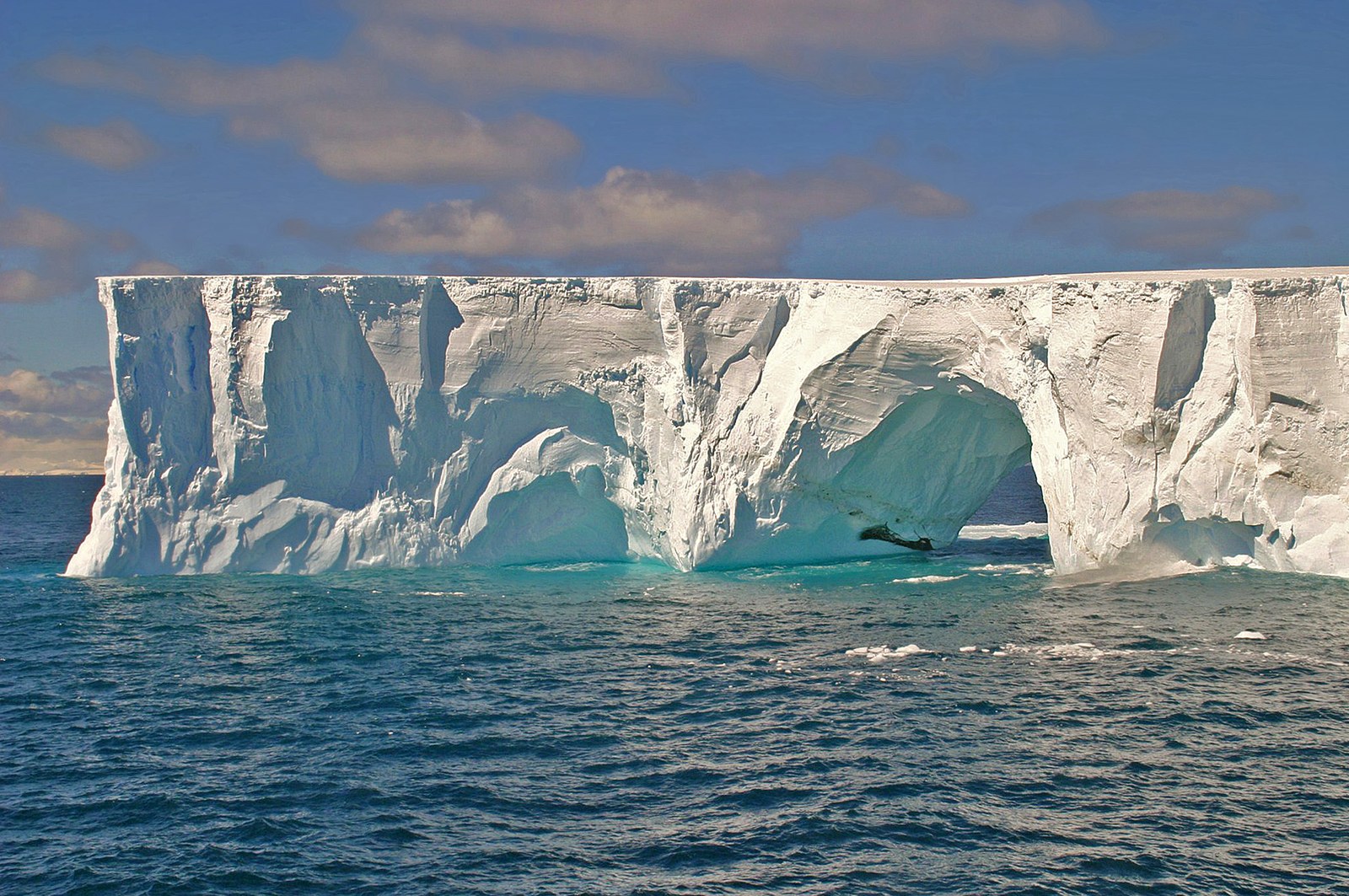
NOAA’s own account is more prosaic and, in its way, more impressive. According to the agency’s Pacific Marine Environmental Laboratory acoustics page, the most likely source of Julia is a large iceberg that ran aground off Antarctica. When a massive iceberg fractures, scrapes against the seafloor, or collides with other ice structures, it produces long, sweeping acoustic signals. Unlike the brittle crack of breaking ice, these interactions involve prolonged friction and deformation, which can generate rising tonal sounds remarkably similar to Julia’s. Detailed modelling later supported the idea that Julia likely originated from iceberg-seafloor interaction near Antarctica.
The case for ice is strengthened by the family resemblance. Julia belongs to the same set of named sounds as the Bloop, which NOAA matched to Antarctic icequakes — the sound of great icebergs cracking and calving — and Slow Down, the falling tone attributed to an iceberg grinding to rest. The Bloop was picked up by hydrophones up to 4,800 kilometres apart and traced to the remote ocean off southern Chile toward Antarctica; its explanation came from comparison with Antarctic recordings, including the sounds of iceberg A53a breaking apart near South Georgia in early 2008. The same physics, the same region, the same instruments. Julia fits the pattern.
There is, however, a limit to what the array could say. The arrival direction of Julia’s signal was not precise, so its origin could sit anywhere between the Bransfield Strait, near the Antarctic Peninsula, and Cape Adare, far away on the other side of the continent, near the Ross Sea. That is a span of thousands of kilometres of Southern Ocean. The source is likely ice, but the exact spot is still uncertain, and that uncertainty is why some people still call Julia unexplained.
The geography of a guess
The uncertainty about Julia’s origin is worth dwelling on, because it shows how ocean acoustics works at its limits. The array could tell that the sound was loud and that it came from the Southern Ocean, but the arrival direction was not precise enough to do better than a range: somewhere between the Bransfield Strait, the narrow passage between the South Shetland Islands and the Antarctic Peninsula, and Cape Adare, on the far side of the continent near the Ross Sea. Those two places are thousands of kilometres apart, separated by the bulk of Antarctica itself. Somewhere in that vast arc of cold water, a great iceberg ran aground on 1 March 1999, and the sound of it travelled north through the SOFAR channel to microphones on the equator. The ocean is so good at carrying sound that the array could hear the event clearly — and so large that hearing it clearly was not enough to say where it happened.
That gap between hearing and locating is the central frustration of the whole family of NOAA sounds. The Bloop was traced to a rough origin in the South Pacific, around 50 degrees south and 100 degrees west, but its exact iceberg was never identified. Slow Down was never tied to a particular grounding. Julia’s iceberg is unknown too. The sounds are real, the physics is sound, and the locations are approximate — and that approximation is honest. It is better to say “somewhere between the Bransfield Strait and Cape Adare” than to invent a precise spot, and the scientists who named these sounds have always been careful to do exactly that.
There is also a lesson in the name. The researchers gave these sounds plain nicknames — Bloop, Train, Slow Down, Upsweep, Julia — so that they could talk about them quickly in the lab. The nicknames escaped into the world, and the world heard in them something the researchers never intended: a bestiary of sea monsters, a chorus of unknown creatures. Julia, the voice in the deep, became the most famous of them all, precisely because its name and its sound suggested a person. The science says ice. The imagination says otherwise. Both responses are human, and the sound belongs to both.
Why Julia endures
It is important to emphasise something NOAA has always been careful about: the agency never classified these sounds as unidentified in the sense of being inexplicable. Julia was recorded, measured, and given a most-likely explanation grounded in the physics of ice and the behaviour of sound in water. What it was not given is a precise location, a named iceberg, or a direct observation of the event. The explanation is a match of pattern and power, not a photograph of the cause.
And yet Julia endures, and it endures because of the voice. A mystery that sounds like a person is a mystery that people remember. The Bloop is famous for its size, Slow Down for its strangeness, but Julia is famous for seeming to speak. That is a trick of the ear, and it is also the reason the sound matters beyond oceanography. It is a reminder that the instruments we build to listen to the planet will sometimes hand us back something that sounds like ourselves — and that the work of science is to hear the voice, admire it, and then ask, patiently, what actually made it.
What is documented, and what is not
Documented facts: Julia was recorded on 1 March 1999, at 21:05 GMT, by NOAA’s eastern equatorial Pacific autonomous hydrophone array, and was loud enough to be heard across the whole array. The signal lasted about fifteen seconds. NOAA’s Pacific Marine Environmental Laboratory identifies a large iceberg running aground off Antarctica as the most likely source. The arrival direction was not precise, so the origin could lie anywhere between the Bransfield Strait and Cape Adare. The version of the recording heard online is sped up sixteen times, which raises its ultra-low frequencies into the audible range and gives it a voice-like quality; the sound was named Julia because of that quality. Related sounds from the same array include the Bloop (1997, matched to Antarctic icequakes) and Slow Down (19 May 1997, attributed to an iceberg grounding).
Unverified or disputed claims: The iceberg-grounding explanation for Julia has not been confirmed by direct observation of a specific iceberg at a known location; the exact source remains uncertain. The voice-like character of the sped-up recording is an artefact of the playback speed and is not evidence of a biological source; claims that Julia is the sound of an unknown sea creature have no supporting evidence and are inconsistent with the signal’s acoustic profile. Some popular accounts give the wrong year for the recording; NOAA’s own page dates it to 1 March 1999.
Sources
- https://www.michelegargiulo.com/blog/the-bloop-mysterious-ocean-sound
- https://seamystics.com/julia-sound-mystery/
- https://www.alonereaders.com/article/details/3756/strange-noaa-sounds-explained-julia-slow-down-and-the-science-behind-ocean-mysteries
- https://www.thisunexplaineduniverse.com/articles/the-bloop