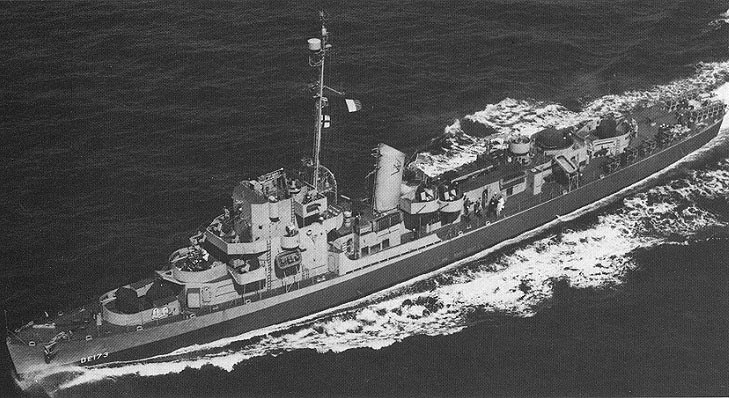
The story is one of the best-known legends in American folklore. On 28 October 1943, at the Philadelphia Naval Shipyard, the United States Navy conducted a secret experiment on the destroyer escort USS Eldridge. Using powerful generators and equipment based on Albert Einstein’s unified field theory, the Navy tried to make the ship invisible to radar. The experiment went far beyond its goal: the Eldridge vanished from sight entirely, disappeared from Philadelphia, briefly appeared in Norfolk, Virginia — more than two hundred miles away — and then returned. In the most dramatic versions, some of the crew were driven mad, some vanished, and some were found fused into the steel of the ship’s hull. The Navy, the story goes, hushed it all up.
It is a wonderful story. It is also, on the available evidence, a hoax. No record of any such experiment exists. The ship’s own logs place her nowhere near Philadelphia on the date in question. The story itself did not surface until 1955, twelve years after the supposed event, in letters from a man whose identity and reliability were doubtful from the start.
Where the story came from
The Philadelphia Experiment did not emerge from a leak, a declassified file or a witness coming forward at the time. It emerged from a book about flying saucers. In 1955, Morris K. Jessup, an astronomer and author, published The Case for the UFO, a book about unidentified flying objects and the exotic means of propulsion they might use. Late that year, the U.S. Office of Naval Research (ONR) received an anonymous package, marked “Happy Easter”, containing a copy of Jessup’s book filled with handwritten annotations in the margins, written in three different shades of blue ink. The notes appeared to be a debate among three individuals, only one of whom was named, and they referred to a secret naval experiment involving invisibility and teleportation.
Shortly afterwards, in January 1956, Jessup began receiving letters from a man calling himself Carlos Miguel Allende — who also identified himself as Carl M. Allen in other correspondence. Allende claimed to be a merchant mariner who had witnessed the experiment from the deck of the SS Andrew Furuseth, and described the Eldridge vanishing from Philadelphia Harbor on 28 October 1943, by the Navy’s application of Einstein’s unified field theory. Jessup initially dismissed Allende as a crackpot. But the ONR contacted him about the annotated book, and Jessup recognised the handwriting as Allen’s. The ONR printed a small number of copies of the annotated edition — now known as the Varo Edition — which gave the story an air of official attention it had never earned.
What the records actually say
The Eldridge was a real ship: a Cannon-class destroyer escort, launched in July 1943 and commissioned on 27 August 1943. That much of the legend is true, and it is the part that makes the rest feel plausible. Everything else falls apart against the record. The ship’s logs and war diary show that on 28 October 1943, the Eldridge was nowhere near Philadelphia: she was conducting training exercises near Bermuda, before joining a convoy to Casablanca, having remained in port in New York until September 1943. The Andrew Furuseth‘s movement records likewise contradict Allende’s account — the two ships were not in the same locations when he claimed to have watched the experiment from her deck.
The crew’s own testimony points the same way. Surviving sailors, including Edward Dudgeon, spoke publicly in the 1990s and 2000s and dismissed the story as complete fiction. None of the Eldridge‘s logs, maintenance reports or mission documents show any sign of unusual activity. Her degaussing equipment — the system that reduces a ship’s magnetic signature to protect against magnetic mines — was routine.
The physics is no better. Einstein did work on a unified field theory, but he never completed it — something he openly acknowledged — and the theory describes nothing that would make a ship invisible or teleport it. The U.S. Navy maintains that no such experiment was ever conducted. The Office of Naval Research stated in September 1996: “ONR has never conducted any investigations on invisibility, either in 1943 or at any other time.” The ONR, it added, was not even established until 1946.
How the legend grew
Once the Varo Edition existed, the story had a life of its own. Later retellings added layers that Allende had never mentioned. In 1989, Alfred Bielek claimed to have been aboard the Eldridge during the experiment, adding time travel and encounters with aliens. Books and films followed, most famously the 1984 film The Philadelphia Experiment, which fixed the teleportation version of the story in popular culture. Each retelling borrowed authority from the one before it, and the Navy’s denials were treated by believers as further proof of a cover-up — a logic in which no contrary evidence can ever count against the legend.
What the evidence says
- Documented: The story of the Philadelphia Experiment first surfaced in late 1955, when Carl M. Allen sent an annotated copy of Morris K. Jessup’s The Case for the UFO to the Office of Naval Research, and in January 1956 began sending Jessup letters claiming he had witnessed the Eldridge vanish on 28 October 1943.
- Documented: USS Eldridge (DE-173) was a real Cannon-class destroyer escort, launched in July 1943 and commissioned on 27 August 1943; her logs and war diary place her near Bermuda on 28 October 1943, conducting training before joining a convoy to Casablanca, not in Philadelphia.
- Documented: The U.S. Navy maintains that no such experiment was ever conducted; the Office of Naval Research stated in September 1996 that it “has never conducted any investigations on invisibility, either in 1943 or at any other time”, and noted that the ONR was not established until 1946.
- Documented: Surviving crew members, including Edward Dudgeon, publicly denied that any such experiment occurred, and no ship’s log, maintenance report or medical record supports the story.
- Claimed, not proven: That the Eldridge was rendered invisible, teleported to Norfolk, Virginia, and returned to Philadelphia on 28 October 1943, and that crew members were driven mad, vanished or fused into the hull. No photograph, document or credible witness supports any of these claims, and the ship’s logs contradict the date and place.
- Claimed, not proven: That the experiment was based on Einstein’s unified field theory. Einstein worked on such a theory but never completed it, and it describes no mechanism for invisibility or teleportation.
- Estimated, not exact: Nothing in the legend is a measured fact; even the date, 28 October 1943, comes from Allende’s letters twelve years after the supposed event, not from any contemporary record.
Why the legend refuses to die
The Philadelphia Experiment endures because it is built from real things: a real ship, a real war, a real genius and a real culture of military secrecy. Take away the records, and the story feels true. Put the records back, and it collapses — the ship was in Bermuda, the witness’s ship was elsewhere, the office that supposedly ran the project did not yet exist, and the physics was never finished.