On 29 August 2019, in a small observatory in Crimea, an amateur astronomer pointed a telescope he had built himself at the night sky and found something that did not belong there. Gennadiy Borisov, a comet hunter and telescope maker working at the MARGO Observatory, spotted a faint, fuzzy smudge moving against the stars. It looked like a comet. It moved like a comet. But when astronomers calculated its orbit, they found that it was not a comet of our solar system at all. It was a visitor from another star — only the second interstellar object ever seen passing through our neighbourhood, and the first interstellar comet ever observed. It was given the name 2I/Borisov, and for four months it gave humanity its best look yet at a piece of another solar system.
The first interstellar visitor, ‘Oumuamua, had arrived two years earlier, in October 2017, and it had been a puzzle from start to finish: a strange, elongated object with no visible coma, no tail, and an acceleration that no one could quite explain. It left behind more questions than answers, and a decade of arguments about what it had been. Borisov was the opposite. From the moment it was found, it behaved exactly like a comet — a dirty snowball of ice and dust, warming as it approached the Sun, throwing off gas and dust in a glowing coma and a tail. It was, in the words of one astronomer, comfortingly ordinary. And that ordinariness was itself a discovery: it meant that comets around other stars are made of much the same stuff as comets around ours.
A discovery made by hand
Borisov’s story begins with the discoverer, and the discoverer is part of the romance. Gennadiy Borisov is not a professional astronomer at a great observatory. He is an amateur in Crimea who builds his own telescopes — the instrument that found the comet was of his own construction — and who spends his nights sweeping the sky for new comets. He found it on 29 August 2019 in Coordinated Universal Time, which was 30 August in local time, and reported it as a possible new comet with the provisional designation C/2019 Q4. Within days, follow-up observations from telescopes around the world confirmed that the orbit was not an ellipse, like the orbits of our own comets, but a hyperbola — an open curve that could only mean the object had come from outside the solar system and was on its way back out again, never to return.
The numbers were startling. The comet’s orbital eccentricity was 3.36, far beyond the value of 1 that marks the boundary between a bound orbit and an unbound one. It was travelling at roughly 177,000 kilometres per hour, having arrived from the direction of the constellation Cassiopeia. It would pass through the ecliptic — the plane of the solar system — at the end of October 2019, reach its closest point to the Sun on 8 December 2019, at just over two astronomical units, and pass closest to Earth on 28 December 2019, at a distance of about 290 million kilometres. It would never come close to Earth, and it would never come back. Astronomers had a window of a few months, and they used every day of it.
The International Astronomical Union gave the object its formal name: 2I/Borisov, the “2I” standing for the second interstellar object ever confirmed, and “Borisov” for the man who found it. It was a rare honour. Comets are usually named for their discoverers, but interstellar objects are rare enough that the name carries a different weight. Borisov had found, with a telescope he had built himself, the second visitor from another star in the history of astronomy.
Hubble takes a look
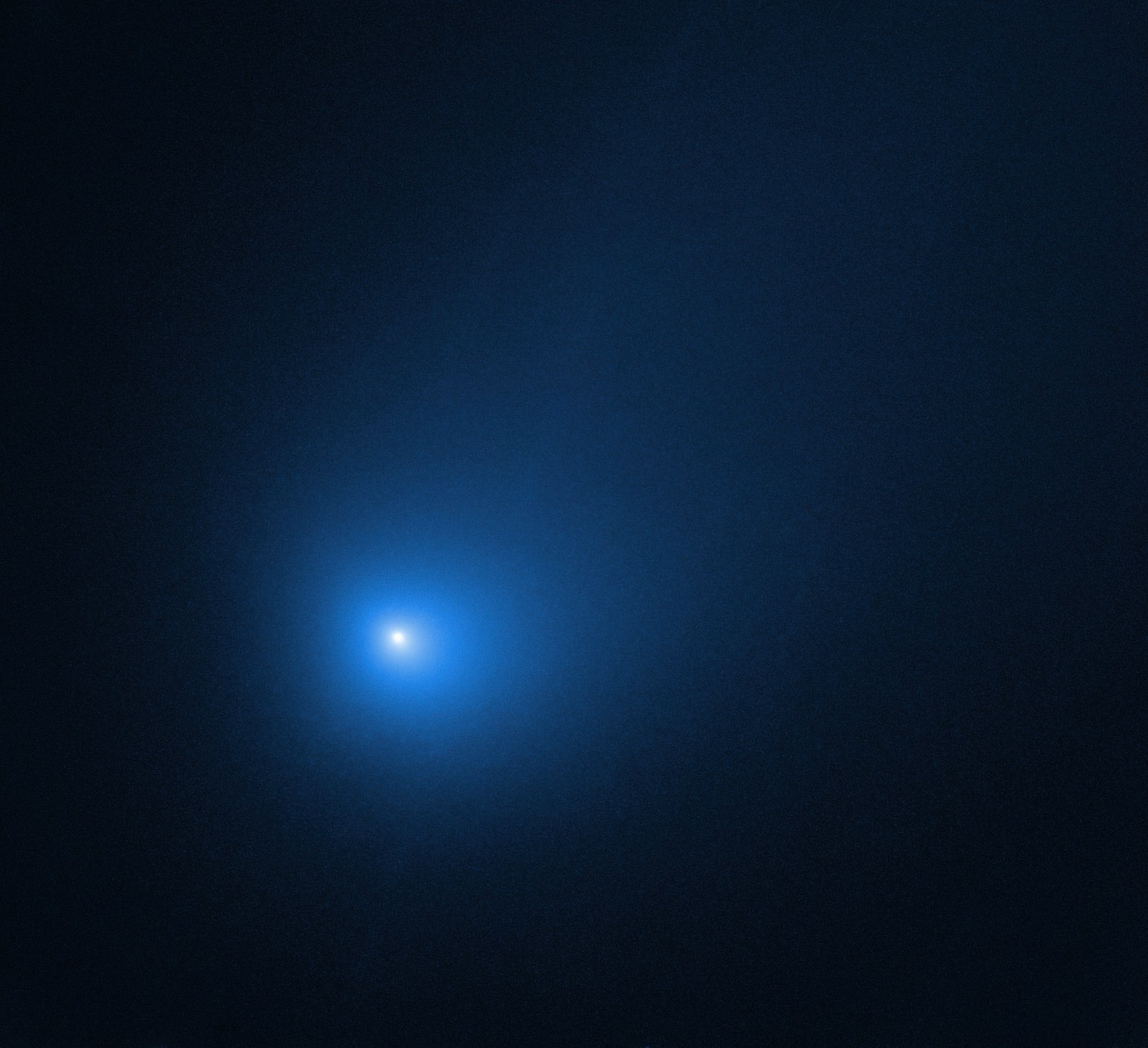
The Hubble Space Telescope began observing Borisov on 12 October 2019, as soon as the comet had moved far enough from the Sun to be observed safely, and the images it returned settled the most important question at once. The comet had a coma — a bright, cloudy envelope of sublimating ices, some 100,000 kilometres wide — and a dust tail. It was, unmistakably, a comet. Hubble’s sharp images could not resolve the nucleus itself, but they put an upper limit on its size: less than a kilometre across, smaller than earlier estimates had suggested, and far smaller than the first guesses. The comet was a modest object, a fragment of ice and rock less than a kilometre wide, that had crossed the gulf between the stars.
As Borisov approached the Sun, astronomers watched it warm up and throw off more material, and they read its chemistry like a fingerprint. The comet’s gases included carbon monoxide in unusual abundance, and its dust carried the signature of a body that had formed in the cold outer reaches of another planetary system, beyond the line where water freezes — the same kind of place where our own comets are born. Observations from the European Southern Observatory suggested something even more remarkable: that Borisov may never have passed close to any star before its 2019 passage through our solar system, and that it had spent its whole existence in the cold dark between the stars, untouched since the day it formed.
Hubble revisited the comet shortly after its perihelion on 8 December 2019, when it was at its closest to the Sun, about twice Earth’s average distance from the Sun, near the inner edge of the asteroid belt. The images showed a bright nucleus surrounded by dust, and a comet that was, by then, already on its way out. It passed closest to Earth on 28 December, and by the middle of 2020 it had swept past Jupiter’s distance and was heading back into interstellar space.
The break-up
Borisov had one more surprise in it. In March 2020, as it receded from the Sun, the comet brightened suddenly in a photometric outburst, and Hubble images taken on 30 March showed a transient “double nucleus” — a second, smaller fragment beside the main body, which had not been present in images taken on or before 28 March and was gone again by 3 April. The most likely explanation, put forward by David Jewitt’s team at UCLA, was that the nucleus had shed a boulder, a metre or more across, which had then broken apart under the torque of outgassing — a rotational bursting of a fragment that had been loosened by the comet’s own jets of gas. It was a small event, but it told astronomers something real about the comet’s structure: that it was fragile, loosely bound, and held together by little more than its own cold.
The last Hubble observations of Borisov were made in July 2020, seven months after perihelion. By then the comet was fading, its ices spent, its coma thinning, and it was already far beyond the orbit of Jupiter. In total, astronomers made more than 3,300 observations of it over an arc of 964 days, from its discovery to its disappearance. It will not return. Its orbit is open, and it is already on its way to wherever it is going next — another star, in another few hundred thousand years, or nothing at all.
Why Borisov matters
Borisov matters for a simple reason: it was normal. ‘Oumuamua had been so strange that some astronomers wondered whether interstellar objects were strange by nature — whether the things that wander between the stars were fundamentally different from the things that orbit our Sun. Borisov showed that they are not. A comet from another star looks like a comet from our star, behaves like a comet from our star, and is made of the same ices and dusts. The processes that build comets — the freezing of water and carbon monoxide in the outer reaches of a young planetary system, the slow accumulation of dust into a fragile nucleus — appear to work the same way around other stars as they do around ours.
That is a profound result, and it came from a telescope built by hand in Crimea, pointed at the right patch of sky on the right night. Borisov was discovered by an amateur, confirmed by the world’s great observatories, and studied for four months by the finest telescope ever flown. It was the second interstellar visitor, and the first that we could truly understand. The third, 3I/ATLAS, arrived in 2025, and there will be more. But Borisov will always be the one that showed us that the universe, for all its strangeness, is made of familiar things.
What is documented, and what is not
Documented facts: 2I/Borisov, originally designated C/2019 Q4, was discovered on 29 August 2019 UTC (30 August local time) by the Crimean amateur astronomer and telescope maker Gennadiy Borisov at the MARGO Observatory, using a telescope he built himself. It is the second observed interstellar object and the first observed interstellar comet. Its heliocentric orbital eccentricity is 3.36, and it is not bound to the Sun. It passed through the ecliptic at the end of October 2019, reached perihelion on 8 December 2019 at 2.006 astronomical units, and passed closest to Earth on 28 December 2019 at about 290 million kilometres. It approached from the direction of Cassiopeia at about 177,000 kilometres per hour. The Hubble Space Telescope observed it from 12 October 2019, finding a coma about 100,000 kilometres wide and a nucleus less than a kilometre across. In March 2020, Hubble observed a photometric outburst and a transient secondary fragment, consistent with the ejection and rotational bursting of a boulder. More than 3,300 observations were made over an arc of 964 days; the last Hubble observations were in July 2020. European Southern Observatory observations indicate the comet may never have passed close to any star before its 2019 perihelion.
Unverified or disputed claims: The exact composition and origin star of Borisov are unknown; its chemistry resembles that of solar-system comets, but its home system has not been identified. Claims about the precise size of the nucleus vary between studies, with Hubble giving only an upper limit. Any suggestion that Borisov was anything other than a natural comet — an artificial object, for example — has no supporting evidence and is not supported by any observation.