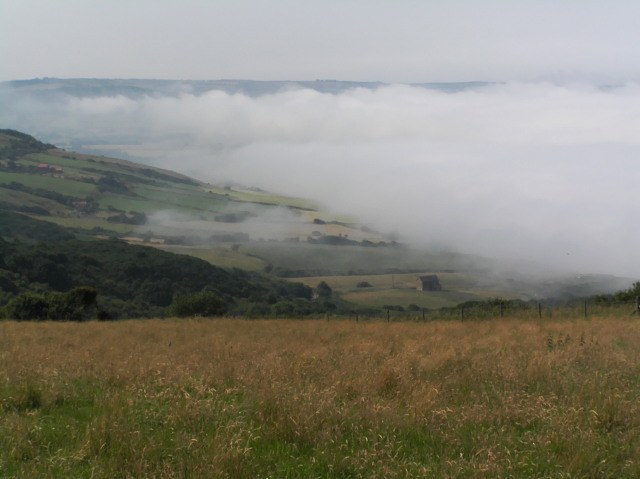
On a foggy morning along the Belgian coast in the 1890s, you might have heard it: a deep boom, like a cannon fired far out at sea, rolling in over the water and fading into the mist. Then another. Then another, at regular intervals, as if some invisible battery were firing a salute. Fishermen would scan the horizon for ships. There were none. Soldiers would check with the coastal forts. No guns had been fired. The sound came from everywhere and nowhere, and the people of the Low Countries gave it a name that captured what it seemed to do: mistpouffers — the fog dissipators — because the booms appeared to blow the mist apart.
The mistpouffers were not a local curiosity. They belonged to a worldwide family of phantom cannon fire, heard wherever people lived beside large bodies of water. In Bengal they were the Barisal guns. In New York they were the Seneca guns. In Germany they were Seeschießen, sea gunshots. In Italy they were brontidi, thunder-like. The sounds were reported for more than a century, investigated by some of the best scientific minds of the Victorian age, and then — around 1950 — they stopped. No one has heard them since.
The guns of the Bengal delta
The best-documented branch of the family comes from the far side of the world. In the Ganges and Brahmaputra delta of Bengal, in what is now Bangladesh, loud booms like distant artillery were heard for decades in the nineteenth century. The town of Barisal — then Bakerganj, under British colonial rule — gave them their name. British officials first assumed the noises were cannons fired from Portuguese or Dutch rival ships on the sea, but investigations found no sign of any fleet, no fort, and no battle anywhere in the delta.
The name itself dates to 1876, when the British civil servant Henry Beveridge published his book The District of Bákarganj: Its History and Statistics. Beveridge wrote that he had heard a loud boom, almost similar to cannon fire, from the southern seaside of Barisal during the 1870s. The locals called it the “Barisal Cannon”, and Beveridge gave it the name “Barisal Guns”. The earliest printed notice, however, sits in an even more unexpected place: in 1867, the Asiatic Society of Bengal published a paper by Babu Gour Doss Bysack on the antiquities of Bagerhat, a survey of ruins that included a mosque roofed with seventy-seven domes. The paper ended with a short account of a curious physical phenomenon — a series of sounds like distant guns, heard at Bagerhat and all along the mouth of the Gangetic delta as far as Backergunge.
The Barisal guns had a signature. Henry S. Schurr, who investigated the sounds in 1890 and 1891, reported in Nature that the guns were always heard in triplets: three guns, one after another, at regular intervals, and though several guns might be heard, the number was always three or a multiple of three. That regularity was strange and important. It suggested a signal, or at least a process with a rhythm — not a random accident.
A letter to Nature
The phenomenon might have remained a Bengal curiosity if not for a letter written in 1895. On 31 October of that year, the astronomer George Howard Darwin — son of Charles Darwin — wrote to the journal Nature about the dull sounds resembling distant artillery in the Ganges delta. Darwin admitted he did not know where the name “Barisal guns” came from. His purpose was to draw the attention of readers to the phenomenon and to the similar “mist pouffers” heard on the Belgian coast. The letter, published as “Barisàl Guns and Mist Pouffers” in Nature volume 52, turned a local oddity into an international scientific question.
The Belgian side of the story had already been assembled by one determined man. Ernest Van den Broeck, curator of the Royal Museum of Natural History of Belgium, had gathered several hundred accounts of the sounds into a series of papers published in Ciel et Terre, a Brussels review devoted to astronomy, meteorology, and terrestrial physics, in 1895 and 1896. His catalogue reads like a logbook of an invisible war. In July 1892, near Brée, detonations were heard at regular intervals of about twelve seconds, repeated about twenty times. On 5 August 1892, near Dunkirk, four reports like the sounds of cannons. On 17 August 1893, between Ostend and Ramsgate, a series of distinct explosions, with the state of the sky giving no reason to think they were meteorological. On 5 September 1893, at Middelkirke, loud sounds of remarkable intensity. On 8 September 1893, in the English Channel near Dover, an explosive sound. On 25 June 1894, at Louvain, Van den Broeck himself heard detonations like discharges of artillery and tabulated their intervals.
The debate that followed was vigorous and inconclusive. The geologist T. D. LaTouche had already presented a note on the sounds known as the Barisal guns to the British Association for the Advancement of Science in 1890, and in January 1896 he wrote to Nature again, pointing readers to Van den Broeck’s complete account and promising further articles on the causes of the phenomenon. George B. Scott answered Darwin in Nature in the same month. Some correspondents thought the booms came from firing at forts on the English coast; artillery officers who had heard the sounds themselves said they could not be traced to any fort. Others blamed the moon. The Theosophical writers took up the booms in their journal Lucifer in 1890, folding them into a mystical framework rather than a physical one. The digest of the debate in Popular Science Monthly called the sounds unexplained and said that the many conjectural solutions offered so far each failed to account for the whole phenomenon.
What could make such a sound?
The explanations proposed for the mistpouffers and their cousins fall into a few families, and each explains part of the evidence while failing on the rest. The most common explanation for the Barisal guns was that they were caused by the sound of waves, broken up by local topography — the surf of the delta, refracted and focused by the maze of tidal rivers, islands, and Sundarbans forest, arriving at the listener as a series of booms. Geological origins were also proposed, including distant earthquakes and the release of trapped gas, the explanation now favoured for the Seneca guns of New York, where craters and methane on the lakebed have been confirmed.
Other candidates have been suggested for the wider family of skyquakes, the modern term for unexplained sudden loud sounds without corresponding earthquake activity. Shallow offshore earthquakes can produce booms, and were the leading explanation for the coastal “Seneca guns” of the Carolinas. Meteors burning up in the atmosphere — bolides — can produce sonic booms, and might explain some reports but not all. Military jets breaking the sound barrier explain modern reports, but the mistpouffers were heard decades before the air age. Atmospheric ducting, in which layers of air at different temperatures trap and carry sound over great distances, can make a distant noise sound close, and a close noise sound as if it came from the sky.
Each of these is plausible for some reports and inadequate for others. The triplet rhythm of the Barisal guns, the twelve-second intervals at Brée, the sheer regularity of the sounds, remain difficult to explain with any single mechanism. And the geography is peculiar: the sounds were heard near water, almost always, and observers insisted they were never heard at sea — only from the shore, looking out.
The silence after 1950
Perhaps the strangest fact about the mistpouffers and the Barisal guns is how they ended. The Barisal guns were a popular mystery in the late nineteenth century, but they became a tale of old times, and no one heard them after 1950. The Belgian mistpouffers faded in the same way, disappearing from the record in the first half of the twentieth century. A phenomenon that had been heard for generations simply stopped.
No one knows why. It is possible that the cause itself changed: if the sounds were produced by gas escaping from river deltas, then changes in the rivers — dams, dredging, the development of gas fields, the shifting of channels — could have closed the vents, just as the development of gas fields in the 1930s appears to have silenced the Seneca guns of New York. It is possible that the sounds were masked by the growth of modern noise: the coasts of Belgium and the delta of Bengal are far louder places now than they were in 1890, and a distant boom that once carried for miles might now be lost under traffic, industry, and aircraft. And it is possible that the sounds were always rare, and that the nineteenth century’s careful record-keeping — Van den Broeck’s hundreds of accounts, Schurr’s triplets, Darwin’s letter — captured a phenomenon that was already fading.
What remains is a body of evidence that is unusually good for a mystery of this kind: dated observations, measured intervals, named witnesses, and a scientific debate conducted in the pages of Nature. The mistpouffers are not a ghost story. They are a reminder that the world used to make sounds we no longer hear, and that the explanation for a mystery can disappear along with the mystery itself.
What is documented, and what is not
Documented facts: Loud booms resembling distant artillery were heard on the Belgian and Dutch coasts in the nineteenth century and called mistpouffers, or “fog dissipators”, and similar sounds were heard in the Ganges delta of Bengal and called the Barisal guns. Henry Beveridge named the Barisal guns in his 1876 book The District of Bákarganj; the earliest printed notice was Babu Gour Doss Bysack’s 1867 paper to the Asiatic Society of Bengal. Henry S. Schurr, investigating in 1890–91, reported that the Barisal guns were always heard in triplets, three at regular intervals. George Howard Darwin drew attention to both phenomena in a letter to Nature on 31 October 1895. Ernest Van den Broeck, curator of the Royal Museum of Natural History of Belgium, collected several hundred accounts and published them in Ciel et Terre in 1895–96, including dated observations from Brée, Dunkirk, Ostend, Middelkirke, and Louvain. T. D. LaTouche presented a note on the Barisal guns to the British Association in 1890. The sounds were no longer heard after about 1950.
Unverified or disputed claims: No single cause has been proven for the mistpouffers or the Barisal guns. Proposed explanations — surf focused by coastal topography, geological gas release, distant earthquakes, meteors, and atmospheric ducting — each account for part of the evidence and none for all of it. The triplet rhythm of the Barisal guns and the regular intervals of the Belgian reports remain unexplained by any single mechanism. Claims that the sounds were supernatural, or messages from spirits, belong to folklore and Theosophical writing of the period, not to evidence. The reason the sounds stopped after 1950 is not established; changes in the rivers and deltas, the development of gas fields, and masking by modern noise are all plausible but unproven.