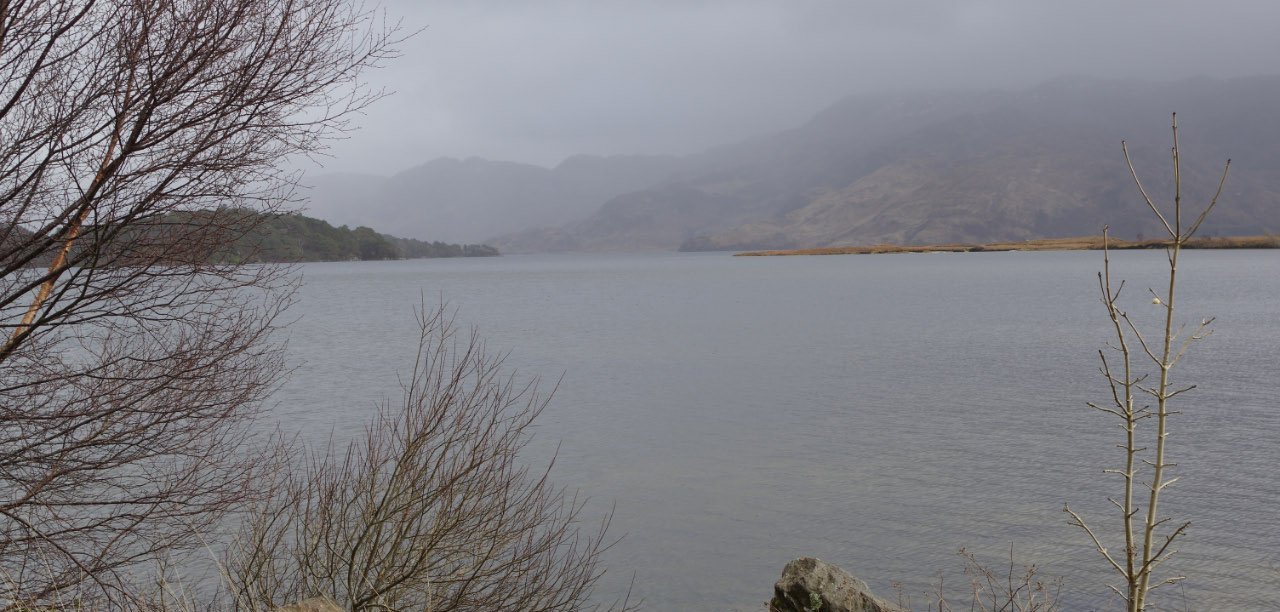
Everyone knows the Loch Ness Monster. Far fewer people know that Scotland has another loch monster, in a loch that is deeper, darker and far more remote than Loch Ness, and that the case for the second monster is, in some ways, stronger than the case for the first. Her name is Morag, and she lives — if she lives anywhere — in Loch Morar, in the West Highlands. The loch is the deepest body of fresh water in Britain, plunging to more than 1,000 feet. It has no road around it. It has no crowds, no sonar surveys, no monster-hunting industry. What it has is a record of sightings going back to 1887, and one encounter, in 1969, that made newspapers around the world.
The loch
Loch Morar is a sea loch in the old county of Inverness-shire, running for about eleven miles through a landscape of moor, mountain and scattered crofting townships. It is long, narrow and exceptionally deep — 310 metres at its deepest, which makes it the deepest freshwater loch in the British Isles, deeper than Loch Ness by a considerable margin. The water is dark and peaty. The shores are steep. There is no road around the loch, and much of it can only be reached on foot or by boat. It is, in short, the kind of place where something large could live without being noticed, and where a sighting, when it happens, is hard to check.
The loch’s remoteness is part of the argument for Morag. Loch Ness is crossed by a main road, visited by hundreds of thousands of tourists a year, and swept by sonar on a regular basis. Loch Morar is none of those things. If a large animal lived in Morar, it would have a far better chance of remaining unrecorded than one in Loch Ness. That does not prove anything lives there. But it explains why the Morar sightings, though fewer in number, have always been taken seriously by people who study lake monsters.
The spirit of the loch
Morag’s story is older than the monster-hunting era. In the folklore of the area, “Mòrag” — the name is Scottish Gaelic — was the spirit of the loch, a mermaid-like figure who appeared when a member of the Gillies family was about to die. A local man, James Macdonald, described her in a book published in 1907, and the folklorist R. MacDonald Robertson collected accounts of her from elderly residents. The creature of the old stories was a death omen, a woman-monster of the water, not a prehistoric animal. The modern Morag — a long, humped, serpentine creature — is a different figure, but she carries the same name, and the same association with the loch’s darkest water.
Elizabeth Montgomery Campbell, a researcher who spent years collecting the Morar accounts, interviewed elderly residents in the 1960s and 1970s who remembered sightings from their youth. Her book, “The Search for Morag”, published in 1972, remains the fullest record of the case. It documents more than a hundred years of sightings and, in the words of one of her subjects, accounts that were “beyond explanation or definition”.
A hundred years of sightings
Reported sightings of Morag date back to 1887, and by 1981 they numbered thirty-four incidents, sixteen of which involved multiple witnesses. The descriptions are consistent: a humped, eel-like or snake-like creature, black and shiny, with rough skin, moving through the water with a wake that witnesses found hard to explain.
In 1948, nine people in a boat reported a peculiar serpent-like creature about twenty feet long, in the same part of the loch where the 1887 sighting had taken place. The fact that the 1948 sighting had nine witnesses, all in the same boat, looking at the same thing, is one of the details that has kept the case alive. It is easy to dismiss a single witness. It is harder to dismiss nine.
There were photographs, too. On 3 April 1971, a local resident named Ewen Gillies photographed something in the loch. In 1977, a Miss M. Lindsay took a pair of photographs showing an object in the water that was claimed to be Morag. Neither set of photographs is conclusive. Both show a dark shape in dark water, and both have been argued over ever since. They are, however, part of a pattern: the Morar sightings come with witnesses, dates and, occasionally, photographs, in a way that many lake-monster reports do not.
The encounter of 1969
The most famous sighting of all took place on 16 August 1969. Two local men, Duncan McDonell and William Simpson, were returning from a fishing expedition at the northern end of the loch when they heard a splash behind them. They turned and saw a large creature swimming straight towards their boat. It approached the boat’s edge, paused, and bumped the vessel. McDonell was convinced the collision was accidental, but he feared what the creature might do next. If it capsized the boat, the two men would be in the water with it.
McDonell defended himself with an oar. Simpson shut down the boat’s engine, retrieved a rifle from the deck, and fired at the creature. The shot appeared to have no effect. The creature gradually moved away and sank slowly out of sight. The encounter lasted about five minutes.
The two men described the creature as brown, twenty-five to thirty feet long, with rough skin, three dorsal humps rising eighteen inches above the surface, and a head a foot wide, held eighteen inches out of the water. The account was reported in newspapers around the world. For a while, the monster hunters who had been camped at Loch Ness decamped to Morar. The Loch Ness Investigation Bureau expanded its search to include Loch Morar in February 1970.
The 1969 encounter is the centrepiece of the Morag case for a simple reason: two men, in a boat, at close range, for five minutes, in daylight, with a rifle and an oar. It is not a glimpse from a roadside. It is a sustained, close encounter, described in detail, by two witnesses who agreed with each other and never changed their story.
The investigators
The 1969 sighting drew investigators to Morar. Among them was Adrienne Shine, a naturalist who began his own Morar investigation in 1974, sparked by the 1969 account. Shine hired a rowing boat and drifted at night with a powerful light fixed to a camera, hoping to repeat the encounter. He found nothing but a false sighting in the form of a rock. Shine has said that he has no single theory, because many animals and physical effects have contributed to sightings. He has also said that the case for a monster in Morar is compelling, and arguably stronger than the case for one in Loch Ness.
Campbell’s book, published in 1972, remains the foundation of the case. She documented the sightings, interviewed the witnesses, and probed the folklore. Her work is careful and unsensational, and it is the reason the Morag case is still discussed seriously, rather than filed away with the rest of the monster lore.
What could it be?
The explanations offered for Morag are the same ones offered for every lake monster, but the Morar case has some features that make them harder to apply. The loch is very deep and very cold, and it supports a population of eels, including large ones. A large eel, or several eels swimming in line, could account for the humps. Otters, which live in the loch, can look surprisingly large and serpentine in the water. Waves, wind and the peculiar optics of dark water can all create the impression of something moving.
None of these explanations has been proven for any specific sighting. The 1969 encounter, in particular, is hard to fit to an eel or an otter. A twenty-five-foot creature with three humps and a head a foot wide is not an otter. It could be a misjudgement of size and distance — the most common error in eyewitness reports — but the two men were close to the creature for five minutes, and their description is detailed and specific.
The honest position is that the sightings are real reports by real people, and that no known animal explains all of them. That is not the same as saying an unknown animal lives in the loch. It is saying that the case is open, and that the loch is deep enough, dark enough and remote enough to keep it open.
Why Morag matters
Morag matters because she is the test case for the lake-monster idea. Loch Ness is too famous, too crowded and too commercial to be a fair test. Loch Morar is the control: a deep, remote loch, with a century of reports, few visitors, and no industry built around the monster. If there is a large unknown animal in a Scottish loch, Morar is where it would be. If there is not, then the Morar sightings show how persistent and detailed a folklore can become without any animal behind it.
Either way, the loch keeps its secret. The water is dark, the mountains close in, and the road does not go around. Morag, if she is there, is in no hurry to be found.
What is documented, and what is not
Documented facts: Reported sightings of a creature in Loch Morar date back to 1887, and numbered thirty-four incidents by 1981, sixteen with multiple witnesses. Loch Morar is the deepest freshwater loch in Britain, at about 310 metres. On 16 August 1969, Duncan McDonell and William Simpson reported a five-minute encounter with a brown, 25–30-foot creature with three dorsal humps; Simpson fired a rifle at it. The Loch Ness Investigation Bureau expanded its search to Loch Morar in February 1970. Elizabeth Montgomery Campbell documented the case in “The Search for Morag” (1972). No physical specimen, carcass or conclusive photograph of the creature exists.
Unverified or disputed claims: The claim that an unknown large animal lives in Loch Morar rests on eyewitness testimony, none of it independently corroborated by physical evidence. The 1971 and 1977 photographs show dark shapes in dark water and prove nothing on their own. The claim that the 1969 creature was 25–30 feet long depends on the witnesses’ judgement of size and distance at close range. The older folklore of Mòrag as a death omen is a separate tradition from the modern monster reports, and the two should not be treated as one continuous account.