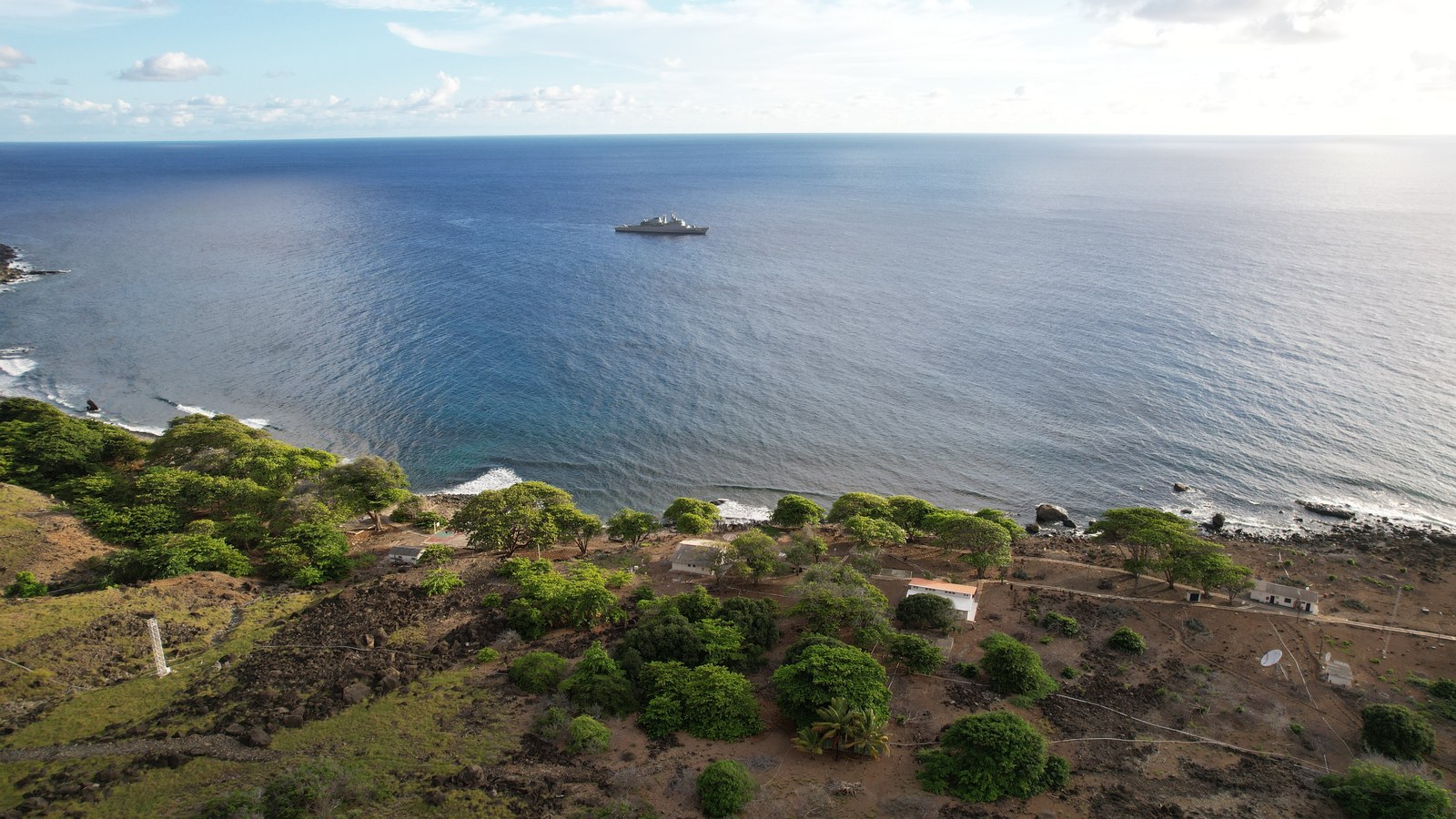
Trindade is a jagged volcanic island 1,200 kilometres off the Brazilian coast, a speck of rock in the South Atlantic that most Brazilians will never see. In January 1958 it hosted a small Navy oceanographic post, established for the International Geophysical Year, and a survey ship, the Almirante Saldanha, anchored offshore with some three hundred crew and a party of civilian guests. At noon on 16 January, as the ship prepared to depart, a dark object swept past the island’s highest peak, and a professional photographer on deck captured it on film. The photographs that resulted are among the most argued-over UFO images ever taken: examined by the Brazilian Navy, endorsed by a president, and doubted ever since by people who point to the one awkward fact about the man behind the camera.
The sighting
The Almirante Saldanha was a Brazilian Navy hydrographic and training ship, commanded by José Saldanha da Gama. It had reached Trindade from Rio de Janeiro carrying scientists and guests invited to collaborate in the research under way on the island. Among the civilians was Almiro Baraúna, a professional photographer who specialised in underwater photography and had formerly worked as a newspaperman.
At about 12:15 p.m. on 16 January 1958, as the ship lay anchored off the south coast of the island and prepared for its return trip, an object was seen approaching. Retired Air Force officer Amilcar Vieira Filho and Captain José Teobaldo Viegas were among the first to spot it. Shouts went up across the deck. Baraúna, who had been photographing the ship’s manoeuvres with a Rolleiflex 2.8 Model E camera, turned and fired six frames in under a minute as the object swept in over the sea, passed behind the peak of Pico Desejado, reappeared, hovered briefly, and departed at high speed toward the horizon. Four of the six frames captured the object; two missed during the scramble on the crowded deck.
The object was described by witnesses as a dark, metallic disc with a pronounced ring around its equator — witnesses compared it to the planet Saturn — surrounded by a greenish haze. It was not luminous. The number of witnesses is given in different sources as 47 or 48, a count that includes crew members and civilian passengers gathered on deck. The sighting lasted one to two minutes.
The photographs and the Navy’s verdict
Baraúna developed the negatives in an improvised darkroom aboard the ship, with officers present, within hours of the sighting. Back on the mainland, the Brazilian Navy took the case seriously. The negatives were examined by the Navy’s own technicians and by the Cruzeiro do Sul Aerophotogrammetric Service, which found no evidence of double exposure or darkroom trickery. Triangulation estimates based on the photographs put the object’s size at around 40 metres and its speed at several hundred kilometres per hour, possibly supersonic.
The Navy’s own report, prepared by Corvette Captain Carlos Alberto Ferreira Bacellar, commander of the oceanographic station at Trindade, was titled “Clarification of the observation of unidentified flying objects sighted on the Island of Trindade, in the period of 12/5/57 to 1/16/58.” It opened with a summary of four earlier UFO sightings by Navy crewmen and workers at the island station between early December 1957 and mid-January 1958, including a phenomenon Bacellar himself had observed through a theodolite. The garrison, in other words, had been reporting unexplained lights for weeks before Baraúna arrived.
In February 1958, President Juscelino Kubitschek personally ordered the photographs released to the press. They were published on 21 February 1958 in the newspapers Correio da Manhã and O Jornal, and ran on front pages around the world. It was one of the only occasions in history in which a head of state ordered UFO photographs released rather than suppressed, and the endorsement gave the case an authority no other photograph set of the era possessed.
The problem with the photographer
The case has one real weakness, and it is Baraúna himself. Years before Trindade, Baraúna had produced an admittedly faked saucer photograph spread to demonstrate hoax techniques for a magazine. He was, in other words, a skilled photographer who knew exactly how to fake a flying saucer photograph, and who had done so publicly. Sceptics have leaned on that fact for more than sixty years.
The Navy’s report was candid about the problem. Its two final conclusions were carefully worded: that the testimony of the photographer “loses its definitely convincing character given the technical impossibility of proving if there was or not previous photographic montage”, and that nevertheless the personal testimonies and the photographs “permit the admission that there are indications of the existence of the UFO”. The Navy, in short, could not prove the photographs genuine, and could not dismiss them either.
There are details that cut against the hoax theory. The garrison’s earlier sightings, including Bacellar’s theodolite observation, predated Baraúna’s arrival and had nothing to do with him. At about 2:30 a.m. on 16 January, less than ten hours before the sighting, a surgeon named Ezio Azevedo Fundão and members of his family reported seeing a Saturn-shaped object off the Brazilian coast in the direction of Trindade, and the same or an identical object was reported at about the same time from the deck of the Navy tow ship Tridente. A radar contact had also been reported by the Almirante Saldanha the day before. A hoax by one photographer does not easily explain a chain of reports from different people, in different places, on the same day.
The American response and the later analyses
The United States took note. The U.S. Naval Attaché in Rio cabled a report on the case, and it entered Project Blue Book’s files. American analysts were far less generous than the Brazilians: Blue Book and the Office of Naval Intelligence treated the photographs as a probable hoax, a judgement shaped in part by Baraúna’s history. The case became a small diplomatic curiosity, a friendly navy’s unexplained photographs sitting in American files marked with suspicion.
Later analyses kept the argument alive. Ground Saucer Watch, a civilian group, examined the photographs with computer-processing techniques and concluded they were authentic. A 1978 laboratory examination using digital photo-analysis techniques reportedly ruled out the double-exposure technique that the sceptic Donald Menzel had proposed, though that analysis has not been widely published. Baraúna gave two major interviews, in 1958 and again in 1983, and his account never materially changed.
Why Trindade still matters
Trindade matters because it is a test case for how evidence is weighed. On one side: four photographs, dozens of witnesses, a Navy technical examination that found no tampering, earlier sightings by the island’s garrison, and a president’s endorsement. On the other: a photographer who had faked a saucer photograph before, a Navy report that stopped short of calling the pictures genuine, and an American intelligence establishment that dismissed them.
Neither side has won, because the evidence does not allow a win. The photographs cannot be proven genuine, because a skilled photographer could have faked them. They cannot be proven faked, because the Navy’s technicians found no evidence of fakery, and because the witnesses and the earlier reports are independent of the photographer. The case sits in the middle, which is where the most interesting UFO cases tend to sit: not proven, not disproven, and not going away.
Trindade itself remains a restricted military outpost, accessible only by naval vessel and closed to casual visitors. No outside researcher can go there and re-examine the scene. Everything rests on the word of the Navy and the men who were aboard the Almirante Saldanha on 16 January 1958. Sixty-eight years later, that is still all there is — and it is still more than most UFO cases have.
What is documented, and what is not
Documented facts: On 16 January 1958 at about 12:15 p.m., photographer Almiro Baraúna took six photographs from the deck of the Brazilian Navy ship Almirante Saldanha off Trindade Island; four frames show a dark, ringed, Saturn-shaped object. About 48 crew members and passengers witnessed the object. The negatives were examined by the Brazilian Navy and the Cruzeiro do Sul Aerophotogrammetric Service, which found no evidence of tampering. The Navy’s report, by Captain Carlos Alberto Ferreira Bacellar, recorded four earlier sightings at the island station between December 1957 and January 1958. President Juscelino Kubitschek ordered the photographs released in February 1958, and they were published on 21 February 1958. Baraúna had previously produced an admittedly faked saucer photograph spread for a magazine.
Unverified or disputed claims: The claim that the photographs show a genuine unknown craft rests on the Navy’s technical examination and the witnesses, but the Navy’s own report acknowledged it could not rule out a photographic montage, given Baraúna’s skill and history. The claim that the photographs are a hoax rests on Baraúna’s earlier fake, but it does not account for the garrison’s earlier sightings, the independent reports on the morning of 16 January, or the Navy’s finding of no tampering. Later civilian analyses concluding the photographs are authentic have not been independently replicated in published form.
Sources
- https://ufology.patrickgross.org/htm/trindade58.htm
- http://www.UFOEVIDENCE.ORG/documents/doc714.htm
- https://www.ufomyst.com/famous/trindade-island-1958
- https://www.searchufos.com/cases/trindade-ufo-1958.html