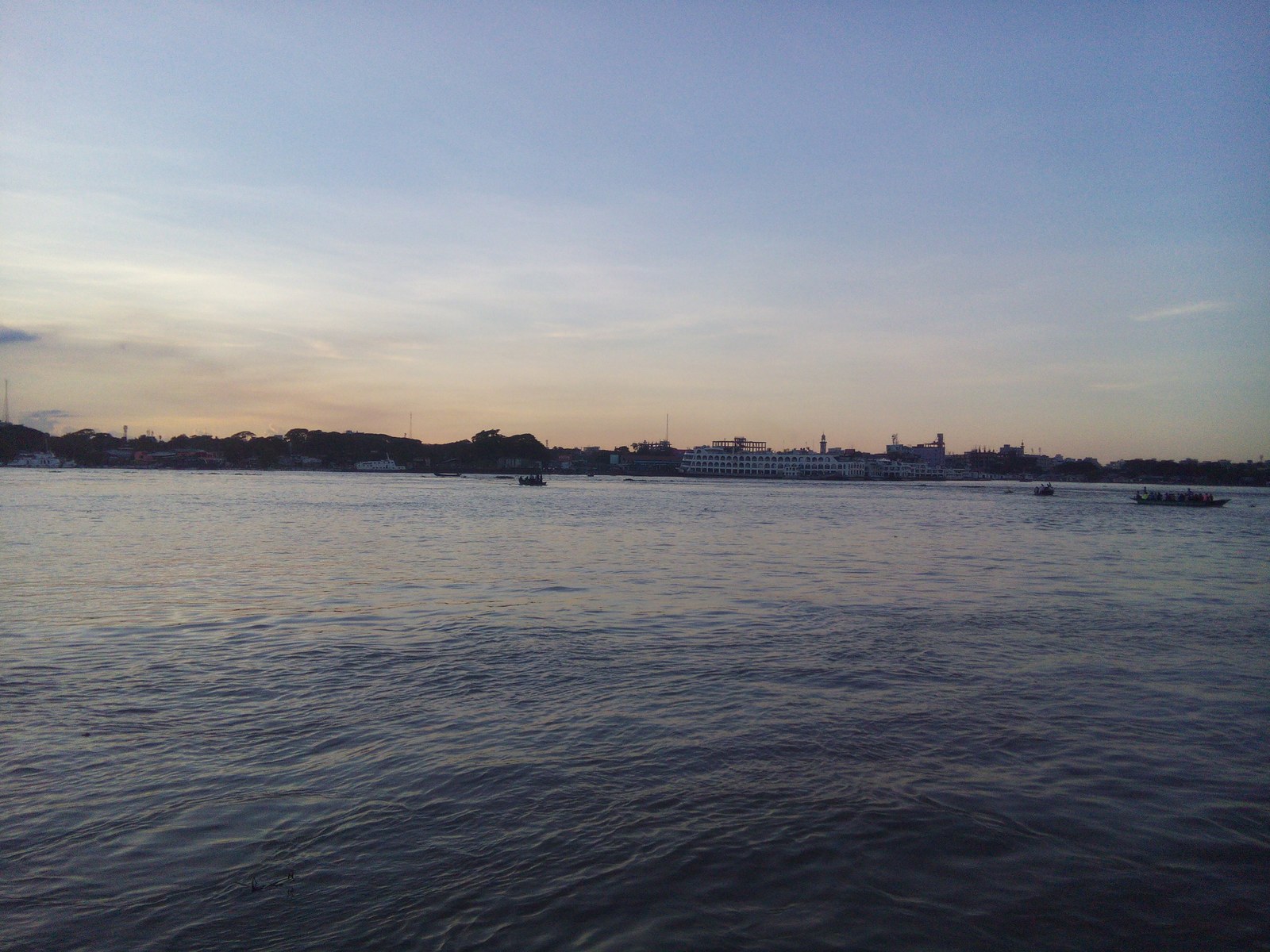
Imagine standing on the bank of a wide river in the Bengal delta, in the heat before the rains, and hearing a cannon fire. The boom rolls in from the south, low and heavy, and fades over the water. A minute or two later it comes again. Then a third time. You look for smoke on the horizon, for a ship, for a fort, for any sign of a battle — and there is nothing. The sky is clear. The river is calm. No one has fired anything. Yet the guns keep firing, in threes, at regular intervals, on still evenings in May and June. For more than a century, that is what happened across the delta of the Ganges and the Brahmaputra, and the people who heard it gave the sound a name that has outlived every explanation offered for it: the Barisal guns.
Barisal — now Barishal, the principal city of southern Bangladesh — stands on the eastern bank of the Kirtankhola River, in the heart of the largest river delta on Earth. In the nineteenth century it was the headquarters of the district of Bakerganj, a maze of tidal rivers, islands and Sundarbans forest, much of it reachable only by boat. The booms were heard across the district and far beyond it, from the mouth of the delta in the south to Faridpur and Jessore in the north, and, some said, as far as Jalpaiguri. They were, by every account, one of the strangest and most persistent natural sounds ever documented — and they have never been satisfactorily explained.
The first records
The earliest printed notice of the sounds sits in an unexpected place. In 1867, the Asiatic Society of Bengal published a paper by Babu Gour Doss Bysack on the antiquities of Bagerhat, a survey of ruins that included a mosque roofed with seventy-seven domes. The paper ended with a short account of a curious physical phenomenon: a series of sounds like distant guns, heard at Bagerhat and all along the mouth of the Gangetic delta as far as Backergunge. Bysack added that they were said to be loudest after storms and during calms, and that two theories were already in circulation. Some people believed the booms came from surf breaking with force on a low beach somewhere along the Bay of Bengal. Bysack himself leaned toward a subterranean cause — something happening beneath the delta rather than at its edge.
Three years later, the phenomenon reached the Society’s formal attention. On 25 June 1870, H. James Rainey, a landowner living at Khulna in Jessore, wrote to the meteorologist Henry F. Blanford asking the Asiatic Society to investigate. Rainey described noises heard periodically across Backergunge and Jessore, and possibly as far north as Furreedpore, during the south-west monsoon and the rainy season. They came from the south and south-east, from the direction of the seaboard, and resembled cannon or loud explosions. In November of the same year, the Society read a note from Fleetwood H. Pellew, who proposed that long rollers advancing obliquely from the south-south-west broke along the coast almost at once, producing a sound that carried inland.
In 1876, the civil servant Henry Beveridge published The District of Bákarganj, in which he documented the “Barisal guns” in detail: booming sounds, like distant cannon fire, heard from the direction of the sea with no visible cause. The name stuck. It was the town of Barisal, the district headquarters, that gave the phenomenon its identity — even though the sounds belonged to the whole delta, not to one town.
The pattern in the record
The fullest description of the guns comes from the Bengal District Gazetteers, the great colonial survey of the province. J. C. Jack’s volume on Bakarganj, published in 1918, describes them with the precision of a man who had listened to them himself. The Barisal guns, he wrote, are sounds resembling the discharge of cannon, which occur at regular intervals of a minute or two apart in May and June, at the beginning of the rains. They are not confined to Bakarganj: they are heard in Faridpur and Jessore, and, Jack believed, as far north as Jalpaiguri. They are supposed to be most frequent in a south wind and before rain, and to be heard best in the evening, perhaps because at that time there are fewer competing noises.
Two details in Jack’s account are worth lingering on. The first is that the sound always came from the south — from the direction of the Bay of Bengal, across the flat delta, where there was nothing between the hearer and the sea but water and mud. The second is that the guns were heard with extraordinary distinctness before the earthquake of 1896, a detail that has fuelled the seismic theory ever since. Jack’s conclusion was candid: the sounds had never been satisfactorily explained, but they were then generally supposed to be an atmospheric phenomenon.
That phrase — “never been satisfactorily explained” — is the honest centre of the whole story. The British administration spent half a century listening to the Barisal guns and never settled what made them. The sounds were real: thousands of people heard them, over decades, in a pattern too regular to be coincidence and too widespread to be a trick of the ear. And no one could find the guns.
What could make a sound like that?
The theories that were proposed fall into three families, and all three are still argued about today. The first is the surf theory: that waves breaking with force on the low beaches and offshore shoals of the Bay of Bengal compress pockets of air and produce impulsive sounds that travel efficiently over flat water and mudflats. The delta is a vast, shallow estuary, and sound carries strangely well over water, especially in the still, humid air of a pre-monsoon evening. A wave breaking on a shoal miles offshore could, in principle, sound like a gun fired just beyond the horizon.
The second family is seismic. The Bengal delta sits on one of the most geologically active margins on Earth, where the Indian plate is driving into Asia, and the region is crossed by faults and buried structures. The observation that the guns were heard with extraordinary distinctness before the earthquake of 1896 suggested to some that the sounds were the audible edge of subterranean movement — the groaning of the earth itself, transmitted through the ground and the air. The problem with the seismic theory is that many Barisal reports coincide with no local seismicity at all, and no earthquake has ever been tied to a specific episode of the guns.
The third family is atmospheric: that the booms are distant thunder, or distant explosions, carried to the hearer by unusual conditions in the air — a temperature inversion, a duct in the atmosphere that ferries low-frequency sound over great distances without losing it. The low-frequency character of the reports supports this: witnesses consistently describe the booms as deep, between roughly 20 and 60 hertz, the kind of sound that travels furthest and fades slowest. But atmospheric ducting explains how a sound travels, not what made it in the first place, and the Barisal guns were heard in fair weather, with no storm on the horizon to supply the thunder.
Theosophical writers of the late nineteenth century gave the sounds a mystical interpretation, treating them as evidence of hidden forces in nature — a reminder that when science cannot name a noise, people find a meaning for it instead.
A sound that faded away
Perhaps the strangest part of the Barisal guns is not that they were never explained, but that they stopped. Reports faded after about 1950, and by the second half of the twentieth century they had largely vanished from the record. The delta did not change its shape, the sea did not stop breaking on its shoals, and the earth did not stop moving — yet a sound heard for at least a hundred years quietly left the written record.
There are guesses, of course. Perhaps the sounds were tied to a particular configuration of the coastline that has since shifted, as the delta’s rivers have moved their channels and the shoals have moved with them. Perhaps they depended on a quiet that no longer exists: the delta is far noisier now, with engines, generators and loudspeakers in every village, and a low boom that once carried for miles might now be drowned out before anyone notices it. Or perhaps the guns were never as regular as the colonial record suggests, and their disappearance is simply the fading of a fashion in reporting — a phenomenon that was written about because it was written about, and forgotten when the writers moved on.
The Barisal guns are not unique. The same family of sounds has been reported around the world, under different names: mistpoeffers in Belgium and the Netherlands, Seeschießen in Germany, brontidi in Italy, Seneca guns on the Finger Lakes of New York. In each place the pattern is the same — a boom like distant artillery, no visible cause, a community that hears it for generations, and an explanation that never quite arrives. The Barisal guns are simply the oldest and best-documented member of the family.
They are also a reminder of how much of the natural world we have stopped listening for. The delta still stretches to the sea, and the wind still comes from the south in May and June. On a still evening, it is not hard to imagine the sound rolling in from the Bay of Bengal, in threes, exactly as it did a hundred and fifty years ago. Whether it is still there, unheard, is a question no one has answered.
What is documented, and what is not
Documented facts: Booming sounds like distant cannon fire were reported across the Bengal delta in the nineteenth century, named the Barisal guns after the town of Barisal, headquarters of the district of Bakerganj. The earliest printed notice appeared in an 1867 paper by Babu Gour Doss Bysack for the Asiatic Society of Bengal; H. James Rainey wrote to the Society in June 1870 asking for an investigation, and Henry Beveridge documented the sounds in The District of Bákarganj in 1876. J. C. Jack’s 1918 Bengal District Gazetteer for Bakarganj records the sounds occurring at regular intervals of a minute or two in May and June at the beginning of the rains, heard in Faridpur and Jessore and as far north as Jalpaiguri, most frequent in a south wind before rain, best heard in the evening, and always coming from the south. Jack also records that they were heard with extraordinary distinctness before the earthquake of 1896, and that they had never been satisfactorily explained. Reports of the Barisal guns faded after about 1950. Similar sounds are reported elsewhere as mistpoeffers, Seeschießen, brontidi and Seneca guns.
Unverified or disputed claims: No cause for the Barisal guns has ever been proven. The surf theory, the seismic theory and atmospheric ducting are all unconfirmed, and the sounds were often reported with no corresponding earthquake or storm. Claims that the sounds were supernatural or mystical, advanced in Theosophical writings, are matters of belief, not evidence. The reason the reports faded after 1950 is unknown; no evidence ties the disappearance to a specific change in the coastline, the climate or the level of background noise.
Sources
- https://en.wikipedia.org/wiki/Barisal_guns
- https://wikibangla.org/barisal-a-hidden-gem-of-bangladesh
- https://mystery.dongriarchive.com/2026/05/barisal-guns-mystery-sound-witness.html
- https://cdn.sanity.io/files/ocgjpig0/dev/ad14d8af47d13b22bf817423fc25cf6f1bb3f76b.pdf
- https://www.exploredplanet.com/travel/facts-about-natural-places-that-produce-mysterious-sounds/11/