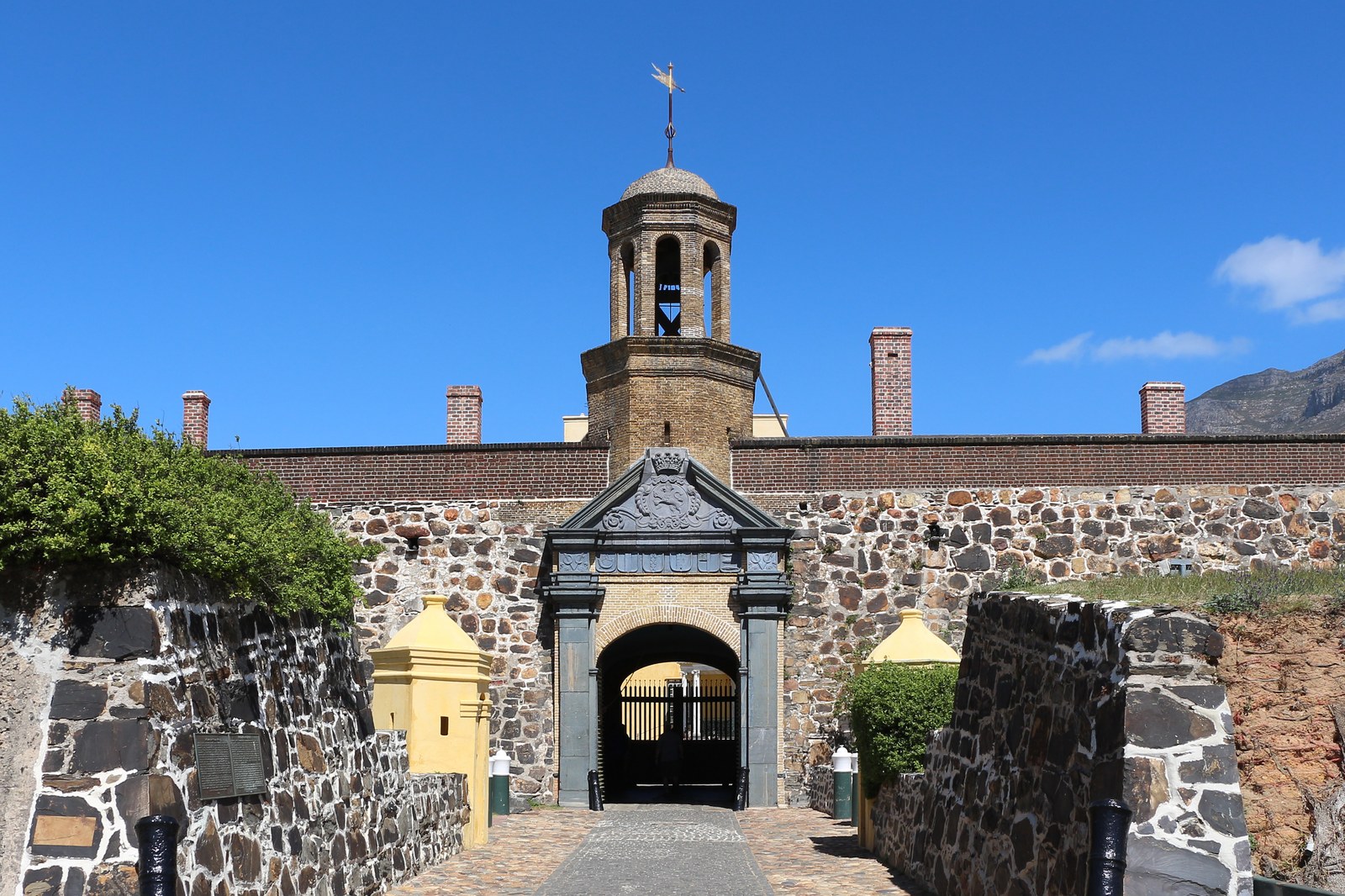
Late in the afternoon, the light turns the colour of old brass over Cape Town, and the Castle of Good Hope seems to grow out of the ground rather than sit upon it.
Its walls are thick stone, patched with brick and shadow, and above the main gate rises a small bell tower whose weathervane has turned in the wind for more than three centuries.
Visitors cross a bridge over what was once a moat, pass beneath the pediment carved with the arms of the Dutch East India Company, and step into a courtyard that has heard announcements, orders, and prayers — and, if the stories are to be believed, voices with no living speaker.
The Castle is the oldest surviving colonial building in South Africa, and, by reputation, one of the most haunted places in the country.
A Fortress Built on a Refreshment Station
The story of the Castle begins not with war, but with thirst, hunger, and the long sea road between Europe and Asia.
In 1652, the Dutch East India Company, known as the VOC, established a settlement on the shore of Table Bay under Jan van Riebeeck.
Its purpose was practical: a refreshment station where ships bound for the Dutch East Indies could take on fresh water, vegetables, fruit, and meat after months at sea.
Van Riebeeck’s men built a first fort of clay and timber, called Fort de Goede Hoop.
It was a modest structure, and it did not last long as the settlement’s defence.
By 1664, tensions between Britain and the Netherlands were rising amid rumours of war.
That year, Commander Zacharias Wagenaer, Van Riebeeck’s successor, was instructed by Commissioner Isbrand Goske to build a proper fortress of stone.
The first stone was laid on 2 January 1666.
Stone, Slavery and the Five Bastions
The Castle that rose over the next thirteen years was a pentagonal bastion fort, a five-pointed star of stone designed according to the military engineering of its day.
Its five bastions were named on 26 April 1679 after the main titles of William III of Orange-Nassau: Leerdam to the west, with Buuren, Katzenellenbogen, Nassau, and Oranje clockwise from it.
The work was slow, and it was interrupted frequently, in part because the Dutch East India Company was reluctant to spend money on the project.
It was also built, in part, by enslaved labour.
The Company did not enslave the local population, fearing revolt, and instead brought enslaved people from Madagascar, Mozambique, the Dutch East Indies, and India to the Cape.
The fortress was largely complete by 1679.
When it was built, the Castle stood on the coastline of Table Bay.
Land reclamation has since pushed the sea back, and the fort now stands a short distance inland in central Cape Town.
The Bell, the Balcony and the Life Inside
Inside its thick walls, the Castle was a small town in itself.
It housed a church, a bakery, workshops, living quarters, shops, and cells.
In 1682, the gated entrance replaced the old entrance, which had faced the sea.
Above the new main entrance, a bell tower was built in 1684.
The bell it holds is the oldest in South Africa, cast in Amsterdam in 1697 by the bellmaker Claude Fremy and weighing just over 300 kilograms.
It was rung to announce the time, to warn citizens of danger, and to summon residents and soldiers, and could reportedly be heard ten kilometres away.
In the inner courtyard stands the De Kat Balcony, one of the Castle’s most photographed features.
The original balcony was built in 1695 and rebuilt in its current form between 1786 and 1790, designed by Louis Michel Thibault with reliefs and sculptures by Anton Anreith.
The balcony leads to the William Fehr Collection of paintings and antique furniture, now administered by Iziko Museums of South Africa.
Prisoners, Soldiers and the Boer War
The Castle’s history is not only one of governors and ceremonies.
For much of its life, it was also a prison, and its cells and dungeons held people whose names are largely forgotten.
The most dreaded of these was the Donker Gat, the “dark hole”, a windowless chamber beneath the walls that served as a dungeon and, according to the Castle’s history, as a place of interrogation.
Prisoners were held there in darkness, and the room has become the focus of many of the Castle’s reported hauntings.
During the Second Boer War, from 1899 to 1902, part of the Castle was used as a prison, and the former cells remain to this day.
One of its better-known prisoners was Fritz Joubert Duquesne, later known as the man who killed Kitchener and the leader of the Duquesne Spy Ring.
According to the Castle’s account, he spent night after night digging at the cement around his cell’s stones with an iron spoon, and nearly escaped before a slipping stone pinned him in his tunnel.
The Castle was also briefly home to Lady Anne Barnard, after whom one of its function rooms is named.
She arrived at the Cape in 1797 as the wife of the colonial secretary, and lived at the Castle until 1802.
A gifted writer and artist, she left letters, journals, and drawings that remain one of the fullest records of life in the Cape Colony in that period.
The Reported Hauntings
The Castle’s ghost stories are among the best known in South Africa, and they are told with unusual confidence by guides, staff, and visitors.
None of them has been verified by any scientific investigation, and they should be read as reported claims and local legend rather than established fact.
The most famous is said to be the ghost of Lady Anne Barnard herself.
Visitors and staff have reported seeing a woman in a white dress in the rooms where she once entertained guests, and some claim to have caught the scent of rose perfume, the fragrance she was said to wear.
The darkest of the Castle’s reported spirits is that of Governor Pieter Gysbert van Noodt.
In 1729, Van Noodt condemned seven alleged ringleaders of a desertion plot to death.
Contemporary records indicate that four of the men were ultimately hanged on 23 April 1729, and that Van Noodt himself was found dead in his chair later that same day.
Legend holds that one of the condemned men cursed the governor from the gallows, and that the curse followed him to his death.
A tall, angry figure has reportedly been heard cursing in the corridors, and a tall figure was reportedly seen on the battlements in 1915 and again in 1947.
Another figure reported at the Castle is the Lady in Grey, said to run through the building weeping.
Members of the royal party visiting Cape Town in 1947 are said to have seen her during their tour.
A large black hound is also reported, said to leap at visitors and vanish at the last moment.
The bell in the bell tower is said to ring by itself, and one legend attributes the sound to the ghost of a soldier who hanged himself in the tower.
From the Donker Gat come the most unsettling reports of all: guards and visitors have described hearing voices, footsteps, and cries for help from the direction of the dungeon.
One guard on a night shift is reported to have heard someone screaming for help from the dungeon and the adjoining chamber.
A story often repeated about the Donker Gat claims that Lady Anne Barnard recorded winter floodwater rising in the dungeon and drowning convicts chained to the walls.
That passage has not been located in digitised sources, and its origin remains uncertain, so it should be treated as unverified.
The Castle Today
In 1936, the Castle was declared a historical monument, the first site in South Africa to be so protected.
It is now a provincial heritage site, and after extensive restorations in the 1980s, it is considered the best-preserved example of a Dutch East India Company fort.
Today it houses the Castle Military Museum and ceremonial facilities for the traditional Cape Regiments, and it is home to the Cape Town Highlanders Regiment, a mechanised infantry unit.
The Castle Guard, formed in 1986, opens the Castle each weekday morning with the Key Ceremony, a ritual based on the early-morning drills of about three hundred years ago.
The Castle is open to the public, and its museums, exhibitions, and guided tours draw visitors from around the world.
Many come for the history, and many come for the ghosts.
What they find is a building that has outlasted the company that built it, the empire that inherited it, and the wars that filled its cells.
Whether the voices in the Donker Gat belong to the dead or to the imagination of the living, the Castle of Good Hope remains a place where the past refuses to stay quiet.
What is documented — and what is not
Documented: The Castle was built by the Dutch East India Company between 1666 and 1679, replacing the clay-and-timber Fort de Goede Hoop built under Jan van Riebeeck in 1652. The first stone was laid on 2 January 1666. The five bastions were named on 26 April 1679 after the titles of William III of Orange-Nassau. The fortress was partly built by enslaved labour. The bell tower was built in 1684, and its bell, cast in Amsterdam in 1697 by Claude Fremy, is the oldest in South Africa. The De Kat Balcony was originally built in 1695 and rebuilt in 1786–1790. Lady Anne Barnard lived at the Castle from 1797 to 1802. Part of the Castle was used as a prison during the Second Boer War (1899–1902), and Fritz Joubert Duquesne was held there. The Castle was declared a historical monument in 1936 and is now a provincial heritage site.
Reported but unverified: All ghost sightings at the Castle — Lady Anne Barnard in a white dress, the scent of rose perfume, Governor van Noodt cursing in the corridors, the tall figure on the battlements in 1915 and 1947, the Lady in Grey seen by the 1947 royal party, the black hound, the figure on the roof, and the bell ringing by itself — are reported claims with no independent verification. The gallows curse is legend, not administrative record. Contemporary records cited in recent research say four men were hanged on 23 April 1729, while older popular accounts say seven were condemned; the two figures describe different stages of the same case. The story of floodwater drowning chained convicts in the Donker Gat, attributed to Lady Anne Barnard, has not been located in digitised sources and remains unverified.
Sources
- https://en.wikipedia.org/wiki/Castle_of_Good_Hope
- https://dev.castleofgoodhope.co.za/
- https://www.capetownetc.com/things-to-do-cape-town/haunted-places-in-cape-town/
- https://www.capetownetc.com/things-to-do-cape-town/cape-town-haunted-places/
- https://shinstories.co.uk/castle-of-good-hope-ghosts/
- http://www.vanhunks.com/cape1/castle1.html