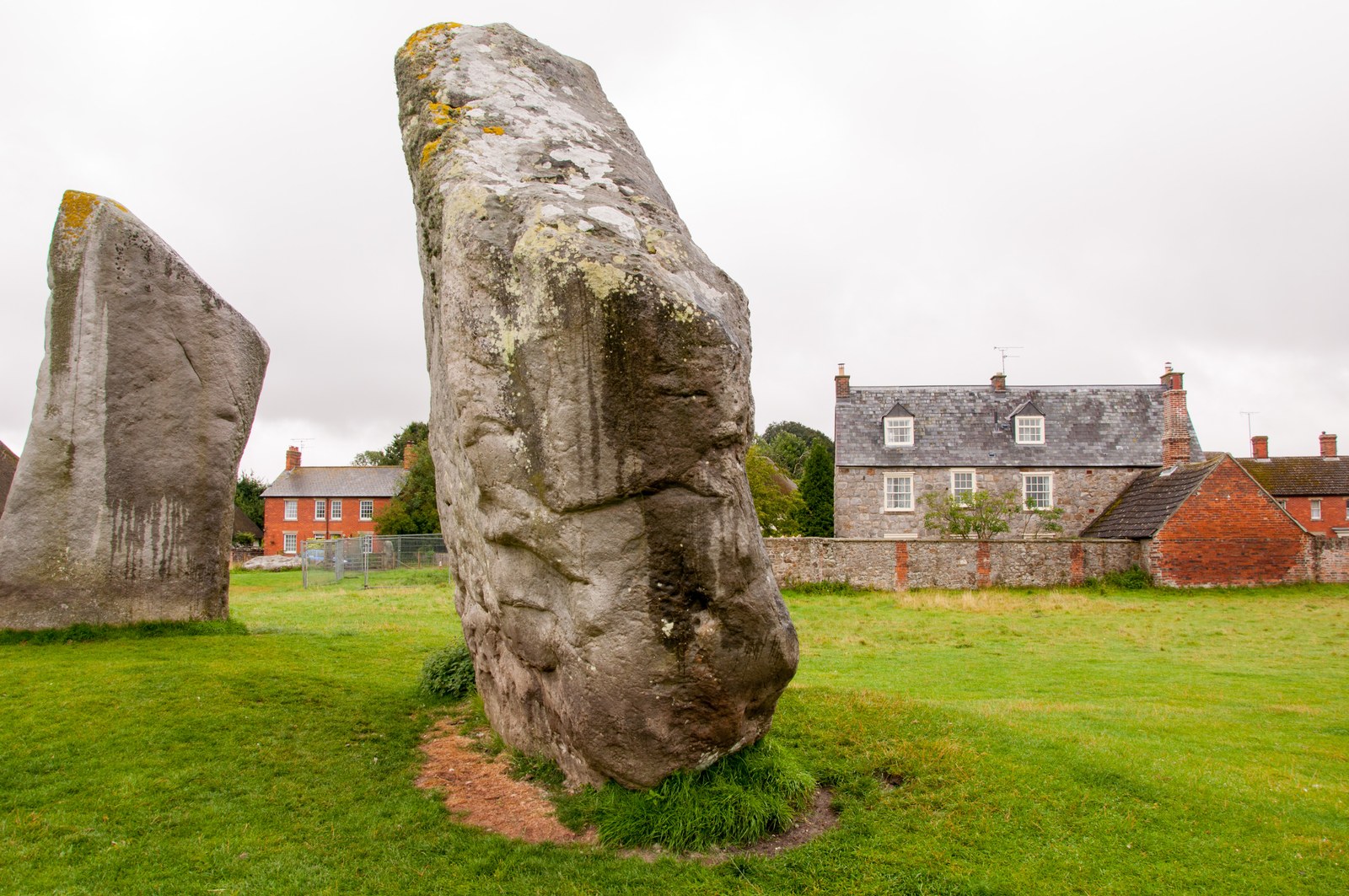
Walk through the village of Avebury in Wiltshire, in the south-west of England, and you will pass a pub, a church, and a row of cottages — and, standing among them in the grass, stones the size of small houses. They have stood here for more than four thousand years. Avebury is the largest stone circle in the world, a Neolithic monument so vast that the village grew up inside it, and its purpose is still one of the great unsolved questions of British archaeology.
The monument was built and modified over several centuries, roughly between 2850 and 2200 BCE, in the Late Neolithic and the early Bronze Age. It is part of the same UNESCO World Heritage Site as Stonehenge, about 25 miles to the south, and the two were inscribed together in 1986. But where Stonehenge is fenced and famous, Avebury is open and oddly overlooked — you can walk right up to the stones for free, and touch rock that was raised when the Egyptian pyramids were still new.
A Monument on a Huge Scale
The Avebury henge is a massive circular earthwork: a bank about 1.4 kilometres in circumference, enclosing roughly 11.5 hectares of ground, with a deep ditch dug into the natural chalk. Inside the bank stands the Outer Stone Circle, a ring of about 100 large sarsen stones — blocks of hard sandstone dragged from the Marlborough Downs, some of them weighing more than 40 tonnes. The circle is about 347 metres across, making it the largest stone circle in Britain and, by most measures, in the world.
Within the great circle stand two smaller ones, the Northern and Southern Inner Circles, each with its own arrangement of stones. At the centre of the southern circle stood a feature known as the Obelisk, a single tall stone that was recorded in the eighteenth century but has since vanished. At the centre of the northern circle stood the Cove, a setting of three large stones, two of which survive. Stone avenues once ran out from the circle across the landscape: the West Kennet Avenue, a double line of stones running south-east for about two kilometres towards the Sanctuary, and the Beckhampton Avenue, running south-west.
Avebury does not stand alone. It is the centre of a ritual landscape that includes Silbury Hill, the largest man-made mound in Europe, rising about 40 metres above the plain a short distance to the south; the West Kennet Long Barrow, a Neolithic chambered tomb older than the circle itself; and Windmill Hill, an earlier Neolithic enclosure. Taken together, these monuments represent one of the most important prehistoric landscapes in Europe.
The Stones and the People Who Raised Them
The stones are sarsen, a dense grey sandstone that occurs naturally on the Marlborough Downs, about two kilometres from Avebury. Moving them was a task of extraordinary effort. The largest weigh 40 tonnes or more, and they were dragged — probably on wooden sledges, over rollers, with ropes — across the chalk downland, then raised into pits dug by hand and packed with chalk rubble. The work was done by farming communities, using stone tools, antler picks, and shoulder blades as shovels. No metal tools were involved.
Who organised the work, and why? That is where certainty ends. The monument was built over many centuries, in phases, and its builders left no writing and no images of themselves. The most likely explanation, and the one most archaeologists accept, is that Avebury was a ceremonial place — a site for gatherings, rituals, and the marking of seasons and ancestors. But that is a broad description, not a detailed one. We do not know what ceremonies took place there, who was allowed to enter, or what the stones themselves meant to the people who raised them.
The alignments have been studied for generations. Some researchers have argued that the stones and avenues mark the rising and setting of the sun and moon at particular times of year, as at Stonehenge. Others have found the evidence for precise astronomical alignment at Avebury much weaker, and argue that the monument’s orientation was governed by the landscape — the line of the Kennet valley, the view towards the Marlborough Downs — rather than by the sky. The debate is unresolved, and honest accounts of Avebury say so.
Buried, Broken, and Rescued
The story of Avebury after its construction is almost as remarkable as its building. In the Middle Ages, the stones were regarded with suspicion. In the fourteenth century, villagers began burying and breaking them, apparently because the monument was associated with pagan worship. The work was dangerous: during excavations in 1938, archaeologists found the skeleton of a man crushed beneath a fallen stone, buried with a small leather pouch containing coins and a set of surgical instruments. He is known as the Barber Surgeon, and the evidence suggests he was killed in the 1320s while helping to topple a stone. The coins in his pouch date to the reign of Edward II, which gives the find a firm date — but whether he was a barber-surgeon by trade, and exactly what he was doing at the stone, is a matter of interpretation, not certainty.
By the eighteenth century, many stones had been broken up for building material or buried in pits. The antiquarian William Stukeley visited Avebury in the 1720s and drew the monument as it then stood, recording stones and avenues that have since disappeared. His drawings are now one of the most important sources for reconstructing the site. Stukeley also gave the monument its first serious published description, and he helped to fix Avebury in the imagination of the learned world.
The rescue of Avebury came in the twentieth century, in the person of Alexander Keiller, a wealthy archaeologist who bought much of the land around the village in the 1920s and 1930s. Keiller excavated the henge, re-erected fallen stones, and marked the positions of stones that had been destroyed with concrete pillars. In 1943 he transferred the site to the National Trust, which manages it today on behalf of English Heritage. The Alexander Keiller Museum, housed in a seventeenth-century barn beside the henge, holds his collection of finds from Avebury, Windmill Hill, and the surrounding landscape.
A Village Inside a Monument
What makes Avebury unlike any other great prehistoric monument is that it is inhabited. The village sits within the stone circle, its houses, its pub — the Red Lion, which claims to be the only pub in the world inside a stone circle — and its church of St James, with Saxon origins, all standing inside a Neolithic henge. Visitors can walk freely among the stones, which is both the site’s great charm and a source of constant care for those who look after it.
The henge is open at all times, free of charge, and sheep graze among the stones, keeping the grass down as they have done for centuries. On the summer solstice, crowds gather at dawn, as they do at Stonehenge — although Avebury’s gathering is smaller, quieter, and far less policed. The monument is a working part of the village, not a museum piece behind a fence, and that is part of what has kept it alive in the local imagination.
What Is Known — and What Is Not
Documented facts: Avebury’s henge and stone circles were built and modified roughly between 2850 and 2200 BCE. The Outer Stone Circle originally held about 100 sarsen stones, is about 347 metres across, and stands inside a bank about 1.4 kilometres in circumference enclosing about 11.5 hectares — the largest stone circle in the world. Two inner circles, the Cove, and the West Kennet and Beckhampton Avenues form part of the monument. The site is part of the Stonehenge, Avebury and Associated Sites UNESCO World Heritage Site, inscribed in 1986. In the fourteenth century, stones were buried and broken; the skeleton found under a fallen stone in 1938, with coins dating to the reign of Edward II and surgical instruments, is known as the Barber Surgeon. William Stukeley recorded the monument in the 1720s, and Alexander Keiller excavated and restored it in the 1930s before transferring it to the National Trust in 1943.
Unverified or open to interpretation: The purpose of Avebury is not known; the most widely held view is that it was a ceremonial or ritual site, but no specific ceremonies or meanings are documented. Claims that the stones are precisely aligned to astronomical events are debated, and the evidence for exact alignments is weaker than at Stonehenge. The suggestion that the monument was laid out according to a deliberate geometric or sacred design is a hypothesis. The identity and exact role of the Barber Surgeon are inferred from the objects found with his skeleton, not recorded. The name the builders gave the site is unknown, and the word “Avebury” itself comes from later history.
Avebury has survived four and a half thousand years — through the Bronze Age, the Romans, the Saxons, the medieval stone-breakers, and the modern age — and it is still there, in the middle of a village, open to anyone who walks in. The people who raised its stones are gone, and their reasons went with them. What remains is the scale of their ambition, written in stone the size of houses, in a circle large enough to hold a village.
Sources
- https://museumsuk.com/museums/avebury/avebury-avebury.html
- https://www.countryfile.com/go-outdoors/historic-places/neolithic-sites-britain-ireland
- https://worldheritagesites.net/stonehenge-avebury/
- https://www.odysseytraveller.com/articles/highlights-of-stonehenge-and-avebury/
- https://commons.wikimedia.org/wiki/File:Avebury_Stone_Circles,_England_15.08.2013.jpg