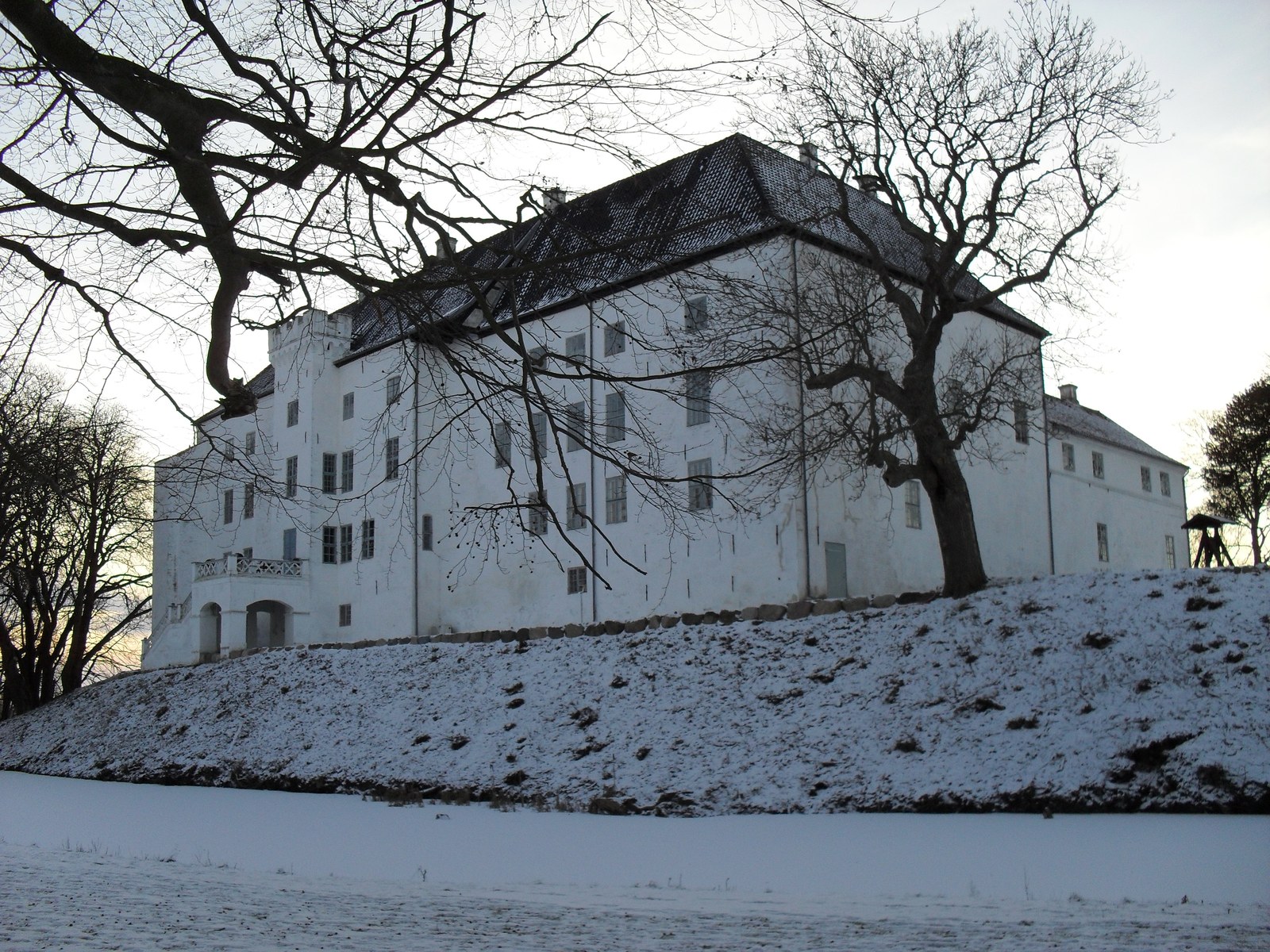
On a winter morning the white walls of Dragsholm Castle seem to rise out of the snow rather than stand on it. The palace sits on an islet in Odsherred, on the island of Zealand, its dark roof and rows of windows reflected in the still water of the moat. It looks orderly, even welcoming: a Baroque country house with a restaurant and hotel inside, reached by a bridge over water that once protected it. Nothing in the view suggests a prison. That is the first surprise of Dragsholm. The second is how long the building has been here, and how many lives it has lived on the same small piece of ground.
The islet by the drag
Dragsholm means the islet by the drag. Before the Lammefjord was drained, Odsherred was joined to the rest of Zealand by a narrow strip of land, a drag, east of the castle, near the mill that still stands at Dragsmølle. The Vikings could haul their ships across that strip and sail on to Roskilde, avoiding the dangerous waters north of Zealand. The islet lies just south of a terminal moraine ending at Vejrhøj, 123 metres high, surrounded by lakes and meadows.
That geography made the site valuable twice over: it controlled a route, and it could be defended. The castle that grew there was never only a residence. It was a toll point and a strongpoint, and its history follows the politics of Denmark as closely as any fortress in the country.
From bishop’s palace to fortress
The original Dragsholm Castle was built around 1215 by the Bishop of Roskilde, with Peder Sunesen named as the original client. It began as a palace, and during the Middle Ages it was modified into a fortified castle. Dragsholm is described as one of the oldest secular buildings in Denmark: a medieval core remade in later centuries, rather than a single building from a single age.
Its strength was tested during the Count’s Feud of 1534 to 1536, the civil war that followed the death of King Frederick I. Dragsholm was, according to the historical record, the only castle on Zealand strong enough to withstand the armies of Count Christoffer. A building that could hold out against an army was a building the Crown wanted to control, and one that could hold people securely was a building it could use as a prison.
Crownland and prison, 1536–1664
With the Reformation, Dragsholm was confiscated by the Crown along with all other property of the Catholic Church. From 1536 to 1664 it was Crown land, used as a prison for noble and ecclesiastical prisoners. Cells were made in the large tower at the northeast corner of the medieval castle, fitted with toilets and windows according to the prisoner’s crime, his behaviour, and the seriousness of his insults towards the King. Imprisonment at Dragsholm was graded, deliberate, and personal.
Among the best-known prisoners were Joachim Rønnow, the last Catholic Bishop of Roskilde and a former owner of the castle, imprisoned in a building he had once controlled; Ejler Brockenhuus, a squire described as seemingly raving mad; and James Hepburn, 4th Earl of Bothwell, the castle’s most famous resident, living and dead. The prison years give Dragsholm its darkest reputation and its ghost stories their anchor: the same rooms that held political prisoners in the sixteenth century are still accessible to overnight guests today.
The Earl of Bothwell
James Hepburn, 1st Duke of Orkney and 4th Earl of Bothwell, was born around 1534 and became the third husband of Mary, Queen of Scots. He had been accused of the murder of Mary’s second husband, Henry Stuart, Lord Darnley, a charge of which he was acquitted. His marriage to Mary was controversial and divided Scotland, and when the rebellion against them grew, Bothwell fled north through Orkney and Shetland towards Norway, where he was arrested in 1567. He would spend the rest of his life imprisoned in Denmark.
His Danish imprisonment was not a single confinement, and the simplified version — eleven years chained at Dragsholm — needs correction. Bothwell was first held in Bergen and then in Copenhagen, where he was at first treated honourably, then moved to Malmö, held there from early 1568 until 1573. Only in June 1573 was he transferred to Dragsholm, to a much harsher and more isolated confinement.
From that point, the record grows thin. Bothwell was cut off from communication beyond the castle walls, and even the date of his death was disputed in his own time, with some reports placing it in 1575 or 1576. The best authorities, Danish as well as Scottish, establish that he died on 14 April 1578 at Dragsholm, aged about forty-four, and that his remains were placed in a vault in the parish church of Fårevejle, near the castle. In December 1567 the Parliament of Scotland had formally stripped him of all his Scottish titles, including the Dukedom of Orkney.
The conditions of his final years are described as appalling, and later tradition says that close, solitary confinement drove him to insanity. That claim should be treated with care: what the record supports is a long imprisonment, in deteriorating conditions, ending in death far from home. The story that he wore a circular groove in the floor by pacing around a pillar to which he was chained belongs to legend.
Bothwell is the prisoner whose life is best documented and whose death is dated with the most confidence. When visitors report hearing the Earl at Dragsholm, they are reporting a presence attached to a real man, in a real room, at the end of a real and miserable imprisonment. That does not make the reports true. It makes them understandable.
Baroque rebirth
Dragsholm did not remain a prison. During the wars against Charles X Gustav of Sweden, an attempt was made to blow it up, and it lay in ruins until the King gave it to royal treasurer Heinrich Müller as part payment of outstanding debts, and Müller began its restoration. In 1694 it was sold to the nobleman Frederik Christian Adeler, and finally rebuilt as the Baroque castle that stands today.
Several owners from the Adeler family left their mark, including G. F. O. Zytphen Adeler, who took the initiative to drain the Lammefjord. The Adeler family lost its wealth when Denmark’s bank collapsed in 1932, and Dragsholm passed to the Central Land Board, which sold it to J. F. Bøttger. The Bøttger family has managed the castle since, through restorations after the First World War that gave the salons their late Romantic character, and through more recent work as a hotel, restaurant and attraction.
Three reported ghosts
Witnesses and psychics have claimed that three ghosts are resident at the castle: a grey lady, a white lady, and Lord Bothwell. The Earl is said to ride through the courtyard with a full horse and carriage, and he is more often heard than seen — the sound of horses, of carriage wheels, or of chains in the corridors.
The White Lady is said to be a young noblewoman, the daughter of one of the castle’s owners, who fell in love with a man who worked at the castle. Her father, discovering the affair, is said to have locked her in a tower cell and bricked her up inside the wall. Then, according to the legend, workmen repairing the castle found the skeleton of a woman in a white dress sealed inside a wall, and the tale gained a physical anchor.
No excavation report has been produced to support that discovery, and no named archaeologist, date, or official record is attached to it. The name sometimes given to the White Lady, Celina Bovles, is likewise part of the legend rather than a documented historical person. The same caution applies to the Grey Lady, described as a servant who stayed on after death out of gratitude for kindness shown to her in life, drifting through the cellars as a friendly presence, the only one of the three ghosts with a good reputation.
These are three very different kinds of story: Bothwell is documented, the White Lady is a legend with an unverified discovery, and the Grey Lady is the thinnest of the three.
What the stones remember
Dragsholm Castle is best understood not as a haunted house, but as a building that has been used hard for eight centuries. The bishop who built it, the count whose armies could not take it, the king who turned it into a prison, the earl who died in it, and the family who rebuilt it as a palace all left something behind — in stone, in records, and in stories.
The Earl of Bothwell is the figure who binds those layers together. He arrived as a powerful Scottish noble, the husband of a queen, and he died as a forgotten prisoner in a Danish tower, stripped of his titles, buried in a village church. If his ghost is heard in the courtyard, it is heard because his story most clearly shows what Dragsholm was: a place where power could be kept, and where it could be ended, far from home and out of sight. Whether anything of him remains is a question no record can settle.
What is documented — and what is not
Documented: a building on the islet by the drag from around 1215, built by the Bishop of Roskilde; its survival as the only castle on Zealand to withstand Count Christoffer’s armies during the Count’s Feud of 1534–1536; Crown ownership and use as a prison from 1536 to 1664; the imprisonment there of Joachim Rønnow, Ejler Brockenhuus and James Hepburn, 4th Earl of Bothwell; Bothwell’s transfer to Dragsholm in June 1573 and his death there on 14 April 1578, with burial at Fårevejle Church; sale to Frederik Christian Adeler in 1694 and rebuilding as the Baroque castle seen today; and the castle’s present use as a hotel and restaurant under the Bøttger family.
Not documented: the claim that Bothwell spent eleven years at Dragsholm, rather than in Denmark as a whole from 1567, with Dragsholm only from 1573; the story that he was chained to a pillar and wore a groove in the floor; the certainty of his insanity; the White Lady’s identity, her walled-up death, and the reported discovery of a skeleton in a white dress inside a wall, for which no excavation report exists; the Grey Lady’s identity and history; and any verified evidence of haunting.
Sources
- https://en.wikipedia.org/wiki/Dragsholm_Castle
- https://en.wikipedia.org/wiki/James_Hepburn,_4th_Earl_of_Bothwell
- https://nordicforbeginners.com/scandinavias-most-haunted-places-and-the-paperwork-behind-them/
- https://www.abandonedspaces.com/castle/dragsholm-denmark.html
- https://www.undiscoveredscotland.co.uk/usbiography/h/jameshepburnbothwell.html