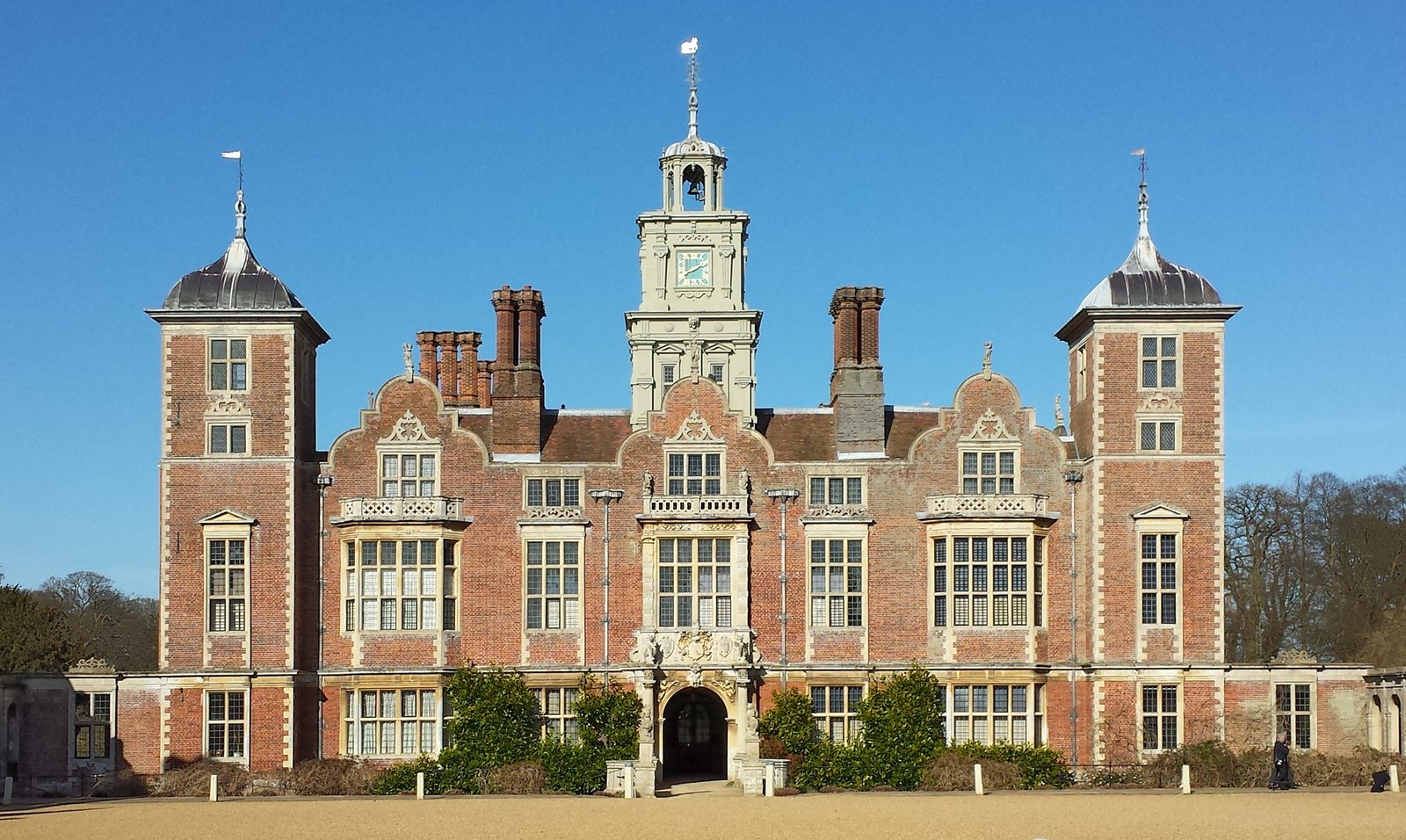
Blickling Hall stands in a loop of the River Bure, just north of the Norfolk market town of Aylsham, and it is one of the most photographed country houses in England. Its symmetrical red-brick facade, shaped gables and domed corner turrets make it an almost perfect image of a Jacobean great house. Yet visitors come for more than architecture. Blickling is widely known as the birthplace of Anne Boleyn, the second wife of Henry VIII and mother of Elizabeth I, and as the National Trust property most often described as haunted. Every 19 May, the anniversary of Anne Boleyn’s execution, attention turns to the old story that her headless ghost returns to the house of her birth.
The house visitors see today was built more than eighty years after her death, on the ruins of an earlier home.
A site with a thousand years of history
The manor of Blickling was recorded in the Domesday Book of 1086, the great survey ordered by William the Conqueror. The land was once held by Harold Godwinson, who became King Harold II and died at the Battle of Hastings in 1066. Traces of the medieval house survive, including a fourteenth-century dry moat.
In the fifteenth century Blickling belonged to Sir John Fastolf of Caister (1380–1459), a soldier who made a fortune during the Hundred Years’ War. His coat of arms is still on display in the house. Tradition links Fastolf with Shakespeare’s Falstaff, though that is unproven. The Boleyn family acquired the estate in the mid-fifteenth century, when Geoffrey Boleyn, a wealthy London merchant and later Lord Mayor of London, bought it. Between 1499 and 1505 it was the home of Thomas Boleyn, later Earl of Wiltshire, and his wife Elizabeth Howard. Their three surviving children — Mary, Anne and George — spent their earliest years there.
Was Anne Boleyn born at Blickling?
The claim that Anne Boleyn was born at Blickling is often repeated, and also carefully qualified. No birth record survives, and the exact birth dates of the Boleyn children are not known. The historian Eric Ives, author of the standard modern biography of Anne Boleyn, concluded that all three children were probably born at Blickling: Mary in about 1499, Anne in about 1501, and George in about 1504.
That conclusion is not universally accepted. Hever Castle in Kent, the Boleyn family’s other home, is the rival claimant. The uncertainty is reflected inside Blickling itself: a statue and a portrait of Anne carry the inscription “Anna Bolena hic nata 1507” — “Anne Boleyn born here 1507”, a date that conflicts with Ives’s estimate. What is certain is that Anne spent her early childhood at Blickling, even if the precise place of her birth cannot be proved.
Anne’s later life is well documented. She married Henry VIII in 1533, was crowned queen, and gave birth to the future Elizabeth I. She was then accused of adultery, incest and treason, tried and convicted, and beheaded at the Tower of London on 19 May 1536. Her brother George had been executed two days earlier. The date of 19 May would later become the centre of Blickling’s ghost lore.
The Jacobean house
The present Blickling Hall was built for Sir Henry Hobart, Lord Chief Justice of the Common Pleas and first Baronet, who bought the estate in 1616 from Lady Agnes Clere. Hobart commissioned the architect Robert Lyminge, who had designed Hatfield House, to build a new mansion on the ruins of the old Boleyn property. Construction began in 1616 and continued until about 1627, although Hobart died in 1625 and the work was completed by his son, Sir John Hobart, second Baronet.
The result is a Grade I listed Jacobean mansion of red brick with stone dressings, set in about 5,000 acres (2,000 hectares) of parkland, its facade balanced around a central clock tower. Later owners left their marks: the Earl of Buckinghamshire created the ha-ha and built the Doric Temple, and in the nineteenth century the Kerr family, Marquesses of Lothian, remodelled the west front.
The library and the Long Gallery
One of Blickling’s greatest treasures is its library. Housed in the Long Gallery, it contains an estimated 13,000 to 14,000 volumes, one of the most historically significant book collections in the care of the National Trust. The core was formed by Sir Richard Ellys (1682–1742), a cousin of the Hobarts, and it was Sir John Hobart, first Earl of Buckinghamshire, who fitted out the Long Gallery to hold the Ellys books.
The collection includes the Blickling Homilies, one of the earliest surviving examples of English vernacular homiletic writing, now held at Princeton University.
The Lothians, the war, and the National Trust
The last private owner was Philip Kerr, eleventh Marquess of Lothian, who inherited the estate in 1930. Lothian played a leading part in the passing of the National Trust Act of 1937 and the creation of the Country Houses Scheme, which allowed historic houses to pass to the National Trust in lieu of death duties. When he died in December 1940, the Blickling estate passed to the National Trust under that scheme, although the Trust did not take full possession until after the Second World War.
During the war the house was requisitioned and served as the officers’ mess of nearby RAF Oulton. Officers were housed in the house itself, while other RAF personnel were billeted in Nissen huts in the grounds, and the lake was used for dinghy drills. After the war the house was let to tenants until 1960, when the Trust began restoring it. It opened to the public in 1962 as the Blickling Estate.
The ghost of Anne Boleyn
Blickling’s reputation as a haunted house rests above all on Anne Boleyn. According to the best-known version of the legend, her ghost returns every year on 19 May, the anniversary of her execution. She is said to arrive at night in a spectral coach drawn by four headless horses and driven by a headless coachman. Inside sits Anne herself, dressed in white, carrying her severed head on her lap. The coach is said to drive up to the house and then vanish, while Anne roams the halls until daybreak.
Other versions place her in the south drawing room, by the lake, or in the dining room, sometimes in grey rather than white — which has led to suggestions that the Grey Lady is another form of the same apparition.
There is no verified eyewitness record that would satisfy a historian, and no photograph or scientific measurement has ever established the presence of a ghost at Blickling. What is documented is the legend itself: that people have told this story, associated it with 19 May, and connected it with Anne Boleyn for a very long time. The legend is real as a piece of cultural history. The ghost is not proven as a fact.
The other ghosts of Blickling
Anne Boleyn is not the only ghost said to haunt Blickling. Her father, Sir Thomas Boleyn, has his own place in the folklore. According to the tale, he is condemned to drive a ghostly coach drawn by four headless horses across twelve bridges before cockcrow, repeating the journey for a thousand years as penance for his part in his children’s downfall.
Anne’s brother George is also said to appear on 19 May, dragged by four headless horses around the countryside — a grim echo of his execution two days before his sister’s. Sir John Fastolf is reported to have been seen in full armour in various parts of the house, most often around the anniversary of Anne’s death. Another reported ghost is Sir Henry Hobart, who died in 1698 after being wounded in a duel. Tradition says his dying groans are heard in the West Turret Bedroom on the anniversary of his death. The Grey Lady is described as a woman in a long grey dress, wearing a white cap and a white lace collar, who passes through walls and disappears.
Britain’s most haunted National Trust house?
In 2007 Blickling Hall topped a National Trust list of its ten most haunted houses, compiled to mark Halloween with the help of Siân Evans, author of Ghosts: Mysterious Tales from the National Trust. The house’s manager at the time acknowledged that visitors did mention the ghosts, especially around 19 May, and that one or two volunteers had reported small unexplained incidents — while also noting, with dry realism, that Blickling is a very old house with a lot of clanking in the pipes.
That balanced response captures the right way to approach Blickling. Its ghost stories have been told for so long that they are part of the history of the house itself, but they remain stories: no investigation has produced evidence that would convince a sceptic, and the National Trust presents the legends as folklore, not as fact.
What is documented, and what is not
Documented facts: Blickling Hall is a Grade I listed Jacobean mansion in Norfolk, built c. 1616–1627 for Sir Henry Hobart to designs by Robert Lyminge, on the site of an earlier Boleyn family house. The manor was recorded in the Domesday Book of 1086; Sir John Fastolf owned it in the fifteenth century, and the Boleyn family held it between 1499 and 1505. Anne Boleyn was executed at the Tower of London on 19 May 1536. The library in the Long Gallery holds an estimated 13,000 to 14,000 volumes. Philip Kerr, eleventh Marquess of Lothian, died in December 1940 and the estate passed to the National Trust; during the Second World War the house served as the officers’ mess of RAF Oulton, and it opened to the public in 1962.
Unverified or disputed claims: That Anne Boleyn was born at Blickling (Eric Ives argued she probably was, in about 1501, but Hever Castle is the rival claimant, and the house’s own inscription gives 1507); that Sir John Fastolf was the model for Shakespeare’s Falstaff (tradition, not proven); and all of the ghost stories — Anne Boleyn’s headless return on 19 May, her father Thomas Boleyn’s thousand-year penance, and the apparitions of George Boleyn, Sir John Fastolf, Sir Henry Hobart and the Grey Lady. These are folklore and reported sightings, not documented facts, and no scientific evidence has established that Blickling Hall is haunted.
Sources
- Wikipedia, “Blickling Hall” — https://en.wikipedia.org/wiki/Blickling_Hall
- National Trust, “Blickling Estate” — https://www.nationaltrust.org.uk/blickling-estate
- Timeless Travel Steps, “The Ghosts of Blickling Hall, Norfolk and Their Haunted Secrets” — https://timelesstravelsteps.com/ghosts-of-blickling-hall-norfolk/
- Spooky Isles, “Royal Haunting At Blickling Hall, Norfolk” — https://www.spookyisles.com/royal-haunting-at-blickling-hall-norfolk/
- Norfolk Local Guide, “17 Most Haunted Places in Norfolk” — https://norfolklocalguide.co.uk/most-haunted-places-in-norfolk/