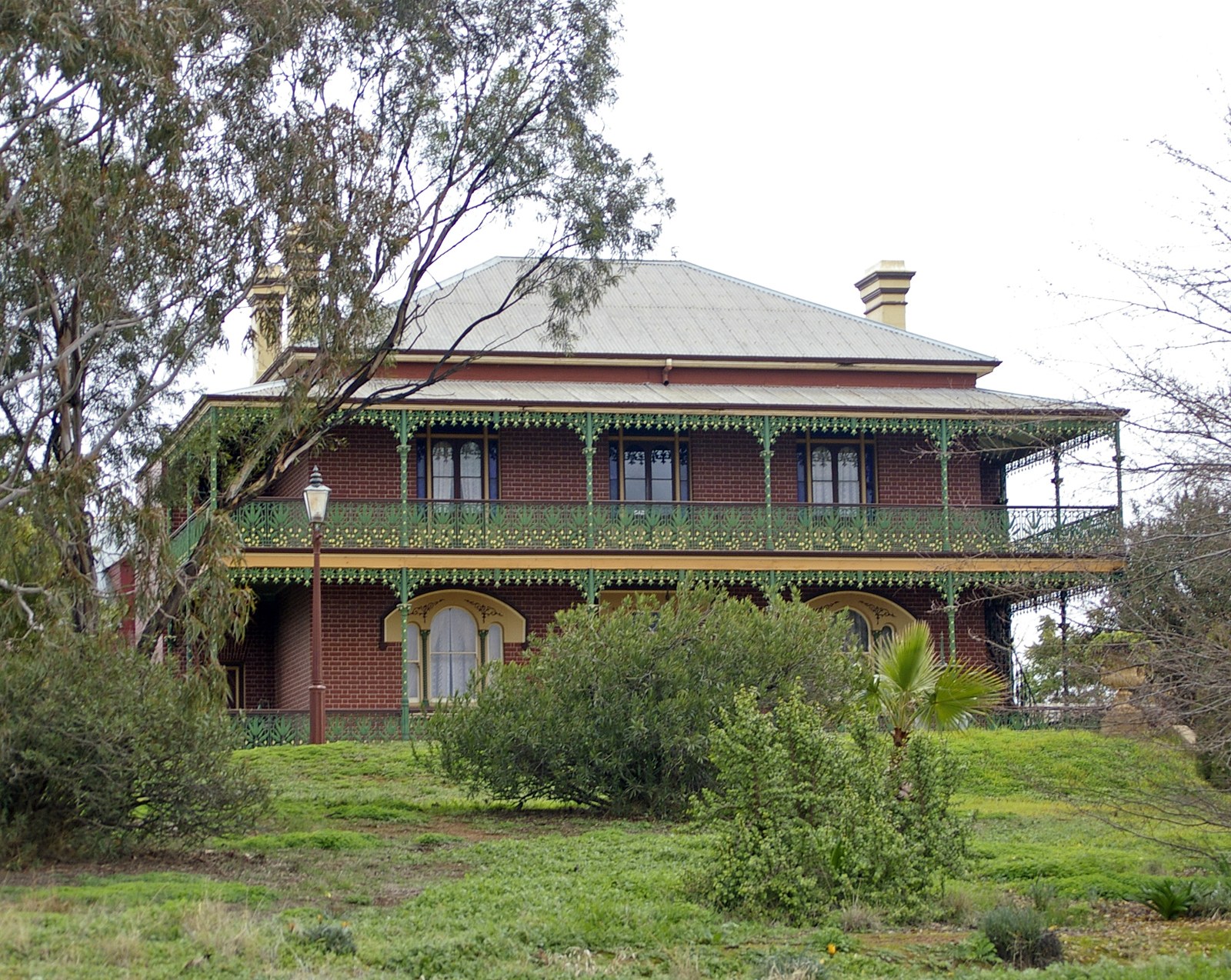
On a hill above Junee, in the Riverina region of New South Wales, a two-storey red-brick house looks out over the town it helped to build. Its verandahs are trimmed with green iron lacework, its chimneys stand tall against the sky, and its gardens slope down toward the streets below. From a distance it looks like the picture of colonial success: the grand home of a man who arrived with little and made a fortune. Up close, it carries a different reputation. For decades it was promoted as “Australia’s most haunted house,” and the stories attached to it are among the darkest in the country’s folklore.
The Man Who Built Junee
The house was built in 1884–85 by Christopher William Crawley, a grazier and businessman who was one of Junee’s founding figures. Crawley had bought land in the district in 1876, betting that the arrival of the Great Southern Railway, which reached the area in 1878, would bring growth. He was right. The town was gazetted in 1885, and Crawley, who founded the town’s first store, hotel and church, grew wealthy as Junee grew around him.
Monte Cristo was his statement of arrival. The double-storey late-Victorian manor stood on a hill overlooking the town, and it was, by local accounts, the finest house in the district. An earlier, more modest brick house on the property became the servants’ quarters, kitchen and dairy. The new house was the centre of the Crawley family’s life, and it would remain in the family until 1948. Christopher Crawley died there on 14 December 1910, aged 69, of blood poisoning caused by an infected carbuncle, or boil, on his neck. His wife Elizabeth lived on in the house for more than two decades, dying there in 1933 at the age of 92.
After the last of the Crawleys left in 1948, the house fell into decline. It stood largely empty under a series of caretakers, and by the early 1960s it had been vandalised and looted. It was in this state that Reginald and Olive Ryan bought it in 1963 and set about restoring it. The Ryans, who raised five children in the house, turned it into a museum and antiques showcase, and later opened it to the public as a tourist attraction. It was under the Ryans that Monte Cristo became famous far beyond Junee.
Ten Spirits, by Reputation
The Ryans reported strange experiences from early in their time at the house, and over the years the stories grew. Tour operators eventually claimed that as many as ten spirits lived at Monte Cristo. Visitors were told of unexplained bright lights, figures seen on the stairs and in the gardens, voices heard in empty rooms, footsteps in corridors, and a feeling of sadness or difficulty breathing in certain parts of the house.
The best-known stories are tied to deaths said to have taken place in and around the house. The most famous concerns the staircase. In the version most often told, a young Crawley grandchild, usually named Ethel and said to have died in 1917, was being carried down the stairs by a nursemaid when the child fell and was killed. In some tellings the nursemaid claimed that something pushed the child from her arms. The name and date are the commonly repeated version; the details have not been confirmed in an independent primary record.
Other stories are darker still. One tells of a maid who fell to her death from a second-floor balcony, said by some accounts to have been pregnant at the time. Another tells of a young stable boy named Morris, who was sleeping on a straw mattress in the coach house when, the story goes, his master set the mattress alight, believing the boy was pretending to be ill. The boy, too ill to rise, is said to have burned to death. A third tells of Harold, a disabled boy said to have been chained in the caretaker’s cottage for decades, whose howls were heard by local children long before anyone knew who was making them.
None of these stories can be verified from contemporary records. They come from oral retelling, ghost-tour accounts and later books, not from documents written at the time, and presenting them as established history would do a disservice both to the people named in them and to the reader.
The Caretaker and the Television Crews
One story from the house’s later years is more recent, and therefore easier to place in time, though it is no more proven as a haunting. In 1961, according to the commonly told version, a caretaker named Jack Simpson was shot dead at the house by a local boy. The boy was said to have been inspired by the Alfred Hitchcock film Psycho, which he had reportedly watched three times that day. Most retellings give the date as 1961, though at least one gives 1960, and the details of the killing have not been independently verified here.
By the 1970s Monte Cristo had become a national curiosity. It was featured on the ABC programme A Big Country in 1977, on the travel show Getaway in 1992, on the paranormal game show Scream Test in 2000, on Ghost Hunters International in January 2010, and on My Ghost Story in 2013. It was also the focus of the 2012 mockumentary horror film Muirhouse. Ghost hunters from Sydney and beyond spent nights in the house, and the Ryans’ son Lawrence, who became known as the stunt motorcyclist Lawrence Legend, once jumped his motorbike over the two-storey homestead using ramps.
The house’s fame fed on itself. Each television appearance brought new visitors, and each new visitor brought a new story. The house’s own publicity leaned into its reputation, advertising itself openly as “Australia’s most haunted house.” Whether the attention created the stories or the stories created the attention is a question with no clear answer.
The House Goes Quiet
For all its fame, Monte Cristo was always a family home first. Lawrence Ryan and his four sisters grew up there, and Lawrence has spoken of it as the place of his childhood, not only as a haunted attraction. His mother Olive lived there for decades after Reginald’s death, and the house remained a museum, antique centre and hub for ghost hunters.
That long chapter ended with Olive Ryan’s death in November 2024. Her family decided to end tourism operations, and Monte Cristo has been closed to the public since January 2025. As of late 2026 the property was reported to be for sale, with its extensive collection of antiques, and its future as a public attraction remains uncertain. The house on the hill is quiet now in a way it has not been for sixty years.
Why the Stories Endure
Monte Cristo’s reputation rests on a combination of real history, family accounts, local folklore, television and tourism. The real history is substantial on its own: a pioneer family, a grand house, a death in 1910 that seems almost absurdly small in its cause, a long widowhood, abandonment, and a family’s determined restoration. The folklore adds the rest: the staircase, the balcony, the coach house, the chained boy, the caretaker. The two are often told as one story, but they are not the same thing, and keeping them apart is the only honest way to write about the house.
Almost all of these stories are about servants and children, people with little power in a large house. The Crawleys themselves are said to haunt the place too — Christopher in the room where he died, Elizabeth upstairs — but the most repeated tales belong to the maid, the stable boy, the child on the stairs. Whether or not any of it is true, the legends preserve a memory of the people who lived and worked in the house’s shadow, and that may be why they have lasted.
Closing Reflection
Monte Cristo Homestead is closed now, and its gates are shut to the ghost hunters who once queued for its night tours. That silence suits it. A house that spent decades as a stage for other people’s fears has returned to being simply a house: brick and iron lace, gardens and hilltop, a view over a town that owes much of its existence to the man who built it.
The stories will not go away. They are too well told, and too deeply woven into Junee’s identity, for that. But the house itself deserves to be remembered for what is certain: that Christopher Crawley built it when the railway came, that his family lived and died in it, that it fell to ruin and was saved by another family who loved it enough to rebuild it. The ghosts, if they are there, are guests. The house belongs to its history.
What is documented — and what is not
Documented: That Monte Cristo Homestead was built in 1884–85 by Christopher William Crawley in Junee, New South Wales; that Crawley bought land in the district in 1876 and that the railway reached the area in 1878; that Christopher died at the house on 14 December 1910, aged 69, of blood poisoning from an infected carbuncle on his neck, and that Elizabeth Crawley died there in 1933, aged 92; that the Crawley family remained in residence until 1948; that Reginald and Olive Ryan bought the house in 1963 and restored it; that it operated as a museum, antiques showcase and tourist attraction advertising itself as “Australia’s most haunted house”; that it appeared on A Big Country (1977), Getaway (1992), Scream Test (2000), Ghost Hunters International (January 2010) and My Ghost Story (2013), and was the focus of the film Muirhouse (2012); and that after Olive Ryan’s death in November 2024, tourism ended and the house has been closed to the public since January 2025.
Not documented: That the house is haunted; that ten spirits reside there; that a child named Ethel died on the stairs in 1917, or that any unseen force caused a fall; that a maid fell from the balcony, that she was pregnant, or that she was pushed; that a stable boy named Morris was burned to death in the coach house; that a boy named Harold was chained in the caretaker’s cottage for decades; and that a caretaker named Jack Simpson was shot in 1961 by a boy inspired by the film Psycho. These accounts come from oral retelling, ghost-tour material and later books, not from contemporary records, and the details — including names, dates and causes — differ between sources. No scientific evidence has established that the house is haunted.
Sources
- https://en.wikipedia.org/wiki/Monte_Cristo_Homestead
- https://www.australiangeographic.com.au/news/2025/05/a-complete-guide-to-junee-nsw/
- https://halloweenhaunt.info/monte-cristo-homestead-a-deep-dive-into-australias-most-haunted-house/
- https://www.domain.com.au/news/what-it-was-like-to-grow-up-in-australias-most-haunted-home-20160907-gr6601/
- https://www.domain.com.au/news/australias-most-haunted-house-searching-for-brave-new-owner-1576658/
- https://www.wikitree.com/wiki/Crawley-331