In the Beqaa Valley of Lebanon, mortared into the western wall of a Roman temple platform, sit three blocks of limestone that together weigh more than four fully loaded jumbo jets. Each stone runs about 19 metres long — roughly the length of two city buses parked nose to tail — and each is estimated at close to 800 tonnes. They are called the Trilithon, and they are the heaviest stones ever successfully transported and set in place in the ancient world.
They are not even the heaviest stones at the site. A short walk up the hill, still lying in the quarry where the masons cut them and apparently walked away, rest unfinished blocks that are larger still — including one discovered in 2014 that is, at an estimated 1,650 tonnes, the largest single block of stone ever quarried in antiquity.
A Roman temple on a Phoenician holy place
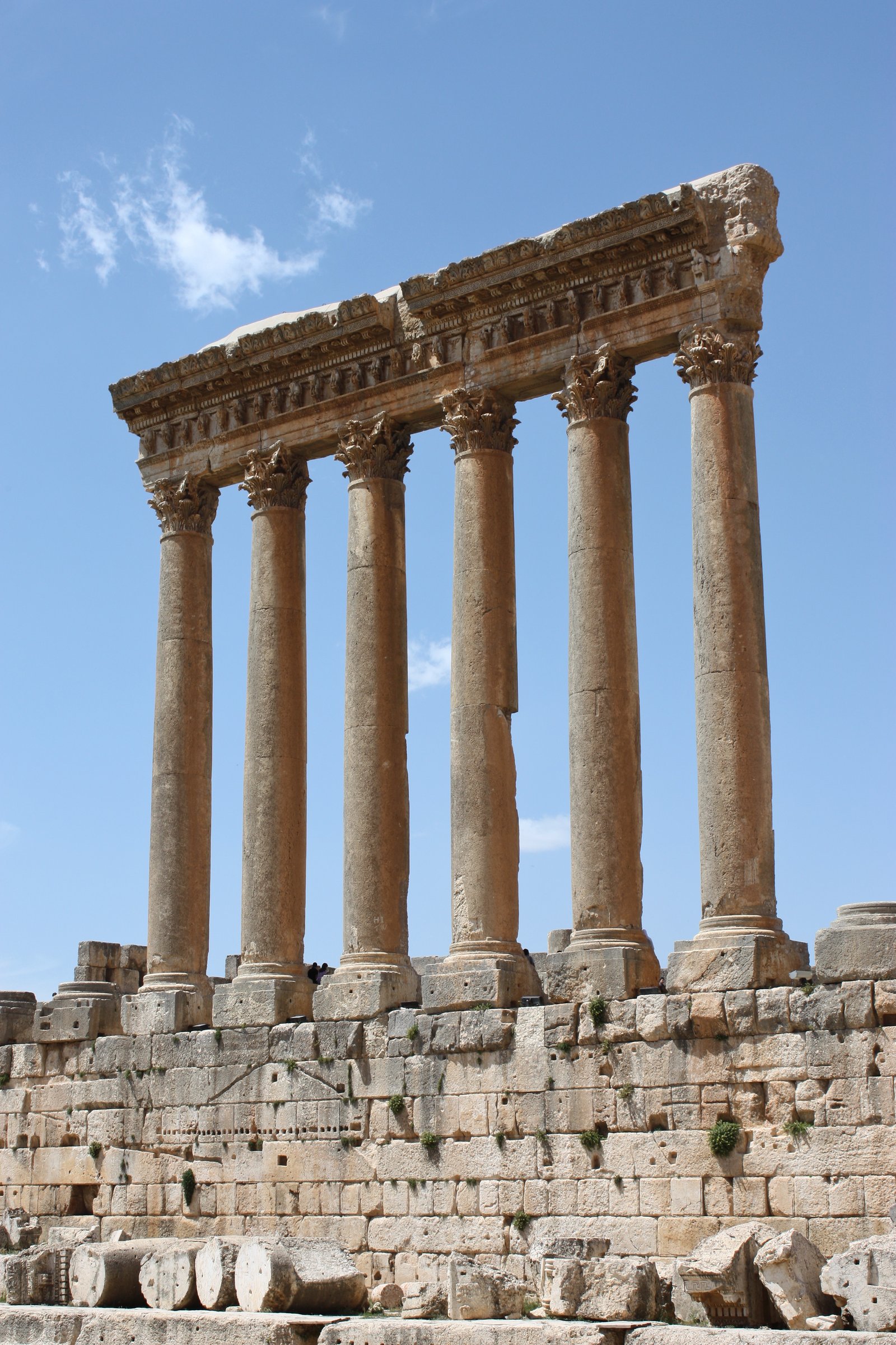
Baalbek was known in the Roman world as Heliopolis — City of the Sun. The site had older religious associations: the Phoenicians had honoured the storm god Baal there long before Rome arrived. When Baalbek was established as a Roman colony, around 15–16 BC, the Romans began building a monumental sanctuary on the spot, dedicated chiefly to Jupiter, with temples to Bacchus and Venus alongside. The Temple of Jupiter, the largest religious edifice in the Roman world, was begun around 16 BC and largely completed by AD 60, based on a graffito found on one of the topmost column drums. The complex was inscribed on the UNESCO World Heritage List in 1984.
To make the temple loom properly over the valley, its builders raised it on an artificial stone platform, elevated about 7 metres above the surrounding plain. The platform’s western retaining wall contains the Trilithon: three limestone blocks, each roughly 19 metres long, 4.2 metres high and 3.6 metres thick, weighing an estimated 750–800 tonnes apiece. The supporting stone layer beneath features blocks weighing an estimated 350 tonnes.
The quarry that produced these blocks lies less than a kilometre from the temple, on ground slightly higher than the platform — a detail that matters, because it means the stones could be moved downhill rather than uphill.
The stones that never moved
The quarry holds three more famous blocks, all unfinished, all still attached to the bedrock or lying where the masons left them. The Stone of the Pregnant Woman (Hajar el-Hibla), visible for centuries, measures approximately 20.5 metres long and weighs an estimated 1,000 tonnes — a figure confirmed by a geodetic survey in 1996 that calculated 1,000.12 tonnes. The Stone of the South, rediscovered in the 1990s, is estimated at 1,242 tonnes. And the Forgotten Stone, discovered in the summer of 2014 by a team from the German Archaeological Institute working with the Lebanese University, measures 19.6 by 6 by 5.5 metres and weighs an estimated 1,650 tonnes — the largest known hewn stone in the ancient world.
The quarry stones show the standard ancient preparation method: workers cut channels around the block and used wooden wedges, wetted to swell and crack the stone free from the bedrock. They were never moved. Their unfinished state is consistent with an interrupted building programme rather than a failed technological demonstration — the temple was, by the time work stopped, essentially complete, and there was simply no need for more blocks.
How did they move them?
No Roman-era construction diary survives for Baalbek, so the exact method is not documented. The leading interpretation, set out in detail by French architect and archaeologist Jean-Pierre Adam in 1977 and in his book Roman Building: Materials and Techniques, is that the blocks were moved on wooden rollers and sledges, levered into place with capstans and earthen ramps, by teams of labourers and oxen. A 2014 study in the journal Physical Review Letters showed that wetting sand ahead of a sledge dramatically reduces friction, allowing far fewer workers than previously estimated.
Estimates for how many workers this took vary widely — from several hundred to well over a thousand — and no ancient source records an actual headcount, so any specific figure should be treated as an informed guess rather than a fact. What is certain is that the Romans had the motive, the organisation and the engineering tradition: Baalbek was an imperial prestige project, built over roughly two centuries, and moving very large stones was a known Roman capability, demonstrated at sites across the empire.
Claims that the Trilithon must have been built by extraterrestrials, or by a lost pre-Roman civilisation, rest on the size of the stones alone. No artefact, inscription or structural analysis supports them, and the blocks sit in a documented Roman building programme, in a Roman temple, on a site whose construction history is well attested in the archaeological record.
What the evidence says
- Documented: The Trilithon — three limestone blocks, each about 19 metres long and weighing an estimated 750–800 tonnes — sits in the podium wall of the Temple of Jupiter at Baalbek, begun around 16 BC and largely complete by AD 60.
- Documented: The quarry, about 900 metres from the temple, holds the Stone of the Pregnant Woman (about 1,000 tonnes), the Stone of the South (about 1,242 tonnes) and the Forgotten Stone, discovered in 2014 and estimated at about 1,650 tonnes — the largest stone ever quarried in the ancient world.
- Documented: Baalbek, ancient Heliopolis, was inscribed on the UNESCO World Heritage List in 1984.
- Leading interpretation, not settled fact: The blocks were moved on rollers and sledges, levered with capstans and earthen ramps, as analysed by Jean-Pierre Adam. No ancient source describes the method, and the number of workers involved is not recorded.
- Unproven: Claims of alien builders or a lost pre-Roman civilisation. The blocks are part of a documented Roman building programme.
- Unresolved: The precise mechanical arrangement used to transport and lift the heaviest blocks.
What remains unknown
Baalbek’s mystery is a narrow one, and that is what makes it interesting. Nobody disputes that the stones are real, or that the Romans built the temple. What is unknown is the exact choreography — the ropes, the rollers, the number of hands — by which 800 tonnes of limestone were coaxed 900 metres and lifted into a wall. The quarry stones, abandoned mid-cut, are the other half of the mystery: a building programme that simply stopped, leaving the largest stones ever cut lying in the ground where they were born.